
Noah Brooks did not become more valuable because his son’s bridge project impressed donors.
He was already Eli’s father.
That should have been enough to enter the auditorium.
The bridge only made visible what the school had tried not to see.
Westbridge Preparatory Academy promoted itself as a place where talent mattered more than background. Its scholarship brochures featured smiling students from different neighborhoods. Eli Brooks appeared in one of those brochures after winning a regional math award.
He was thirteen, quiet, and careful. His mother had died when he was young. Noah raised him while working at the port, mostly on early shifts and weekend overtime.
Noah loaded and secured shipping containers, checked rigging angles, marked weight limits, and trained newer workers to respect load charts. His job was dangerous when done carelessly and invisible when done well. He earned steady wages, but not enough to look comfortable among Westbridge Prep families.
Eli’s scholarship covered tuition, not everything else.
Noah bought uniforms secondhand.
Packed lunches.
Worked extra shifts for lab fees and transportation.
He attended parent meetings when schedules allowed, usually wearing work clothes because going home to change would make him late.
Some teachers welcomed him.
Admissions director Celeste Hart saw him as a complication.
She believed scholarship students succeeded when their families learned the school’s culture. In practice, that often meant asking families to hide the parts of themselves that made donors uncomfortable.
Career Day was a showcase.
Parents and mentors set up tables about law, medicine, architecture, finance, engineering, and public service. Eli signed up for “structural design” and wrote his mentor as Noah Brooks, port operations.
Celeste changed the program to:
Independent student project.
She told herself the change prevented Eli from being embarrassed. She did not ask him.
Eli had built the bridge over six weeks at the kitchen table. His teacher gave the design assignment, but Noah helped him understand forces through the language he knew.
“This string is like a sling,” he said.
“If the load pulls here, this joint needs to answer there.”
“Weight always tells the truth.”
They used fishing line because real cable was too expensive. Washers became counterweights. Craft sticks became beams. Noah marked stress points in pencil and showed Eli how to tighten connections evenly instead of overcorrecting one side.
The project was Eli’s.
The knowledge moved through his father’s hands.
On Career Day, Noah took his meal break early, rode two buses, and arrived with fifteen minutes before Eli’s presentation. He carried a small torque wrench because Eli had asked him to bring “the tiny tool that makes the washer not wobble.”
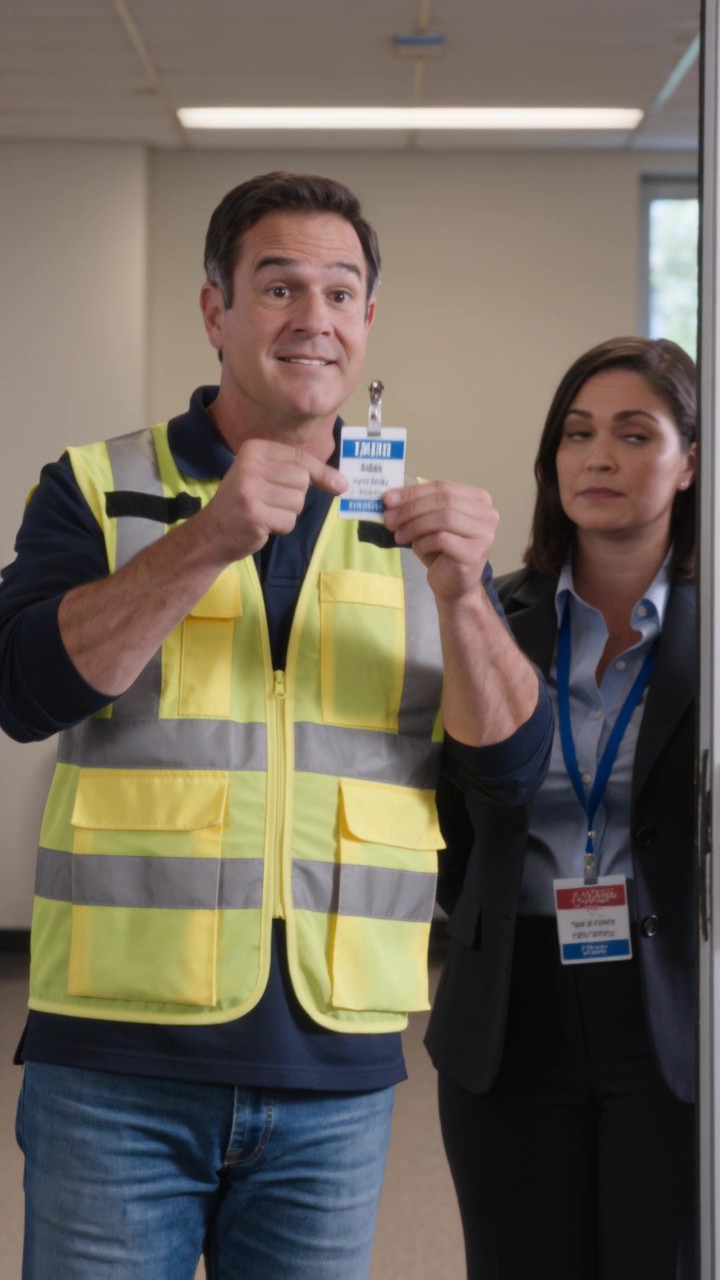
At the entrance, Celeste saw the vest and assumed delivery.
When Noah said he was Eli’s father, the issue changed but the barrier remained.
She did not say poor.
She said professional environment.
She did not say dirty.
She said not the right moment.
Charles, the headmaster, joined because donors were nearby. He worried about a scene more than an exclusion. He asked Noah to let the school “handle the presentation.”
That phrase stayed with Noah later.
Handle.
As if a father arriving for his child were a problem to manage.
Eli saw everything through the glass. For most of the year, he had tried to keep school and home separate. At school, students talked about ski trips and internships with family friends. At home, his father fell asleep at the table after 4 a.m. shifts. Eli loved him and sometimes wished the difference were less visible. He felt ashamed of that wish and then ashamed of the shame.
When Celeste reached for Noah’s badge, Eli chose.
He stepped away from the microphone stand, carrying the bridge with both hands.
The microphone picked up his sentence:
“That bridge fails without him.”
The room heard it.
Once Noah tightened the washer and the bridge leveled, the moment became impossible to smooth over.
But the school still tried.
Charles praised “family inspiration” and attempted to continue the program. Eli’s teacher, Ms. Alvarez, interrupted politely and asked that Noah be listed correctly on the judging sheet as the technical mentor. Several parents nodded. One donor asked Noah a question about crane load limits. Noah answered simply and accurately.
The donors were not the heroes of the scene.
Some had watched the exclusion happen before speaking.
Still, their attention made the administration stop minimizing it.
After the event, Celeste apologized to Eli first.
“I did not want you to feel uncomfortable.”
Eli answered:
“You made me feel like my father was the uncomfortable part.”
That was the real harm.
The school conducted a review after Ms. Alvarez filed a formal report. It found that scholarship families were regularly “coached” away from donor-facing events unless their occupations fit the school’s preferred image. This was not written policy. It lived in emails, event edits, seating choices, and subtle discouragement.
Noah did not sue immediately or demand a public firing. He asked for three changes.
First, the school had to correct the program and send it to every family who attended.
Second, scholarship students could name mentors from any lawful field without staff rewriting the relationship.
Third, future staff training had to include working-class occupations as skilled work, not merely service background.
The board accepted.
Celeste lost responsibility for family-facing scholarship events and underwent discipline. Charles apologized publicly at the next parent meeting.
His first draft said:
We regret that Mr. Brooks felt unwelcome.
Noah rejected it.
“I did not feel unwelcome. I was blocked.”
The final statement said:
Mr. Noah Brooks was prevented from entering an event to which his child had invited him. The decision was based on assumptions about appearance, occupation, and donor presentation. That decision was wrong.
Eli kept his scholarship.
For a few weeks, he became the student with the dockworker dad. He hated that label because it made one part of his life into school gossip. Ms. Alvarez helped by turning the conversation back to engineering. She invited Noah to speak to the whole class about load safety, but only after asking Eli privately if he wanted that.
Eli said yes.
Noah came in the same yellow vest.
This time, he entered through the front.
He showed students how a small imbalance in a sling could shift force across an entire load. He did not pretend the port was romantic. He talked about fatigue, weather, safety rules, and why shortcuts hurt people.
A student asked whether he was an engineer.
Noah said:
“No. I work with weight before it becomes a problem for engineers and drivers.”
The class understood.
The bridge project won second place, not first. Another student’s water-filtration model had stronger data. Eli accepted that. The point was never that disrespect made his project the best. The point was that his father’s contribution had been real even before the room admitted it.
Months later, Westbridge Prep changed Career Day to Skills Day.
Parents included surgeons, mechanics, nurses, electricians, accountants, warehouse supervisors, home-care aides, architects, cooks, drivers, scientists, and artists. The school did not pretend every job paid fairly or carried equal status. It did insist every invited adult be treated as a person with knowledge.
Noah still worked at the port.
Eli still sometimes felt the ache of moving between worlds.
But when the school printed the final project booklet, under Eli’s bridge photo it read:
Mentor: Noah Brooks, Port Load Operations.
Under the caption, Eli added one sentence of his own:
Weight always tells the truth.
He had learned that from his father.
The school had learned it too late, but not too late to open the door.






Leave a Reply