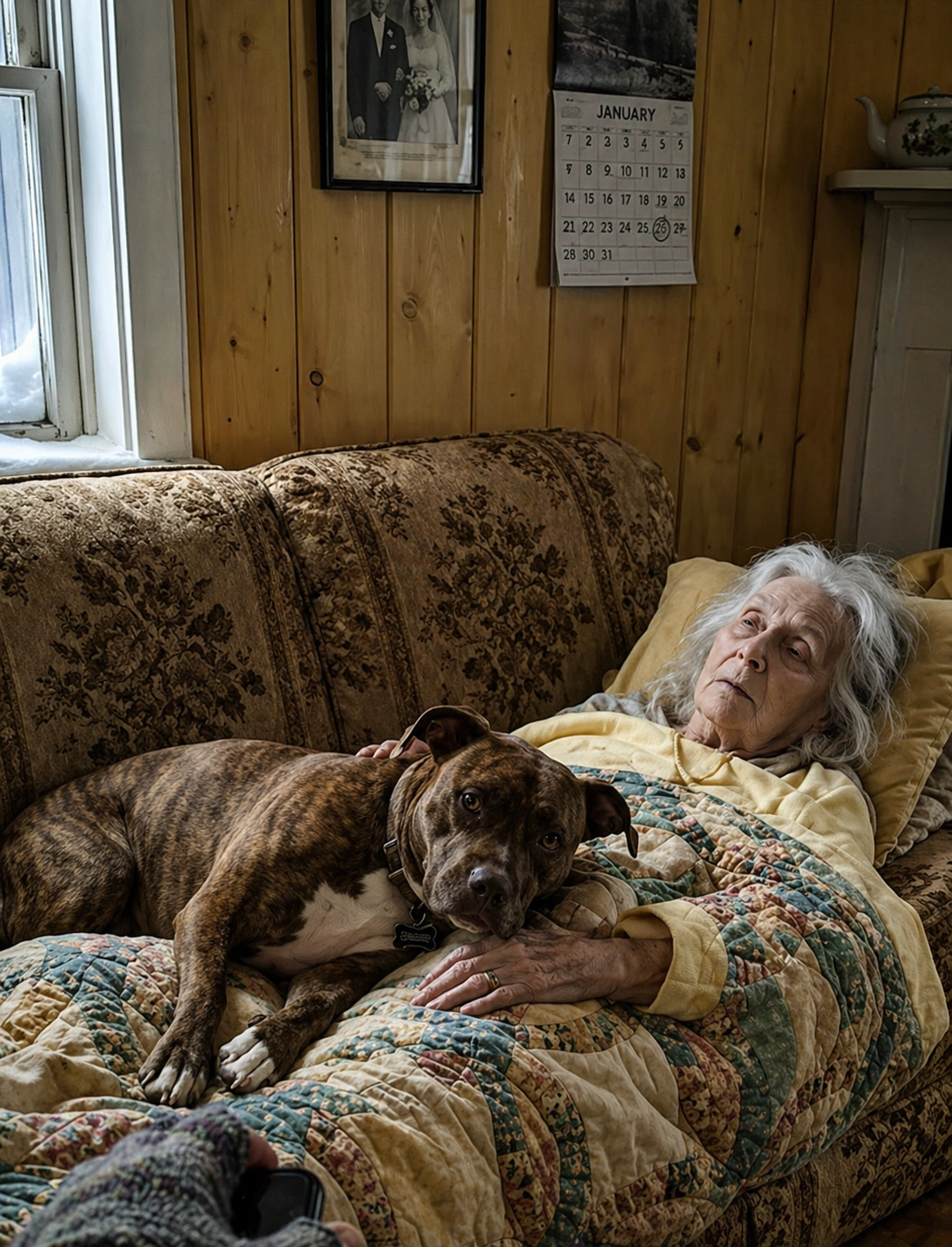
A 94-year-old woman. Three days trapped in a freezing farmhouse. No heat. No food. No way to call for help. She should not have survived. But she did. And when the veterinarian checked the body temperature of the Pit Bull who stayed on her chest the entire time… he had to stop writing—and step out…
Fiction. This story is a dramatized work created for entertainment. Names, characters, events, and circumstances are fictional.
I want to tell you what was really happening inside that farmhouse while all of us were stuck outside, completely helpless.
On Wednesday at 7 p.m., I called my grandmother. The line was busy. I tried again at 9 p.m., and this time it rang before going to her old answering machine—the one that still carried my grandfather Ed’s voice: “You’ve reached Ed and Maggie, please leave a message and we’ll call you back.” He had been gone for years, but hearing his voice in that moment felt like a warning I didn’t yet understand. I left a message. The next morning, I called again. The line was dead.
The phone company told us there were outages across northern Grafton County. Lines were down everywhere. Roads were closed. No one could give us a timeline. My mother couldn’t drive up from Concord, and I couldn’t reach her from Burlington. So we did the only thing we could—we called every neighbor we could think of. Some had no signal. One had a tree through his roof. Beverly, who lived closest, tried to walk there on Friday morning, but the snow was too deep and the wind too strong. She turned back before even leaving her own driveway.
By hour thirty-six, there was nothing left to do but wait—and imagine. My mother and I sat on the phone in silence for long stretches, each of us picturing the same scene. We were right.
My grandmother was on the couch. She wore layers—a wool sweater over flannel pajamas over thermal underwear—with three heavy quilts piled on top of her. The quilt closest to her body was the one her own mother had made for her in 1948. Lying on her chest was Captain. He had climbed there late Wednesday night and never left.
There was no food. There was no heat. The temperature inside the farmhouse dropped to forty-one degrees by Thursday afternoon and kept falling. She couldn’t stand after the first night; her legs simply stopped working. A glass of water sat within reach on the floor, and she sipped from it slowly. Captain didn’t drink. He licked the moisture from her hand.
Then he did something no one had taught him. He breathed warm air into her sweater, and she breathed it back. For three days, that was how they stayed alive—breath for breath, warmth for warmth—waiting without knowing if anyone would come.
On Saturday morning, at hour sixty, a three-truck snowplow convoy finally cleared Tenney Hill Road. The lead driver, Russell Frenette, had worked that route for nineteen winters. He noticed immediately that something was wrong: no tracks in the driveway, no smoke from the chimney, no light in the windows. Then he heard it—a bark. Weak, slow, barely there. Then another.
It wasn’t a warning. It was a call for help.

They cleared the driveway in fifteen minutes. The front door was locked. Russell kicked it open. The cold air hit them first—still, silent, unnatural. Inside, they found her on the couch, eyes open. Alive.
Captain was still on her chest. His eyes were open too. He lifted his head and looked at them, but he didn’t move. He had already used everything he had to keep her alive.
Russell knelt beside her and said, “We’re going to get you out of here.” She answered in a quiet, steady voice, “Don’t move the dog… yet.”
So he didn’t. He waited, even though he didn’t understand why.
About forty-five seconds passed. Then Captain moved. Slowly, painfully, he stood, stepped back, and sat down. He looked at Russell, as if giving permission.
Only then did Russell lift my grandmother—quilts and all—and carry her outside.
Captain followed under his own strength. Step by step, he made it to the porch, and that was where his legs finally gave out. In that moment, it became clear to everyone there—he hadn’t been holding on for himself.
He had been holding on for her.
They took my grandmother to the hospital in an ambulance that had to follow the plow the whole way. Russell Frenette did not go with her. He wrapped Captain in her mother’s 1948 quilt, carried him to his own truck, and drove him straight to the veterinarian in town.
I was not there for that part. Russell told it to me later, standing in my grandmother’s kitchen with his cap in his hands.
Dr. Pruett had seen frozen animals before. He laid Captain on the table and slid the thermometer in, and the number made him stop. Ninety-one degrees. A dog that cold should not have been able to lift his head, let alone stand up and walk to a porch.
He read it again. Then he put down his pen and stepped out into the hallway for a minute. When he came back his eyes were red, and he said only, “He gave her his warmth. He kept the rest for himself as long as he could.”
Captain spent two nights under heat lamps with warm fluids and a technician who sat with him on the floor. On the third morning he ate.
My grandmother lost the feeling in two toes and had a bruise from the couch cushion. She was out of the hospital in five days, and the first place she asked to go was the veterinarian’s office.
She did not say anything when Captain limped out to meet her. She only knelt, slowly, the way you do at ninety-four, and rested her forehead against his.
“You can move now,” she told him quietly.
He climbed into the back seat on his own, and she held his head in her lap the whole way home.