Fiction. This story is a dramatized work created for entertainment. Names, characters, events, and circumstances are fictional.
Part 1: The Voice on the Laptop
“Sweetheart, your mom can never know about this.” My husband’s voice drifted out of the laptop speakers, low and weary. I turned the volume down, though nobody else was awake. I was alone at the kitchen table in the dark, with the whole house silent around me. On the screen, our sixteen-year-old daughter, Ellie, sat behind the steering wheel of Patrick’s car, and the little dashcam on the windshield had caught both of them in grainy green night-vision light.
Ellie was crying. It wasn’t loud. Tears just ran down her face while she gripped the wheel with both hands, even though the car was parked. “Please don’t make me do it again,” she whispered. Patrick stared straight ahead through the windshield and never looked at her. “We’ve come too far to stop now,” he said. I hit pause. My hands were shaking so badly that I missed the button the first time.
The clock on the microwave said 2:17 a.m. Patrick was asleep upstairs in our bed, on his side, one arm under the pillow, the way he always slept. I had lain next to him for three hours, listening to him breathe, before I finally crept downstairs. He had no idea I had found his secret. Until that night, I would have trusted him with my life. I would have trusted him with hers.
My name is Beatrice, but everyone calls me Bea. I’m forty-one. I married Patrick when Ellie was five. But Ellie’s story doesn’t begin with Patrick. It begins with a man named Scott. I was twenty-three when I met him, and he was twenty-six, a bartender at a downtown place called The Anchor, where my friends and I went on Friday nights. He had dark curly hair and a dimple in one cheek, and he made a fuss over me every time I walked in. He remembered my drink and my name, and once he wrote it on a napkin with a heart beside it.
Scott was fun. That was the thing about him. Everything was an adventure: road trips on a Tuesday, concerts in other states, cooking breakfast at two in the morning. I got pregnant eight months after we met, and he was happy about it. He really was, at least at first. He cried when he saw the ultrasound. He bought a tiny Cleveland Browns onesie and hung it on the refrigerator, and he talked to my stomach every night.
Ellie was born on a rainy Tuesday morning in October, seven pounds, two ounces, with his dark curly hair. Scott held her in the hospital and said, “I’m going to be the best dad in the world. You’ll see.” He wasn’t. He wasn’t a bad man, and I want to be fair about that. He never hit me and never yelled at her. He just couldn’t stay. He would vanish for a weekend, then a week, and come back with a sunburn and a story: a buddy needed help moving to Florida, a friend had festival tickets in Tennessee. He’d bring Ellie a stuffed animal from a gas station and act as if he had never left.
When Ellie was two, he lost his job at The Anchor and said he would look for work in Columbus, two and a half hours away. He promised to send money and come home on weekends. He came home twice. The last time, Ellie was two and a half. He stayed one night, took her to the park, and pushed her on the swings. He bought her an ice cream cone that she dropped on the sidewalk, and then he bought her another. The next morning he kissed her forehead while she slept and told me he’d be back in two weeks.
He never came back. He didn’t call or write, and he changed his phone number. Once, when Ellie was three, he sent forty dollars in an envelope with no return address. That was the only money I ever got from him. I filed for child support, and the court found him once and garnished his wages for about four months. Then he quit that job, and nobody could find him again.
Ellie doesn’t remember him leaving. She was too little. But she knew she was supposed to have a dad somewhere. Other kids at daycare had dads who picked them up and carried them on their shoulders. Somehow, without anyone telling her, she decided he would return on her birthday. Starting when she was three, she dragged a kitchen chair to our front window, climbed up, and stood with her nose pressed to the glass, watching the street.
“What are you looking at, baby?” I’d ask. “I’m waiting,” she’d say. “For who?” “For my daddy. It’s my birthday. He’ll come on my birthday.” I didn’t know how to tell a three-year-old that her father wasn’t coming, that he had forgotten, that he had chosen not to. So I said nothing. I just let her stand there with her tiny hands against the glass.
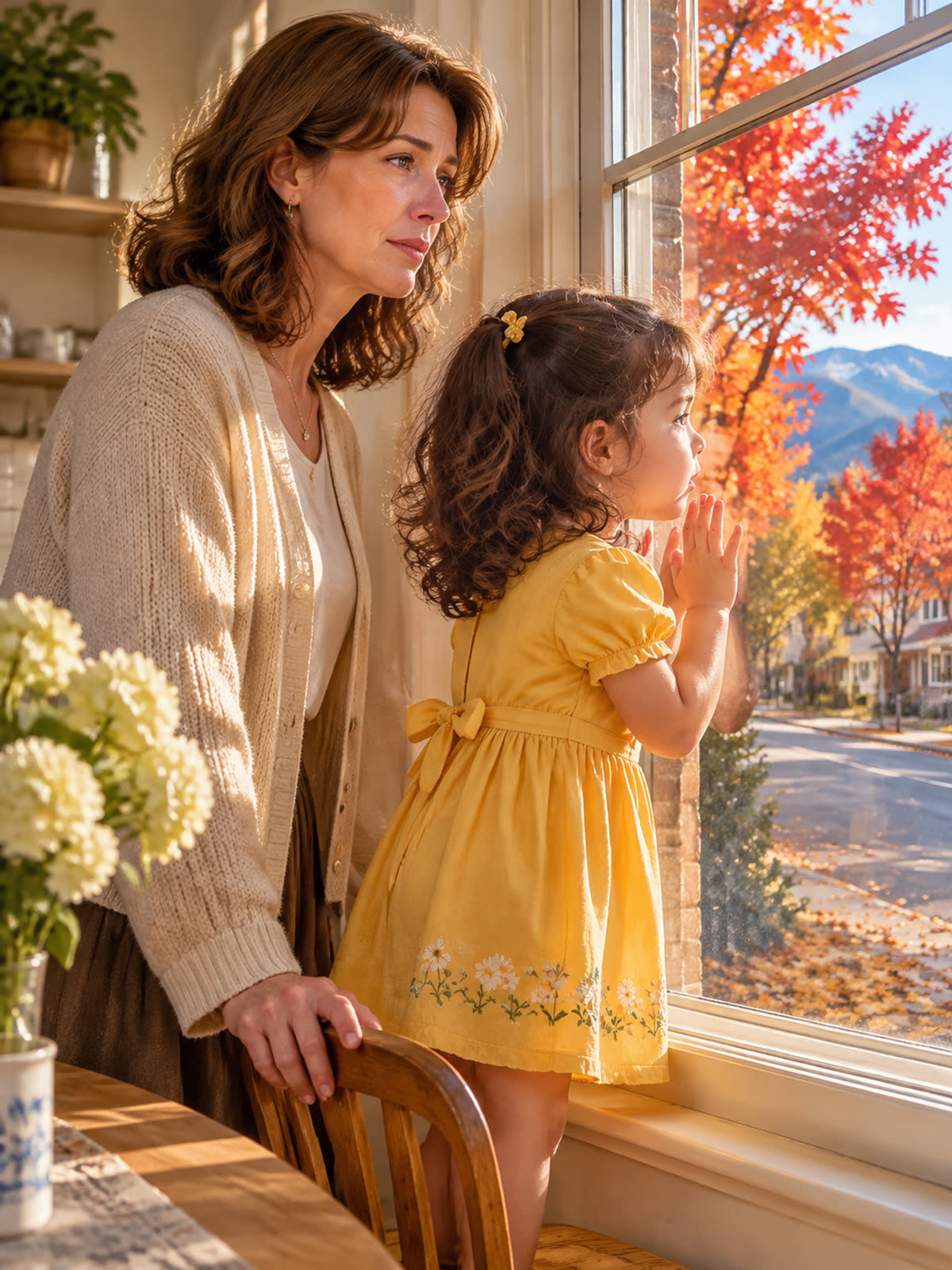
She stood at that window for two hours on her third birthday. On her fourth, she stayed most of the afternoon and wouldn’t leave even for cake, so I carried the cake to the window. He never came. He never even called.
I met Patrick when Ellie was four. He was the pharmacist at the CVS on Elm Street, where I picked up her ear infection medicine. She had so many infections that year that I was in there every three weeks. He was tall and a little awkward, with glasses that always slid down his nose and a nervous laugh. He talked to Ellie every time we came in, and not in baby talk. He asked what she would name her stuffed rabbit. He asked whether she preferred bubblegum medicine or grape. She said grape, and he said grape was the correct answer.
The fifth time we came in, he handed her a lollipop from the jar he kept behind the counter. Then he blushed bright red and said, “Would it be strange if I asked her mom out for coffee?” I said, “A little.” He looked crushed. I said, “But yes.”
He never tried to be her father, and that is the part I always come back to. He never tried to replace Scott and never said I’m your dad now. He just showed up, every single day. He filmed her preschool Thanksgiving play, when she was a turkey with one line, Gobble gobble, I’m thankful for my mom. She forgot it and simply waved, and Patrick clapped as if she’d won an Oscar. He learned to braid her hair, watching YouTube videos and practicing on a doll head from a beauty supply store. Every morning he sat on the edge of the tub while she ate a waffle on the closed toilet lid. The braids were lumpy and lopsided and came out by lunchtime. She wore them every day anyway.
When Ellie was five and a half, we married in my parents’ backyard under a big oak tree, with forty guests and a potluck. Ellie was the flower girl and dumped all her petals in one pile at the start of the aisle. During the vows, Patrick turned to her too, kneeling in the grass in his suit. “I’m not going to try to be anybody else,” he said to her. “I’m just going to be Patrick. And I’m going to be here. Every day. Okay?” She studied him very seriously. “Even on my birthday?” she said. His face changed. He knew about the window, because I’d told him. “Especially on your birthday,” he said.
He kept that promise. On her sixth birthday she didn’t go to the window at all. Around two in the afternoon I noticed her in the backyard with Patrick, running through the new sprinkler in her bathing suit and screaming with joy. I went into the bathroom and cried for ten minutes. At seven, she called him “Dad” for the first time. It slipped out in the backseat when she spotted a horse in a field. “Dad! Dad, look! A horse!” The car went quiet. Patrick kept both hands on the wheel, tears running down behind his glasses. “I see it, sweetheart,” he said, his voice rough. “That’s a beautiful horse.” He pulled into the next gas station, said he needed coffee, and stayed inside for fifteen minutes. When he came back with red eyes, he handed her a candy bar. “For spotting the horse,” he said.
One more story explains who he was. When Ellie was twelve, she got her first period on a Saturday while I was at a work conference in Chicago. She called Patrick from the bathroom, crying, embarrassed and scared. He had no idea what to do. He told me later that he drove to three stores: CVS, where he worked, then Target, then Walgreens. He stood in front of the shelves at CVS and couldn’t decide, because there were so many kinds, with wings or without. His sister didn’t answer his call, so he bought one of everything. He set four bags on the bathroom counter, knocked, and told Ellie he’d left some things for her. Then he made her a grilled cheese and hot chocolate, put on her favorite movie, and waited on the couch. When she came down an hour later, he put a blanket over her and handed her the cup. Neither of them said a word about it.
The next day she told me everything, laughing. “Mom, he bought like forty boxes. Of everything. There are some in there for ladies over fifty.” Then she stopped laughing. “He was really nice about it, though,” she said quietly. “He didn’t make it weird.” We had a son, Ben, when Ellie was eight, and Patrick loved them exactly the same. If anything, he was a little more careful with her, because he knew about that window. That is why the driving lessons didn’t worry me at first.
Ellie turned sixteen in October and got her learner’s permit the week after. She had studied for a month, with flash cards on the counter and Patrick quizzing her at dinner. “What do you do at a four-way stop?” “The person who got there first goes first.” “And if you both got there at the same time?” “The person on the right goes first.” “And if there’s a tie and nobody knows who’s on the right?” “You wave at each other awkwardly until somebody gives up.” “Correct,” Patrick said. “That’s actually in the manual.” He was always going to be her teacher, because I scream, grab the dashboard, and stomp an imaginary brake. Patrick can watch you back into a mailbox and say, “Okay. Let’s try that one more time.”
At first they practiced in the elementary school parking lot before dinner, and Ellie came home pink-cheeked. “Mom, I parked between the lines! Twice! I only hit one cone!” “You hit a cone?” “It was a very small cone.” Then in early November the lessons multiplied, to Tuesdays, Wednesdays, Thursdays, almost every night, and they ran later and later. Seven to eight-thirty became eight to ten, then nine to nearly midnight. “Why so late?” I asked one night at eleven-forty, while Ellie went straight upstairs without saying good night. “Less traffic,” Patrick said, hanging his keys on the hook. “She’s nervous around other drivers. It’s easier for her to practice on the highway when it’s empty.” “She’s only had her permit for a month.” “She’s ready,” he said. “She’s good, Bea. She’s really good.” I accepted it. I didn’t push, because it was Patrick, and I trusted Patrick.
But Ellie changed, so slowly that I didn’t notice, and then I couldn’t stop noticing. She quit telling me about school and said only, “It was fine.” She pushed food around her plate, though Patrick used to joke that she had a hollow leg. She left drama club because she was always tired. And something made the back of my neck go cold: whenever Patrick mentioned driving, she looked at him first, a long look, like she was waiting to learn what she was supposed to say. Then she said, “Okay.” Not the excited yes she used to give in October. Just okay, flat and quiet. I told myself she was a teenager. I told myself that every night. It didn’t help.
One Thursday in early December, I was folding laundry when headlights swept across the living room wall at 11:36 p.m. I waited for the car doors and the footsteps on the porch. Nothing happened. I went to the front window, the one Ellie used to stand at, and saw Patrick’s car in the driveway with the engine running. Ellie sat in the driver’s seat, shoulders shaking, both hands over her face. Patrick reached over and squeezed her hand, and she yanked it away as if his touch burned. She turned her whole body toward her window. I started for the front door, but Ellie got there first, pushed past me with swollen red eyes, said she was just tired, and went upstairs. She didn’t slam her door. She closed it quietly, which was worse.
The next morning I sat on her bed and asked what I had been dreading. “Ellie, does Dad make you do anything you don’t want to do?” Her head snapped up. “No! No, Mom. Oh my God. No. He’s not like that. He would never. It’s not that.” I let out a breath. “Then why are you crying after these lessons?” “It’s complicated,” she said. “Please, Mom. Just leave it alone.” That afternoon my last patient canceled, and I came home early to find Patrick’s laptop on the kitchen counter. A year earlier, after a minor accident, he had installed a dashcam that recorded the road and the car’s interior and saved everything to an app on that laptop. I knew his password. We had always shared them. That night, after his breathing went slow and his arm went under the pillow, I carried the laptop downstairs. The recordings were listed by date. The first ones were ordinary, with Ellie hitting a cone and screaming “I KILLED IT!” while Patrick laughed so hard he had to take off his glasses. Then I opened Thursday’s footage, and heard Ellie say, “I don’t want to do this, Dad,” and Patrick answer, “I know. It’ll be fine.” They had driven south for an hour and a half and pulled into a neon-lit diner called Rosie’s. Ellie sat gripping the wheel. “I don’t want to see him,” she said. “I said I wanted to know why he left!” On screen, a man crossed the parking lot toward the car, thin, in a canvas jacket, dark curls going gray. He leaned down to the passenger window, and a dimple appeared in his cheek. “Hi, Ellie,” he said. I knew him at once. It was Scott.
Part 2: The Dashcam Never Lies
The man who had kissed my sleeping daughter on the forehead and promised to come back in two weeks was standing at my husband’s car window, fourteen years later. On the screen, Ellie turned her face toward her own window and gripped the wheel so hard that her knuckles went white. “Can we go?” she said to Patrick. “Please. Can we just go?” Scott frowned and leaned in a little further. “Ellie, come on,” he said. “I just wanted to talk. That’s all. I drove two hours.” Ellie didn’t look at him. “You had over a decade,” she said.
Scott stepped back and stood there with his hands in his pockets. Patrick looked at Ellie, then at Scott, and rolled the window up. Ellie began to sob, with Scott ten feet away watching. “Why did you bring me here?” she said. “Why? Why did you keep bringing me?” “You wanted to meet him,” Patrick said. “I wanted answers,” she said. “I didn’t know he’d make everything my fault. I didn’t know he’d keep saying I owed him.” Patrick reached for her hand, and she pulled it away. “Please take me home.”
Patrick hesitated for ten seconds or more. On the recording it felt like forever. Then he said, “Okay. Okay. Let’s switch. I’ll drive.” They changed seats while Scott said something the dashcam couldn’t catch. I closed the recording, physically sick with anger. Patrick had secretly taken my daughter to meet the father who had broken her heart, the one I had spent fourteen years shielding her from. He had sat in that car and watched her cry, and he hadn’t told me.
I went back through the list and found three earlier meetings. The first was a Saturday in early November at the same diner. The camera caught them walking in and walking out an hour later, and Ellie barely spoke on the drive home. “I don’t know,” she told Patrick when he asked if she was okay. The second was the week before Thanksgiving, when Scott sat in the back seat for forty minutes asking why she hadn’t answered his messages. “I had a lot of homework,” Ellie said. “I sent you six messages,” he said. “You couldn’t answer one?” “I’m sorry,” Ellie said. My daughter apologized for not texting back after fourteen years.
The third was in late November, with Scott in the back seat talking about his warehouse job in Columbus, his apartment, his truck, how nobody ever gave him a break. Near the end he said, “Can I ask you something, Ellie?” “Okay.” “Why do you still call him Dad?” Patrick sat right there in the driver’s seat, and Scott spoke as if he weren’t. “I’m your dad,” Scott said. “Not him. You know that, right? I’m your real dad. I’d like you to call me that. It would mean a lot to me.” Ellie said nothing, and neither did Patrick. That was what made my hands shake. He just sat there.
Recording by recording, Ellie grew quieter, like someone slowly sinking in water. In one clip, after the third meeting, rain streaked the windshield while she sat in the passenger seat. “Dad,” she said. “Can you cancel the next one?” Patrick took a while to answer. “I think you should give him another chance,” he said finally. “He’s trying, Ellie. He came a long way.” “I don’t want to,” she said. “Please. Can you just cancel it?” “Let’s just try one more time,” he said. “One more. If it doesn’t go better, we’ll stop.” She turned to the rain and said nothing else the whole way home.
Then I understood. I understood why she dreaded the lessons, why she looked at Patrick before answering, why she said okay in that flat voice, why she stopped eating and cried in the driveway. Driving was never the point. It was only the excuse. But I still didn’t understand why Patrick had agreed to any of it, why he’d hidden it from me, or why he kept pushing when she begged him to stop. That wasn’t the man who drove to three stores, or the man who cried at a gas station because she called him Dad.
I opened the last recording, Thursday night again, after the long drive home. At 11:36 p.m. the car sat in our driveway with the engine running, and through the windshield I could see our living room window and a shadow behind the curtain, which was me. Ellie sat crying with both hands over her face. “Please don’t make me do it again,” she whispered. “We’ve come too far to stop now,” Patrick said. “Why?” she said. “Why do I have to keep doing this?” He didn’t answer. Instead he said, “Sweetheart, your mom can never know about this.” “Why?” “Because she’ll be furious.” “At me?” Her voice was so small, like she was five again. “No,” he said. “At me.” “Then tell her,” she said. He looked away into the dark yard for a long time. “You’re right,” he said, very quietly. “I should have told her from the beginning.” He squeezed her hand again, and she pulled away, got out, and ran up the porch steps.
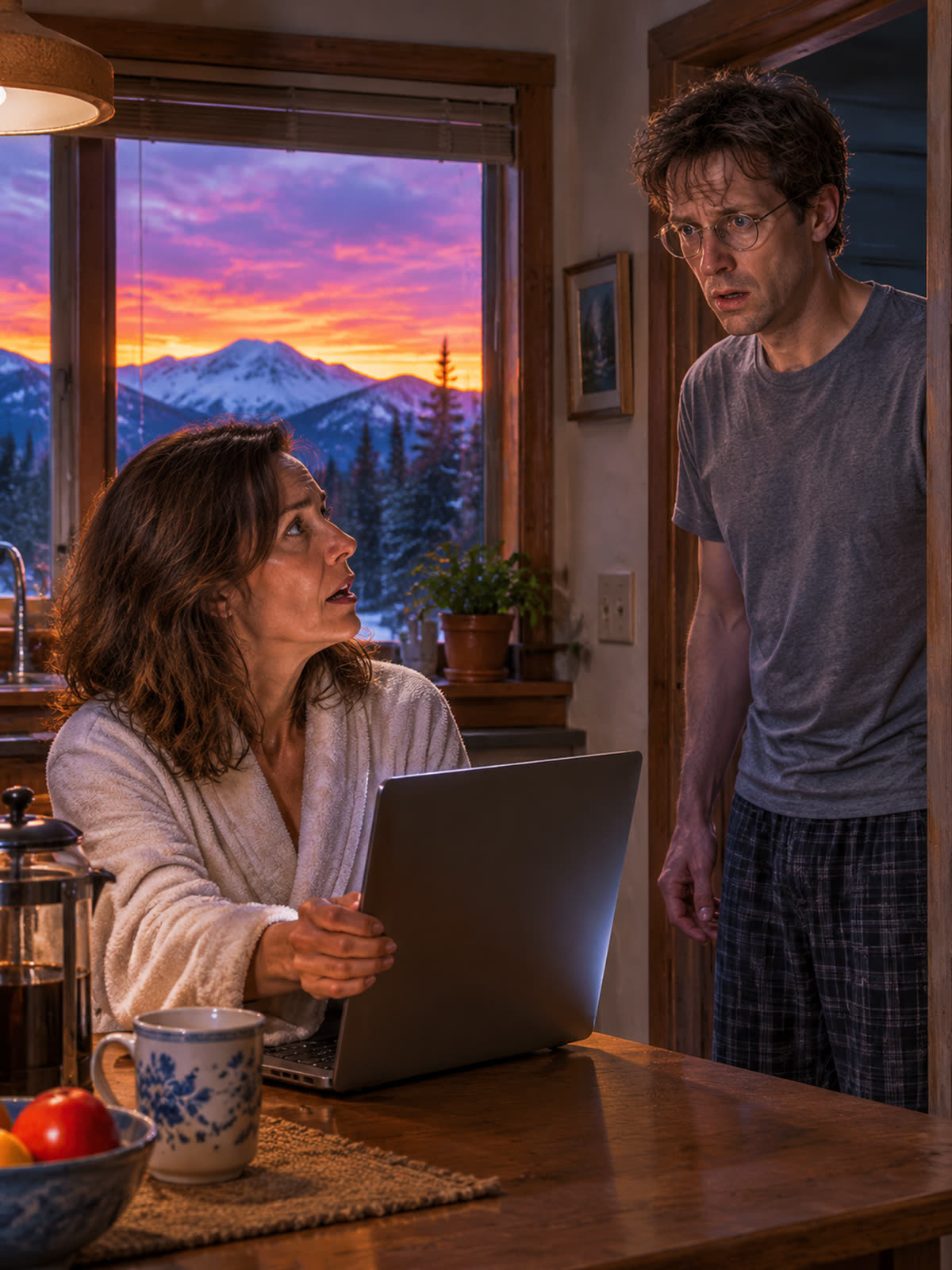
I closed the laptop and sat with my hands flat on the lid. It was 2:31 a.m. A floorboard creaked behind me, the one outside the kitchen doorway that always creaks. Patrick stood there in his gray T-shirt and pajama pants, glasses on, hair sticking up on one side. “Bea?” he said. “What are you doing? Why are you awake?” I opened the laptop again and turned the screen toward him. Rosie’s Diner. November 4. November 18. November 25. December 5. “Sit down,” I said. All the color drained from his face like somebody had pulled a plug.
“How much did you see?” he asked quietly. “Enough,” I said. He pulled out the chair across from me and lowered himself into it like an old man. “Please,” he said. “Please, Bea. Let me explain.” “Start,” I said, “with why you told my daughter to lie to me.” He covered his face with both hands for a long time. Then he told me something I never expected. “Ellie was the one who found Scott,” he said. “He contacted her. Online. In October. On her birthday. He found her on Instagram. He sent her a message.” “And she answered him.” “She answered him.” “And you knew?” “She told me a few weeks later. In November. Before the first meeting. She showed me the messages. She was scared and confused. She didn’t know what to do.” “Why didn’t you tell me?” “She begged me not to.”
“She’s sixteen, Patrick,” I said, my voice rising, though Ben was asleep upstairs. “I’m her mother. You don’t get to keep secrets with a child about her own father. Not from me. Not ever.” “I know, Bea.” “Then why take her to meet him? Why drive her two hours to a diner in the middle of the night? Four times?” He looked at the screen. “She wanted to know why he left,” he said quietly. “Her whole life. She told me she used to stand at the window on her birthday. She told me she used to think it was her fault. That if she’d been better, or quieter, or prettier, he would have stayed. I thought if she could just ask him and hear his answer, she could finally let it go. To close the door.” “And when she asked you to stop?” He looked down for a long time. “I thought she needed closure,” he said. “She needed you to listen,” I said. “I know,” he said. “I was wrong.”
“Did you really think I’d forbid her from seeing Scott if she wanted to?” I asked. “No.” “Then why?” “Because I was afraid you’d think I’d betrayed you. That I’d brought him back into our lives after everything he did to you.” “You did betray me,” I said. He didn’t argue, and his eyes were wet behind his glasses. The microwave clock said 2:58. “There’s something else,” I said. “Isn’t there?” He looked at his hands. “My father left when I was four,” he said quietly. I knew that. He had told me in one sentence on one of our first dates and never spoken of it again.
“I never got to ask him why,” he said. “He died when I was twenty-two, in Arizona. I found out from a cousin three months after the funeral. I never got to ask him one single question. I spent my whole life wondering if it was me, if I wasn’t enough. I thought if I could give Ellie the chance I never got, to look him in the face and ask…” He stopped. “I think it stopped being about her somewhere. I think it started being about me. And I didn’t even notice.” I didn’t forgive him, not then, but I understood a little more than five minutes earlier. “Go to bed, Patrick,” I said. At the doorway he asked, “Are you going to tell her you know?” “Yes. In the morning.” “She’ll be relieved,” he said. “She’s been wanting to tell you for weeks. I kept telling her to wait.” I stayed at the table until the sun came up.
On Saturday morning Patrick took Ben to swim lessons, on purpose, I think, to give us space. Ellie came down at nine-thirty in her pajamas and poured a bowl of cereal. I waited until she took a bite. “Ellie. Dad told me. About Scott.” Her spoon fell into the bowl and milk splashed across the table. “Are you mad?” she whispered. I took her hand. “I’m upset. But not at you, sweetheart. I’m upset that you felt like you couldn’t tell me. That you had to carry this by yourself. For two months.” She cried big, gulping sobs, the way she used to after falling off her bike. “I thought you’d hate me. Because Patrick’s my dad. He’s my real dad. And I thought if I wanted to meet Scott, that meant I didn’t love him enough. And it would hurt him. And it would hurt you.”
I knelt by her chair. “Wanting answers doesn’t mean you love Patrick any less. It doesn’t mean you love me any less. It just means you’re a person with questions. And you deserve answers.” She wiped her eyes on her sleeve. “He said he thought about me all the time. Every single day. He said he never stopped loving me. He said he tried to contact me for years. He said he called and called. And he said…” She looked at our hands. “He said you stopped him. He said you changed our phone number so he couldn’t call. He said he sent birthday cards, every year, and you sent them back. Unopened. Return to sender. He said you told him I didn’t want to hear from him.” My chest got so tight I couldn’t breathe.
“Ellie,” I said, my voice shaking. “I never got any cards. Not one. Not ever. In fourteen years.” “Never?” “Never. Not a card, not a phone call, not a letter. He sent forty dollars once, when you were three, in an envelope with no return address. That’s the only thing I ever got from him. I didn’t change our phone number. We had it until you were seven, when we moved in with Patrick. I even left a forwarding message on the old one for a whole year in case he called.” She was quiet a long time. “I didn’t know who to believe,” she said. “He knew things, Mom. About the stuffed rabbit I had. That I was scared of the vacuum cleaner. About the ice cream I dropped on the sidewalk at the park.” “He was there for the first two years,” I said quietly. “It made his stories sound true,” she said.
She told me the rest. After weeks of messaging she had grown scared and confused, so she showed Patrick everything on her phone, one night in his car after a real lesson. He had read them in silence and then offered to take her to meet Scott, so she wouldn’t go alone. “At first I was really glad he offered,” she said. “And then Scott started wanting more. More meetings. More messages. He wanted me to come to Columbus for Christmas. He wanted me to call him Dad. And when I said I didn’t know, he got mad. Sad mad. Guilty mad. He said you’d turned me against him. He said I was just like you. He said I owed him a chance, because he was my real father. He said everybody deserves a second chance.”
“You don’t owe him anything,” I said. “Not one single thing.” She looked at me for a long moment. “Can I stop seeing him?” “Of course you can. You never had to see him in the first place.” She let out a long breath, as if she’d held it for two months, and her shoulders came down. Then something steady came into her face. “But I want him to know why,” she said. “I don’t want to just disappear. That’s what he did to me. I want to look at him and tell him why. And then I want to leave. On purpose.” I looked at my sixteen-year-old in her pajamas, with milk on the table and tear streaks on her face, and I had never been so proud of anyone. “Okay,” I said. “Then we’ll do it together. You and me. Once more.”
Ellie messaged Scott that afternoon and showed me before she sent it. I want to meet one more time. My mom is coming. Saturday at 2. The Coffee Bean on Main Street. Near our house. Not the diner. He answered in four minutes. Of course. I’ll be there. I can’t wait to see you. He didn’t say a word about me. That night I told Patrick that Ellie and I were going without him. “Do you want me to wait in the car? Just in case?” he asked. “No,” I said. “She needs to know she can do this without you.” For the first time in two months, he simply listened. And I lay awake wondering what kind of man would walk into that coffee shop, and what he might say to my daughter when I was sitting right beside her.
Part 3: The Window, Finally Open
On Saturday afternoon we drove to the Coffee Bean, a little shop on Main Street with exposed brick walls, mismatched chairs, and a chalkboard menu. Ellie and I used to go there on Saturday mornings when she was small, before Patrick, when it was just the two of us. She’d order hot chocolate with extra whipped cream and I’d get a latte. We hadn’t been there together in years. Scott was already at a table by the front window. When he saw us he stood, and he looked older up close than on the dashcam, with deep lines around his eyes and a jacket worn at the cuffs. He smiled at Ellie, that same dimple. “There’s my girl,” he said.
Ellie didn’t smile back. She pulled out a chair and sat across from him, and I sat beside her. Scott looked at me for the first time in fourteen years. “Bea,” he said. “It’s been a long time.” “Yes,” I said. That was all. I had rehearsed this moment at three in the morning for years, with long, furious speeches and lists of everything he had missed. None of it mattered now. This wasn’t my moment. It was Ellie’s.
She laid both hands flat on the table and looked straight at him. “Why did you tell me Mom kept you away?” His smile vanished and he looked down at his coffee. “Things were complicated, sweetheart. Back then. It was a hard time. For everybody.” “Did she stop you from calling?” He glanced at me. I looked back and said nothing. He looked at the cup again. “No,” he said. “Then why did you say she did?” After a long moment he said, “I didn’t want you to hate me.” Her voice began to shake, but she kept going. “What about the birthday cards?” “I wrote them,” he said quickly. “Where did you send them?” He rubbed the back of his neck. “I don’t remember the address. It was a long time ago.”
“You said Mom returned them,” Ellie said. “You said they came back. Return to sender. You said she wrote that on them.” A woman at the next table had stopped turning the pages of her book. Scott noticed and lowered his voice. “Ellie. We can talk about this privately. Just you and me. We don’t need to do this here.” “No,” she said. “Answer me.” He swallowed, and I watched his throat move. He looked out the window at the people walking by. “I never mailed them,” he said finally. Ellie stared. “Did you even write them?” He didn’t answer. The silence stretched ten seconds, then twenty. The espresso machine hissed, the woman put her book down, and his silence was the answer.
Ellie’s face crumpled all at once, her chin shaking, her eyes filling. “You lied,” she said. “About everything.” “I was ashamed,” Scott said, his voice cracking. “Of leaving me?” “Yes.” “So you blamed Mom instead? You made me think my mom kept me from my dad? For fourteen years? You made me think she lied to me my whole life?” He nodded slowly, unable to meet her eyes. “I thought you’d never forgive me,” he said quietly. “If you knew the truth. That I just… left.” She looked at him, wet-eyed but unflinching. “I spent years thinking you didn’t want me.” “That’s not true,” he said. “Then why didn’t you come back?” He opened his mouth and closed it again.
“You missed every birthday,” Ellie said, her voice growing stronger. “Every single one. I used to stand at the window. Did you know that? When I was little. On my birthday. I’d stand on a kitchen chair at the front window all day. Waiting for you. Because I thought you’d come on my birthday. You missed every school play. Every soccer game. Every time I was sick. Every time I was scared. Every time I needed you. You missed my first day of kindergarten. You missed me learning to ride a bike. You missed everything.” His eyes filled with tears. “I’m here now,” he said. “But you came back,” she said, “and the first thing you did was lie to me.”
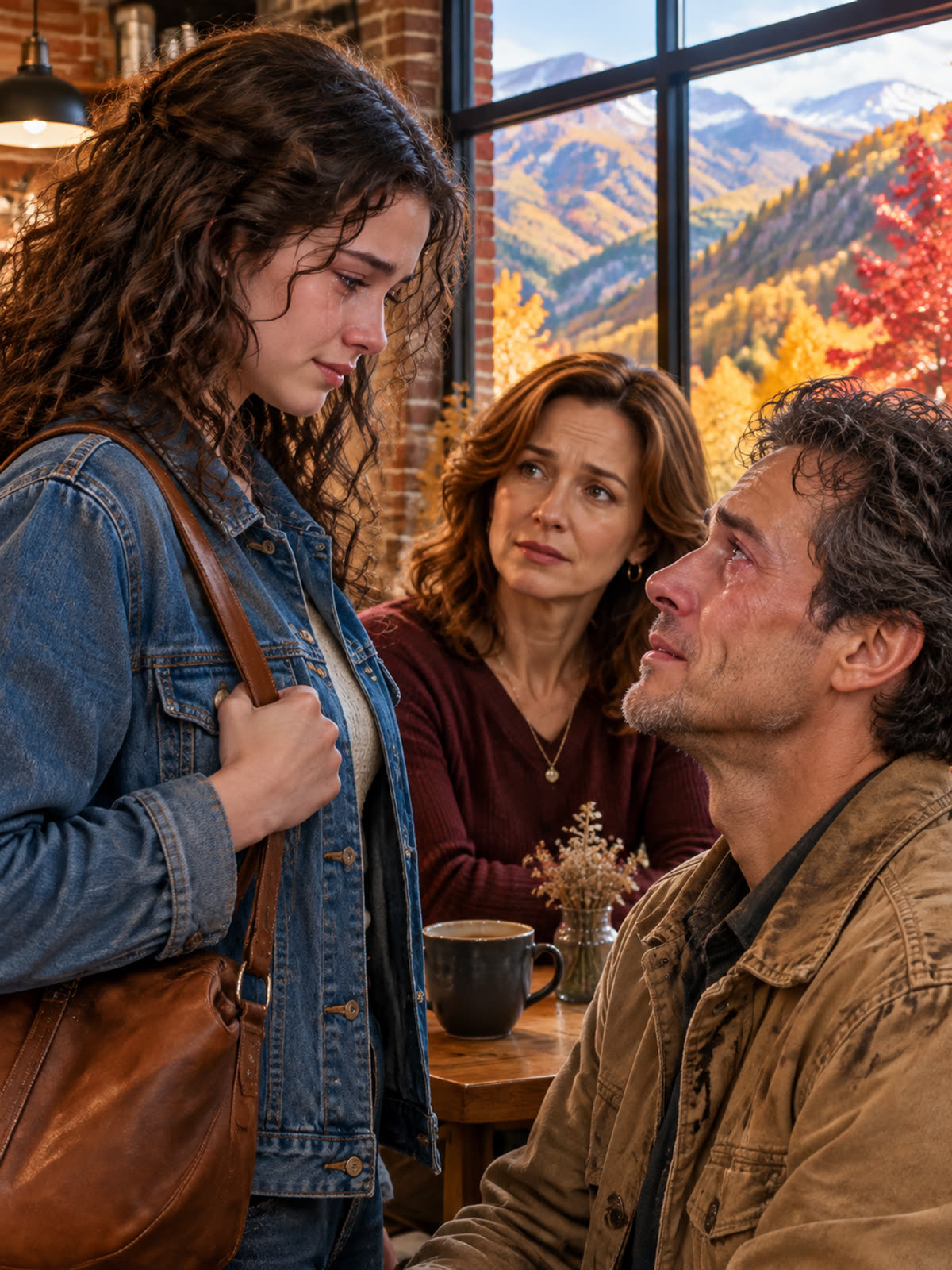
He reached across the table for her hand, and she pulled it back and stood, her chair scraping the floor. “I don’t want to see you again.” “Ellie, please. Please, sweetheart. Give me a chance. Just one more.” “No,” she said. “You don’t get to make me feel guilty for that. Not anymore. I don’t owe you a chance. You had fourteen years of chances.” She slung her bag over her shoulder and looked down at her father, sitting by the window with tears running down his face. “I wanted to know why you left. That’s all I ever wanted. Now I know.” She took a breath. “You chose to,” she said. Then she turned and walked out.
I stood and watched Scott stare after her through the window as she crossed the sidewalk to our car. I thought of all the speeches I had practiced at three in the morning and gave none of them. “Goodbye, Scott,” I said, and followed my daughter outside. Through the glass I saw him still sitting there alone, staring at the door. For once in his life, he was the one left waiting.
Outside, Ellie stood by the passenger door with her hand on the handle, not opening it. “Was I too harsh?” she asked. “No.” “He looked really sad.” “He did.” “Is it bad that I feel sorry for him?” I thought about it. “You can feel sorry for him without forgiving him. Both of those things can be true at the same time. You don’t have to pick.” She nodded and got in. I sat behind the wheel without starting the car, in the parking lot of the place where we used to drink hot chocolate on Saturday mornings. “You really never got those cards?” she asked quietly. “Not one. Not ever.” “I’m sorry I believed him. I’m sorry I thought you’d lie to me.” “Ellie,” I said, turning to face her. “You were trying to understand your father. You don’t have to apologize. Not for that. Not ever.”
She leaned her head on my shoulder and cried, not the quiet way she had cried for two months, not with her hands over her face in the driveway, but out loud, like the three-year-old on the kitchen chair at the window. I held her until she was ready to go home. Patrick was waiting in the kitchen, pretending to make coffee. He had made the same pot three times, I learned later, dumping it out and starting over. He looked at Ellie’s face, then at mine, and didn’t ask. She sat at the table and told him everything: the birthday cards, I never mailed them, You chose to. He listened without interrupting, holding a mug he never drank from. When she finished, he said, “I’m proud of you, Ellie.”
“Are you disappointed? That I don’t want to see Scott anymore?” “No,” he said. “But you kept telling me to give him another chance. Every time. You kept saying one more time. Just one more.” He took a long breath. “I was wrong.” “You made me feel like I had to forgive him. Like if I didn’t, I was a bad person.” “I know I did,” he said, his voice cracking. “I’m so sorry, sweetheart.” She looked at him for a long moment and nodded once. She didn’t say it’s okay and she didn’t hug him. She went upstairs to her room, and he stood looking at the empty doorway. Then he turned to me. “How do I make this right? Bea. Tell me.”
“You start by respecting what Ellie tells you,” I said. “When she says no, it means no. Not one more time. No. And you stop making decisions about her behind my back. Ever. About anything. We’re her parents. Both of us. Together.” “I will,” he said. I still didn’t fully understand. “You’ve been her father for eleven years. You braided her hair. You bought forty boxes of pads. Why did you ever think you owed Scott anything?” His eyes filled. “Not Scott. Never Scott. I thought I owed Ellie. The chance to know her biological father. The chance I never got. But somewhere along the way I got so caught up in making it happen, in getting her the answer I never got, that I stopped listening to what she actually wanted.”
“That’s what hurt her,” I said. “Not the truth about Scott. She’s tougher than both of us. What hurt her was that she couldn’t trust you to protect her from it when she begged you to. You were the one person she thought always would.” Patrick put his face in his hands and cried quietly, shoulders shaking. I didn’t go to him, not yet. We didn’t fix our marriage that night. One conversation doesn’t repair eleven years of trust, and one apology doesn’t undo two months of lies. Trust takes more than I’m sorry.
Over the next few weeks, Patrick gave Ellie space. He stopped arranging driving lessons completely, and when her permit log sat half-empty on the counter, he said nothing. He never mentioned Scott unless she did, and she didn’t. When she said no to anything, he accepted it right away. Do you want to go to the movies with me and Ben? No. Okay. Do you want pancakes? No. Okay. Do you want to watch the game? No. Okay. It was hard to watch how much each no hurt him, each time she passed him in the hallway without looking. At first she ate dinner in her room and came downstairs only after he went to bed. He never complained and never asked me to talk to her. He kept making breakfast, asking Ben about sharks, and saying good night through her closed door, just like when she was five.
After about three weeks, Ellie came down for dinner. She said nothing, just sat in her usual chair across from Patrick and ate. He didn’t make a big deal of it. He passed her the potatoes. A few nights later, Ben told one of his terrible knock-knock jokes. “Knock knock.” “Who’s there?” Patrick said. “Shark.” “Shark who?” “Shark-uterie board!” Nobody understood it, because Ben had heard it on a cooking show. Patrick looked at him very seriously. “That’s the worst joke I’ve ever heard. I’m so proud of you.” And Ellie laughed, just a little, covering her mouth right away. Patrick didn’t look at her, but I saw his hand shake when he picked up his water glass.
One January evening I found them on opposite ends of the couch, watching the ridiculous baking show they used to watch on Sunday nights when she was twelve, the one where people make cakes shaped like things that aren’t cakes. They weren’t talking or sitting close, but they were together. Then, on a Saturday morning in late January, I came downstairs early and found Patrick at the kitchen table with coffee and the newspaper, and Ellie standing across from him in pajamas with her arms crossed, as if she’d been working up to something. I stopped in the doorway, unseen. “Dad,” she said. “Can we talk?” He put down his coffee at once. “Of course, sweetheart.”
She sat across from him. “I’ve been thinking about what happened.” “I know I hurt you, Ellie,” he said. “I should have listened when you told me you didn’t want to see Scott again. The first time.” “You should have.” “I thought I was helping you find something you’d been missing. But I made you feel like you didn’t have a choice.” She looked at her hands. “I did want answers. I really did. But that doesn’t mean I wanted a different dad. You’ve been there for everything. My first day of kindergarten. Every birthday. Every time I got sick. Every time I had a nightmare. You came to every single play. Even the turkey one.” He laughed, small and shaky. “You even learned how to braid my hair.” “I was terrible at that.” “You really were,” she said, smiling through tears. “They fell out by lunch. Every single day. I wore them anyway.”
“Scott might be my biological father,” she said. “But you’re my dad. You always have been. You’re the one I meant. Every time I said it. Even in the car, when I saw the horse.” Patrick put a hand over his mouth and couldn’t speak for a long time. “I was scared,” he admitted. “I thought if you got to know him, you’d realize there was a part of your life I couldn’t give you. And maybe you’d want that part more than me.” “You didn’t have to give me everything,” she said. “You just had to be there.” She put her hand on his. “And you were.” A tear slid down behind his glasses. “I’m sorry I forgot being there also means listening.”
She stood and walked around the table. “I forgive you, Dad.” “Are you sure? You don’t have to. Not yet.” “I’m sure. But you have to promise me something. Next time I tell you I’m uncomfortable, believe me. The first time. Even if you think you know what’s best. Even if you think it’ll be good for me. Believe me.” “I promise.” She put her arms around his neck, and he held on, his face against her shoulder, crying into her pajamas like a little boy. “I love you so much, sweetheart.” “I love you too, Dad.” I stood in the doorway wiping my eyes on my bathrobe sleeve. For the first time in weeks, I felt like our family was finding its way back.
That afternoon Ellie came into the kitchen holding my car keys, not Patrick’s. “Mom. Will you teach me that three-point turn? I still can’t get it. I always hit the curb.” “What about Dad?” “He’s helping Ben with his science project. Something about sharks. There’s glue everywhere. Besides, I want you to teach me. Today.” We drove to the elementary school lot, empty on a Saturday, where Patrick’s orange cones still lined one side. I’m a terrible driving teacher, but I sat on my hands and kept my feet flat. I would not grab the dashboard. Ellie turned the wheel left, stopped, reversed, and turned right. Halfway through she stopped. The car sat crooked across two spaces, a foot from the curb. “I messed up,” she said, and put her head on the wheel. “Then try again,” I said.
She gave me a sideways smile. “You’re not going to tell me that we’ve come too far to stop?” My heart tightened as I remembered the green night-vision light and my daughter crying behind the wheel. “No, sweetheart. You can stop whenever you need to.” “And if I want to try again?” “Then I’ll be right here.” She checked her mirrors and her shoulder, backed up slowly, put it in drive, and turned the wheel the other way. The car slid perfectly into place, facing the other direction, in the middle of the lane, without touching the curb. “Mom! Did you see that? Did you see that?” “I did! I saw it!” She laughed, big and loud and surprised, the way she used to when she was little.
When we pulled into the driveway, Patrick was on the porch with Ben, who had glue in his hair, and Patrick had glue on his shirt. They held something of cardboard and blue paint that was supposed to be a hammerhead shark. Ellie jumped out before I’d turned off the engine. “Dad! I finally did it! A three-point turn! Without hitting the curb!” “That’s my girl!” he said, grinning. She threw her arms around him so hard he nearly fell into the door. Over her shoulder he looked down the driveway at me, still sitting in the car with my hands on the wheel. I smiled, and he smiled back.
For years, Ellie had wondered why one father walked away. She had stood on a kitchen chair at the front window, on every birthday, with her nose against the glass. Now she knew the truth: it was never her. He chose to go. And she had finally been able to tell the man who stayed that he never needed to compete with the one who left. Scott had given Ellie questions she might never fully answer. Patrick had given her a childhood full of love: lumpy braids, forty boxes of pads, and a candy bar for spotting a horse. Neither truth erased the other. They both just were.
On the porch, Patrick took his own car keys from his pocket and jingled them in the air, the way he used to every Friday night in October. “So,” he said. “Think you’ll let me ride along next time?” Ellie crossed her arms and pretended to think hard. “Maybe. But I’m choosing where we go.” “Deal,” he said. I sat in the car and watched them, Ellie laughing, Patrick with glue on his shirt, Ben trying to show them both the cardboard shark. I realized that for two months I had been terrified that somebody was taking my daughter’s father away from her, first Scott, and then I thought Patrick. But Ellie never needed anyone to choose her father for her. Not Scott. Not Patrick. Not me. She had known who her dad was all along.
Disclaimer: This story is a work of fiction inspired by real-life themes. Names, characters, places and events are fictionalized, and any resemblance to real persons is purely coincidental. Images are for illustration purposes only.