A 17-year-old tried to humiliate me in class yesterday. In front of thirty students. We were in the middle of a senior seminar, talking about social class and the idea of the “American Dream.”It was one of those rare moments when the room felt alive—students engaged, thinking, questioning. Then Leo raised his hand. “Hey, Mr.…
Fiction. This story is a dramatized work created for entertainment. Names, characters, events, and circumstances are fictional.
A 17-year-old tried to humiliate me in class yesterday. In front of thirty students.
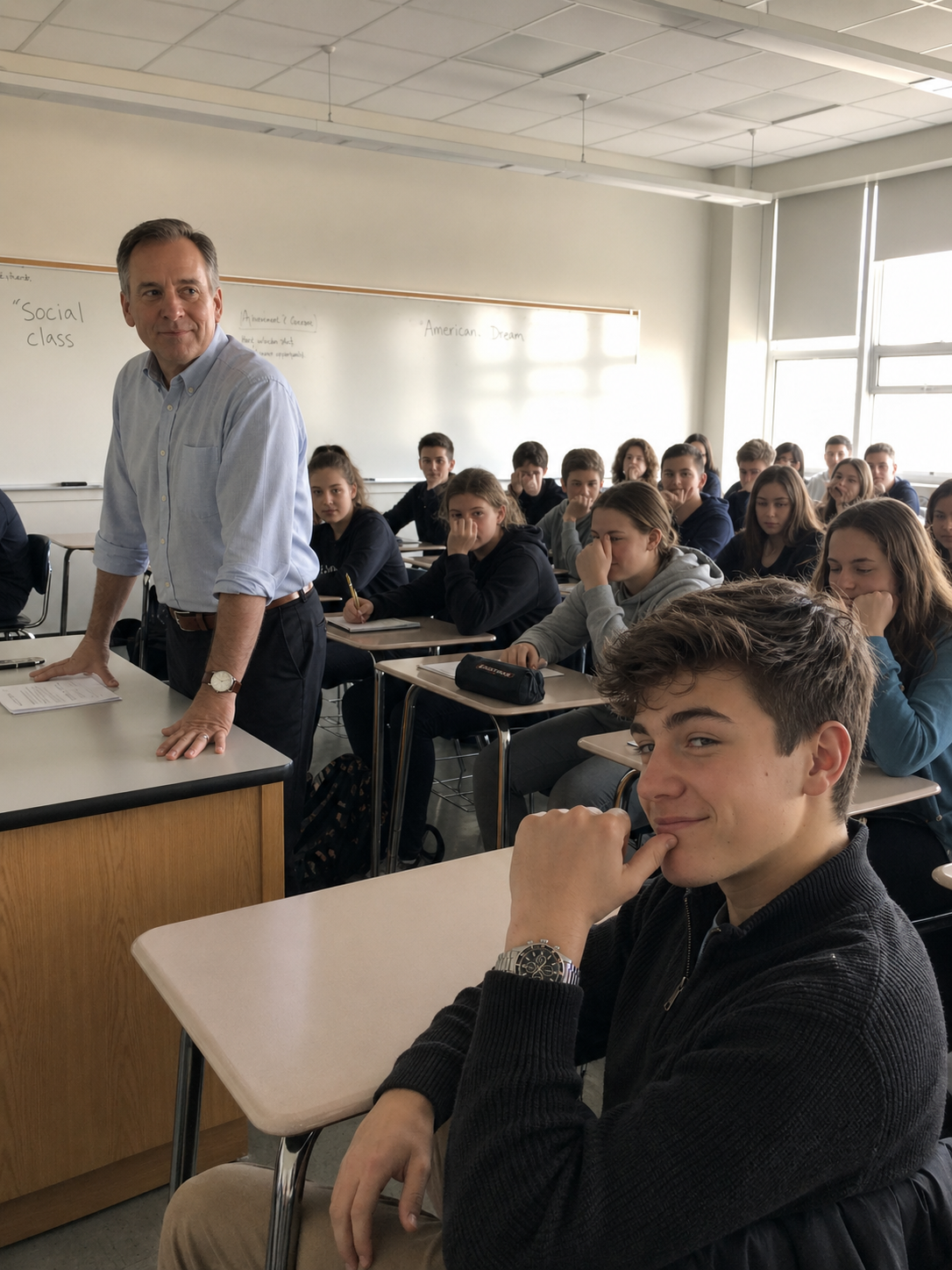
We were in the middle of a senior seminar, talking about social class and the idea of the “American Dream.”
It was one of those rare moments when the room felt alive—students engaged, thinking, questioning.
Then Leo raised his hand.
“Hey, Mr. Sterling,” he said, his voice polished but edged with something else.
“That’s an interesting watch. Is it a Rolex?”
The room went still.
Not because they were curious.
But because they understood exactly what he was doing.
He wasn’t asking.
He was drawing a line.
Between what I had… and what I didn’t.
I glanced at his wrist—sleek, expensive smartwatch, the kind that silently announces status.
Then I looked back at him and smiled.
“Thanks for noticing, Leo. It’s actually a vintage piece I picked up at a flea market for ten dollars. Keeps perfect time.”
A ripple of laughter passed through the room—uneasy, uncertain.
“Ten bucks?” someone muttered. “That’s gross… you don’t know who wore that.”
Leo leaned back, satisfied.
“Yeah, I don’t do ‘used.’ My parents taught me to buy quality.”
I set the chalk down.
The lesson plan? It could wait.
Because this—this was the real lesson.
“Quality is a funny word,” I said, meeting his eyes.
“It doesn’t matter if a watch costs ten dollars or ten thousand… time moves the same for all of us.”
Silence again.
Not the awkward kind.
The thinking kind.

“The truth is,” I continued, “a lot of the ‘luxury’ brands people chase are made in the same factories as the ones they look down on. You’re not paying for better craftsmanship most of the time—you’re paying for the story they sold you.”
I told them about the things I’ve found in secondhand shops—
Italian leather boots that lasted a decade.
Heavy wool coats that outlived trends, winters, and versions of myself.
But then I stopped talking… and started looking.
I saw Chloe in the third row.
She carefully stitches her sweaters at home so they last another year.
I saw Marcus near the door.
Same worn-out sneakers every day—not by choice, but because every dollar he earns goes toward helping his family keep the lights on.
They weren’t laughing.
They were listening.
And more than that, they were finally being seen.
“Listen to me,” I said, my voice quieter now, but stronger.
“There is no shame in having less.”
No shame in secondhand clothes.
No shame in old cars.
No shame in doing your best with what you have.
I paused, letting every word land.
“The only real shame… is believing that money makes you better than someone else.”
Because I’ve lived the other side.
I’ve stood at gas stations counting coins, hoping it was enough for another gallon.
I’ve swiped a card while holding my breath, praying it wouldn’t be declined.
And you know what?
Those moments didn’t make me less.
They built me.
They taught me resilience.
They taught me humility.
They taught me how to be grateful for things people with everything often overlook.
Your worth is not stitched into a logo.
It’s not measured by a price tag.
It’s found in your character.
In your integrity.
In how you treat people who have nothing to offer you in return.
The bell rang, but nobody reached for a backpack right away.
Leo sat very still, looking at the smartwatch on his wrist as if he had not seen it before. Chloe had her sweater sleeve pulled over her hand. Marcus was looking at the floor, and then, slowly, he looked up at me.
The room emptied in twos and threes. Leo stayed in his seat until the last of them was gone.
“I shouldn’t have said that,” he said. He did not say it the way a boy says it to avoid detention. He said it like he was reading it off the inside of his own head.
“Thank you,” I said. “That took more nerve than the question did.”
He nodded and stood. At the door he stopped, one hand on the frame.
“That flea market,” he said. “Is it open on weekends?”
“Saturdays,” I told him. “Bring cash.”
He almost smiled. On the way out he held the door for Marcus, and the two of them walked down the hall without saying anything at all.