Fiction. This story is a dramatized work created for entertainment. Names, characters, events, and circumstances are fictional.
PART 1
My name is Warren. I’m seventy years old. I carried the mail for a living until I retired, and now I live by myself on a few acres outside Lancaster, Pennsylvania.
My wife died four years ago. Since then it has been just me and the silence. My heart is bad. I have two stents in it, and a little bottle of nitroglycerin pills rides in my pocket every hour of every day.
Burt is my neighbor. He raises pigs for a meat company, two hundred of them, packed into long metal barns you can smell from a mile off.
One September morning, a truck from Burt’s farm was rolling down our road toward the processing plant. Its wheels slammed into a pothole, and the rear gate rattled loose and swung open.
One pig leaped out.
She was small, for a pig. Pink, with black spots, and one ear that folded over. She bolted into the cornfield behind my house and vanished.
The truck never even slowed.
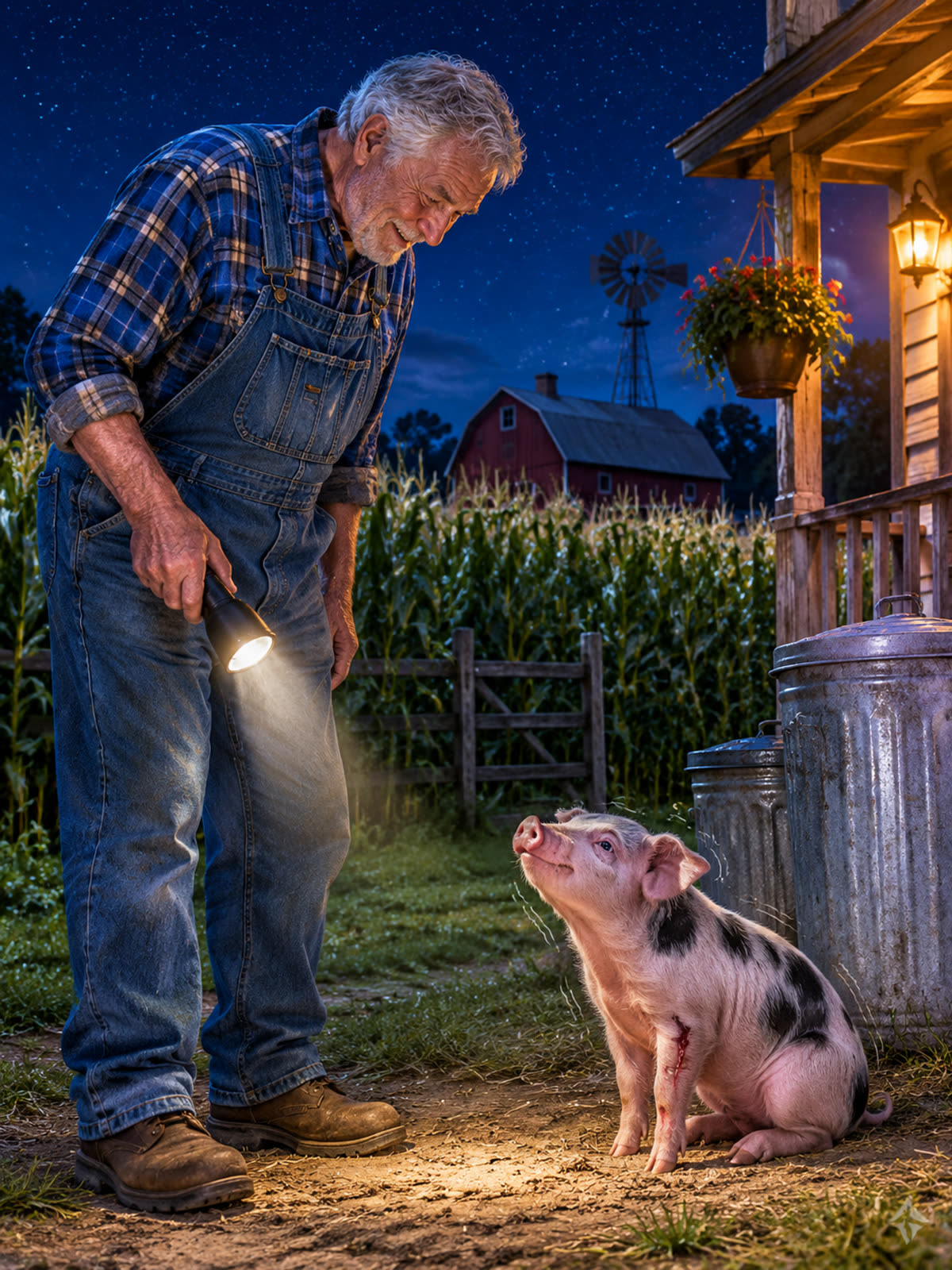
That night I heard something rooting around my garbage cans. I took a flashlight and went outside.
And there she was. Trembling. Frightened. A cut on her leg from the jump.
She looked up at me with small, clever eyes.
I couldn’t tell you why I did what I did next. I had eaten bacon all my life.
Still, I pulled open the door of my empty barn and set down a bucket of water and a few apples. She walked straight inside.
I named her Dolly.
From then on, I fed her every morning. Apples. Corn. Leftover bread. I washed the cut on her leg. I sat on an upside-down bucket and told her about my wife, about the weather, about nothing at all.
She trailed me around like a dog. She learned her name in three days. In a week she would sit for an apple. Each morning when I walked into the barn, she squealed and spun in a circle.
She was the best company I’d had in four years.
On the fortieth day, Burt appeared at my door.
He is a big man in his fifties, with a red face and a temper that never seems to cool.
"Warren," he said, "one of my drivers says he saw a spotted pig in your yard. I’m missing one from the September load."
I did not lie to him.
"She jumped off your truck. She was hurt. I took care of her."
"That’s my pig. I’m taking her."
"Burt, I’ll buy her from you. What’s she worth?"
He laughed.
"She’s not for sale. She’s property. And you’ve been hiding stolen property for over a month." He jabbed a finger at my chest. "I’m coming back Sunday with my trailer. That pig goes to the plant. Bacon by Sunday. And if you give me any trouble, I’ll call the sheriff and have you charged with theft. You’ll pay me for every day you hid her."
Then he stomped off my porch.
That night I sat in the barn with Dolly for a long while. She laid her head in my lap.
I didn’t sleep. I stopped arguing in my head. I only said to her, very softly, "Okay. We’ll figure it out."
The next morning was day forty-one.
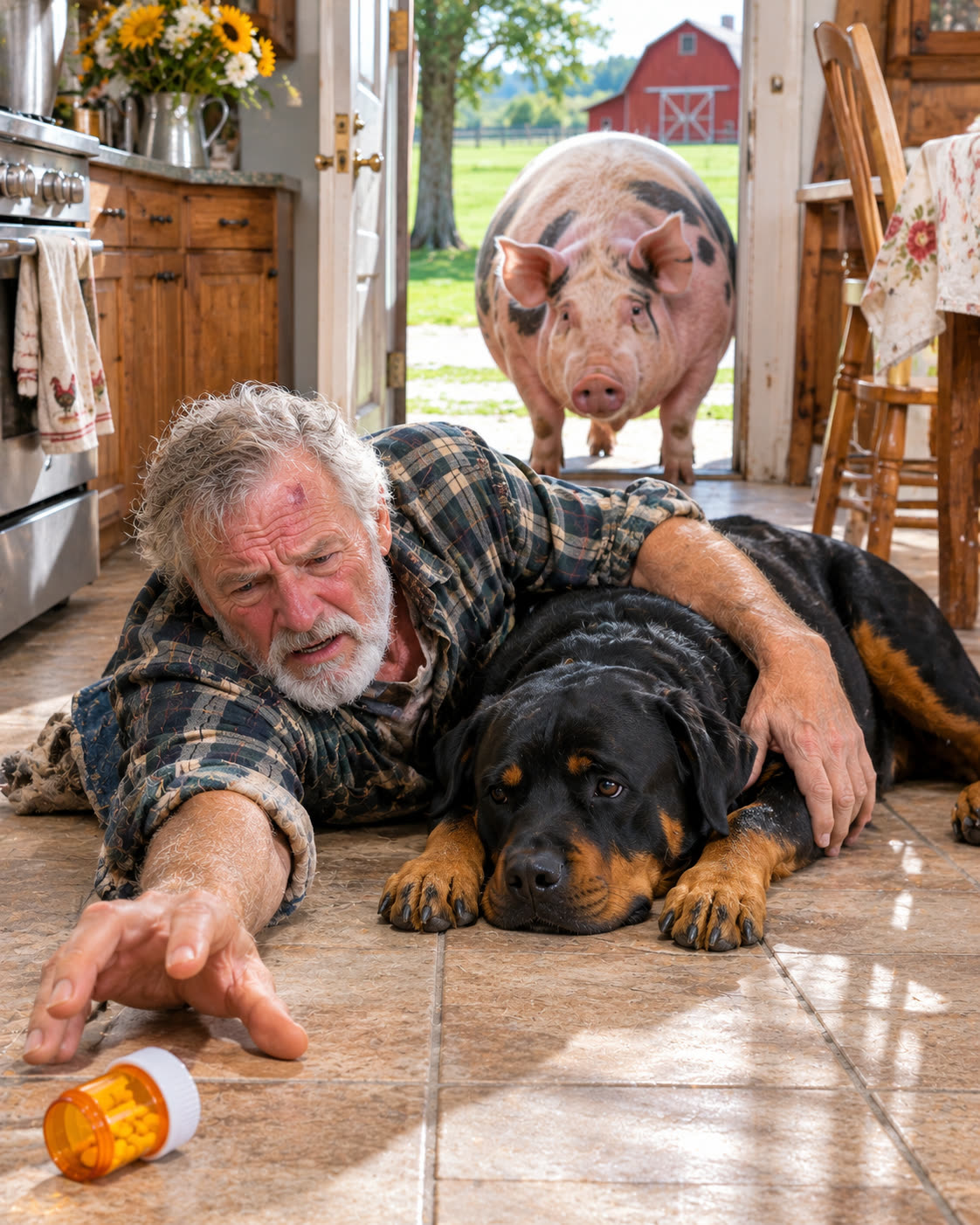
I was standing in my kitchen, pouring coffee, when a pain struck my chest like a hammer.
I couldn’t breathe. My left arm went numb. The coffee pot slid from my hand and burst across the floor.
I grabbed for the pill bottle in my pocket. My fingers refused to work. It dropped and rolled under the stove.
I went down beside it.
My phone sat on the kitchen table. Six feet away. It might as well have been six miles.
I tried to crawl. I couldn’t.
I can’t say how long I lay there. Ten minutes. Maybe longer.
Then I heard a loud squeal at the back door.
Dolly.
She had pushed open the barn door. She stood outside the kitchen, peering at me through the screen.
She squealed again. Then she shoved the screen door open with her nose and trotted over to me. She sniffed my face. She nudged my cheek.
"Good girl," I whispered. "Go. Get help."
I don’t know if she understood.
But she turned and ran out the door.
Straight down my driveway.
And out onto the road.
The last thing I saw, before everything went black, was a little spotted pig racing toward the highway, where the cars go sixty miles an hour.
PART 2
I put together what happened next from the people who were there.
A young nurse named Brianna Kowalski was driving to her morning shift at Lancaster General. At 7:20 she rounded the bend on Route 30, still half-asleep, her coffee going cold in the cup holder.
A spotted pig was lying in the middle of her lane.
Not running. Not wandering. Lying flat on the asphalt, right in the path of anything that came around that curve.
Brianna stood on the brakes. Her tires screamed, and her car stopped about ten feet short.
She honked. The pig didn’t move.
She climbed out, heart pounding, and waved her arms. "Hey, piggy. You’ve got to get out of the road."
The pig stood up. She trotted a few steps toward a gravel driveway. Then she stopped and glanced back over her shoulder.
She squealed.
Brianna stayed where she was. The pig trotted a few more steps and looked back again. Squealed again, louder, as if she were running out of patience.
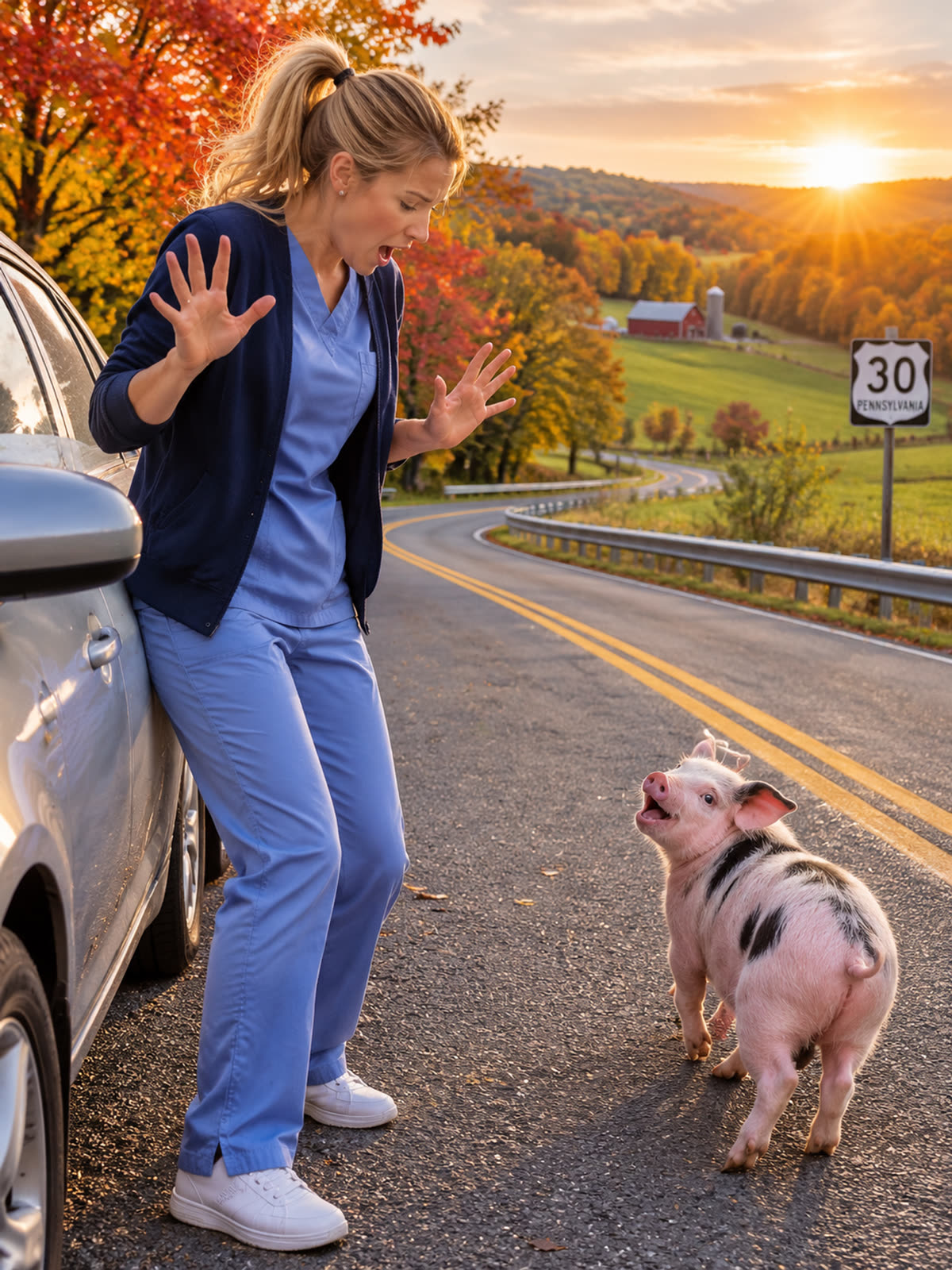
"I know how this sounds," Brianna told the newspaper later. "But she was asking me to follow her. Like those dogs in old movies. I honestly thought I’d lost my mind."
She followed anyway. Up my driveway, past the barn with its door flung wide, to my back door, which hung open.
And there I was, gray-faced on the kitchen floor in a puddle of cold coffee.
Brianna worked cardiac care. Eleven years of it. She dropped to her knees, found no pulse worth the name, and shouted for 911 on speaker while her hands were already moving. She dug my pill bottle out from under the stove. She started compressions.
My heart stopped twice before the ambulance reached the house. Twice she brought me back, on the linoleum, with a pig standing three feet away, watching.
"She never left," Brianna said. "She stood right there the entire time. When the paramedics came through the door, she backed up to the wall to give them room. Like she knew."
I woke in the hospital two days later, tubes in both arms and a new stent in my chest. A woman I didn’t recognize stood at the foot of my bed in scrubs.
"Mr. Warren? I’m Brianna. I’m the one who found you." She smiled. "Well. Your pig found me."
I started laughing. It hurt like fire. I didn’t care.
"Where is she? Where’s Dolly?"
The smile faded.
"Your neighbor came by the house while the paramedics were loading you up. He had a trailer."
My stomach turned over.
"What day is it?"
"Sunday."
I shut my eyes. Forty-one days of apples and bad jokes and a spinning pig in a barn doorway, and I had lost her anyway, because my heart couldn’t hold out until Monday.
I lay there a long time. Brianna sat down beside me and said nothing, which was the kindest thing she could have done.
Around four that afternoon, someone knocked on the door frame.
Burt stood there with his cap crushed in both hands. He looked ten years older than he had on my porch. His face was less red and more gray, and his eyes were swollen.
"Warren."
I couldn’t think of one thing to say.
He came in slowly and lowered himself into the visitor’s chair as if it might break under him.
"That nurse found me in the parking lot this morning," he said. "She told me everything. About Route 30. About the pig lying down in the road." He rubbed his jaw. "I’ve been raising hogs thirty-one years. I’ve loaded about forty thousand of them onto trucks. I never once thought of them as…."
He stopped.
"I stood in your barn at six o’clock this morning with a rope in my hand," he said. "And she looked at me. She wasn’t scared, Warren. That’s what got me. She looked at me like she was waiting to see what kind of man I was going to be."
My throat tightened.
"I didn’t load her," he said. "I couldn’t."
He reached into his jacket and drew out a folded sheet of paper. His hands weren’t steady.
"Bill of sale. One spotted sow, sold to Warren Hadley for one dollar." He laid it on my blanket. "I already put the dollar in the till myself. She’s yours. She’s been yours since the day she jumped off my truck, I just didn’t have the sense to see it."
I picked up the paper. The ink blurred.
"And I’m sorry," Burt said quietly. "For what I said on your porch. About the sheriff, and the days, and the bacon. You didn’t deserve that. You were a better neighbor to that animal than I’ve been to anybody in a long time."
"Where is she now?"
"Back in your barn. I fed her this morning. Gave her some of those apples out of your cellar." He cleared his throat. "She wouldn’t eat until I told her you were alive."
I laughed and cried at the same time, and I didn’t feel one bit ashamed of either.
But the happiness did not last long. Before Burt left, he paused in the doorway and looked back at me, and something in his face had changed again.
"Warren, there’s one more thing," he said. "When I drove up your road this morning, there was a car parked at the end of your driveway. Dark sedan. A man was standing at your barn door, writing something down. He took pictures of her, and he didn’t see me."
My blood went cold.
"Who was he?"
Burt shook his head slowly. "I don’t know. But he drove off the second he spotted my truck. And Warren, he was holding a rope."
PART 3
They let me go home eight days later.
Brianna drove me. She had offered, and I had quit arguing by the second day, because I could tell it was a waste of breath. She carried my bag up the steps and made me sit in the kitchen while she checked my blood pressure, my pills, my pulse, and the refrigerator.
"Mr. Warren, there’s nothing in here but pickles and half a stick of butter."
"I live alone."
"Not anymore," she said, and she nodded toward the window.
Out in the yard stood Dolly, at the barn door, ears pricked, staring at the house. The second my face appeared in the glass, she let out a squeal that rattled the panes and began to spin in circles so fast she nearly toppled.
I made it out to the barn without my cane. Dr. Patel would have had my hide. I didn’t care. Dolly shoved her whole warm snout into my stomach and leaned there, grunting, and I stood in the straw with my hands on her bristly shoulders and cried like a child.
"Okay, girl," I said. "Okay. I’m here. I’m here."
Still, the stranger with the rope stayed in my mind. That night I checked the barn latch three times.
The answer came sooner than I expected. The newspaper ran the story that Thursday. A reporter named Gladys Finch drove out with a photographer and spent three hours at my kitchen table. The headline said PIG SAVES RETIRED MAILMAN, and the photo showed Dolly sitting at my feet, ears flopped, looking dignified.
As it turned out, the man with the rope was that very photographer, scouting the barn the week before and hoping for a picture. Burt had a good laugh over it, and so did I, though neither of us laughed until our hearts had settled.
By Saturday, cars were lining my road.
People came from Ohio and Maryland and one family all the way from Vermont. They stood at my fence and took pictures. Kids fed her apples through the boards. A woman in a church dress held a toddler up to scratch behind that crooked ear, and Dolly allowed it, with the patience of a queen.
I put out a coffee can with a sign. Apples for Dolly. By the end of the month it was a barrel.
One morning in November, Burt’s pickup crawled to a stop at my fence.
I’d seen him a few times since the hospital. A nod at the mailbox. A wave over the hedge. We hadn’t really talked.
He climbed out with a bucket of cracked corn and set it on the ground as though he wasn’t sure he was allowed to come any closer.
"For the hero," he muttered.
"She’ll eat every kernel," I said.
He stood there with his hands in his pockets. The cold made his breath puff white.
"Warren, I did something."
"What’s that?"
"I called the company yesterday." He stared at the ground. "I told them I’m cutting my herd. Not all at once. I can’t, I’ve got a mortgage and a son at Penn State. But I’m converting half the barns. Going to try pasture-raised. Smaller. Slower." He shrugged, awkward. "It won’t pay as well."
"Why?"
He gazed at Dolly for a long moment. She had wandered over and was leaning her whole weight against the fence post, eyes half-closed.
"Because I stood in that barn," he said, "and I couldn’t do it. And if I couldn’t do it to one, I don’t know how I’ve been doing it to two hundred."
I said nothing. There wasn’t a thing to say that he hadn’t already said better himself.
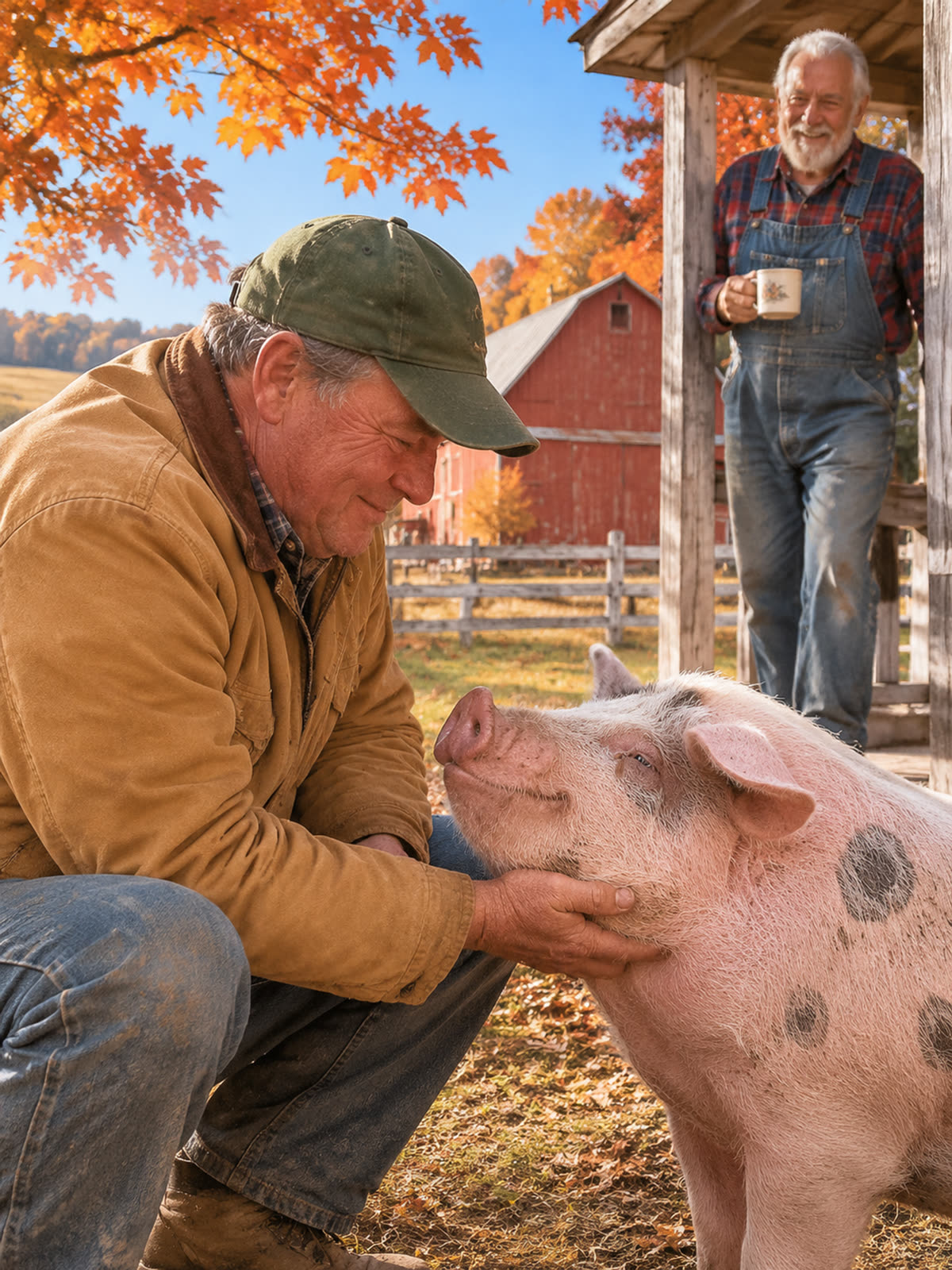
He opened the gate, slowly, and stepped into my yard. He crouched, grunting, and held out one hand toward Dolly.
She sniffed it. Then she pushed her head under his palm.
He scratched behind that floppy ear for twenty minutes.
I watched from the porch, sipping coffee, and pretended I wasn’t looking. He never knew I saw it, the way his rough old face went soft and wet and almost young.
It’s been two years now.
Dolly weighs three hundred pounds. She has her own heated corner in the barn, with a quilt my wife knitted forty years ago and a mound of fresh hay that Burt’s son delivers every other Saturday, free, over my protests.
Brianna still comes every Sunday. She says it’s to check my blood pressure, but she stays for supper, and sometimes she brings her fiancé, a quiet carpenter who built Dolly a covered porch for the rainy days. My heart has held steady. Dr. Patel says I’m the most boring patient he has, and he means it as a compliment.
Every morning, I carry my coffee out to the barn.
And every morning, before I’ve even reached the latch, I hear it. That squeal. Then the sound of hooves scrambling in the straw.
I open the door, and Dolly spins in a circle.
I sit down on my overturned bucket. She rests her enormous head in my lap. And I tell her about the weather, about nothing, about my wife, who I think would have liked her.
The quiet in this house doesn’t feel like quiet anymore.
It feels like company.
THE END.
Disclaimer: This story is a work of fiction inspired by real-life themes. Names, characters, places and events are fictionalized, and any resemblance to real persons is purely coincidental. Images are for illustration purposes only.