
Fiction. This story is a dramatized work created for entertainment. Names, characters, events, and circumstances are fictional.
The commercial jet was two hours into its Atlantic crossing when the captain’s voice stopped nearly three hundred passengers mid-breath: “If there is a fighter pilot aboard, please make yourself known to the flight crew immediately.”
None of them could have known that the woman dozing in seat 8A was the one person on board able to keep them alive.
The overnight flight from New York to Madrid had begun without incident. The cabin lights were dimmed. Some passengers slept against neck pillows, others watched movies without a sound, and a few just stared at the dark clouds sliding past the windows.
One of them was Laura Vance, thirty-eight, in a plain green sweater with a blanket across her knees and an unopened book in her lap. To a casual observer she was just another tired traveler, someone who had asked for a glass of water and declined the meal.
Nobody near her knew that she had once been one of the most decorated fighter pilots in the U.S. Air Force.
They didn’t know she had flown punishing combat missions and made split-second decisions where life and death balanced on a knife’s edge. They didn’t know that after a devastating loss, she had left military flying for good.
Laura no longer wanted to command anyone. She didn’t want to be looked at like a hero. All she wanted was an ordinary life.
That was precisely why she had chosen seat 8A: a window, almost no conversation, and a red-eye where no one would recognize who she used to be.
Then the captain’s voice came over the intercom again.
“Ladies and gentlemen, this is your captain. We’re dealing with a technical problem and need help right away. If anyone aboard has fighter pilot experience, please let a flight attendant know immediately.”
A heavy silence settled over the cabin. A mother pulled her baby closer. An elderly man took his wife’s hand. Passengers traded glances, searching for answers that nobody had.
Why would a commercial airliner need a fighter pilot? What on earth was going on up front?
Laura’s eyes opened slowly. She needed no further explanation to recognize that tone. She had lived inside it before, in a fighter cockpit: the sudden spike of urgency, the fear pressed just below the surface, a pilot’s voice working hard to stay calm while the systems around him began to fail.
A flight attendant made her way down the aisle, checking each row. The strain on her face showed that the real situation was worse than the announcement had suggested.
Laura closed her eyes again. No. That part of her life was over. She was no longer the one who had to step forward while everyone else was afraid.
Then the flight attendant stopped at her row.
“Excuse me, ma’am—do you know if anyone nearby has a military flying background? The captain urgently needs a military pilot.”
Laura looked across the cabin. Children. Families. People with no say at all in what was happening miles above the ocean.
For a moment she recalled the promise she had made herself: never again to be somewhere she could lose someone in her care. But another memory surfaced, one that years of service had burned into her: A pilot doesn’t leave people behind.
She took a breath. “I’m a pilot.”
The attendant blinked. “I’m sorry—what?”
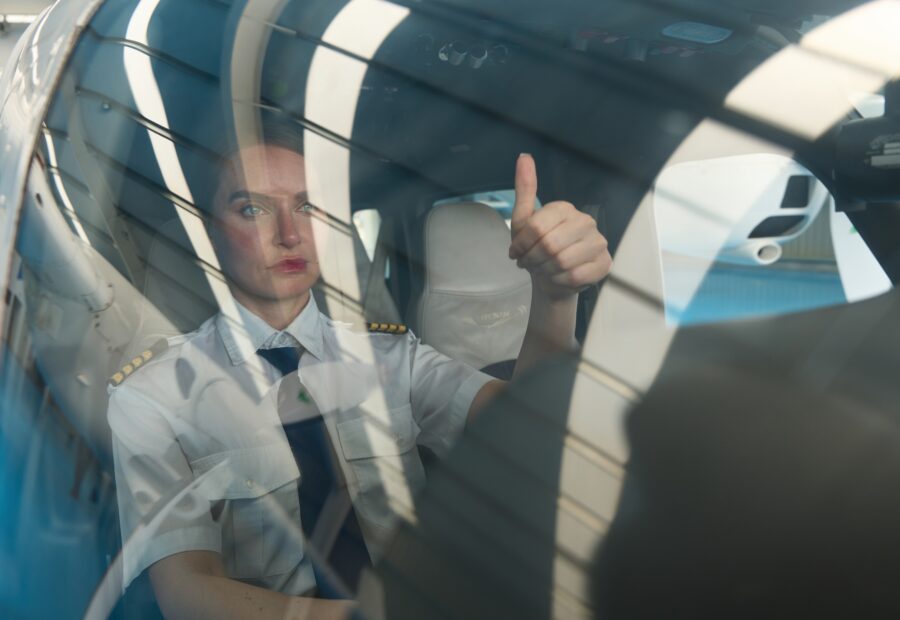
Laura unbuckled her seatbelt and sat up straight. Her whole bearing shifted in an instant, from weary passenger to seasoned officer.
“I’m a fighter pilot. Former U.S. Air Force. I flew F-16s for years.”
Whispers moved through the surrounding seats. The man beside her stared in shock. “You?”
Laura only nodded.
Relief and disbelief mingled on the attendant’s face. “Come with me right now, please.”
Laura stood. The click of her buckle sounded almost too loud in the hushed cabin. As she walked up the aisle toward the front, it felt as though she were stepping directly back into a past she had worked hard to bury.
She had no idea that something far worse than a mechanical fault waited behind the cockpit door. She was about to collide with the dark secret that had destroyed her life years earlier, and to learn that someone aboard already knew exactly who she was.
The cockpit door swung open. In the cramped space, the sharp smell of overheated electronics, stale coffee, and raw nerves hit her at once. Captain Andrew Holt sat in the left-hand seat, pale and fixed on the flight display.
Beside him, the first officer lay slumped and unconscious, an oxygen mask over his face.
Andrew glanced back at Laura, taking in her casual clothes. “You’ve got military flying experience?”
“Yes, sir.”
“What did you fly?”
“F-16 Falcons.”
The captain hesitated. “When were you last at the controls?”
Laura paused. “Eighteen months ago.”
Andrew’s jaw tightened. “I need someone current, not just someone with memories.”
Before Laura could reply, a sharp tremor ran through the airframe. It wasn’t turbulence. It was an unnatural, rhythmic shudder.
Laura’s eyes snapped to the primary flight display. “How long has the control column been shaking like that?”
Andrew frowned. “About ten minutes.”
Laura stepped further in, her eyes sweeping the instruments. “Talk me through what happened.”
Andrew gestured toward the status screens. “The autopilot kicked off with no warning. The flight computer started throwing conflicting error messages, and right after that my first officer said his arm had gone numb, then he went out.”
Laura studied the unconscious co-pilot. “Did he eat the same crew meal you did?”
“No. He had his own thermos of coffee from the terminal.”
Something in Laura sharpened. “Has anyone else on the crew shown any symptoms?”
“No. Just him.”
Laura read the digital displays carefully. Even after months away from the cockpit, her old training took over without hesitation. She weighed the data, cross-checked the readings, and listened to the pitch of the engines.
The jet drifted to the right on its own. Andrew grabbed the yoke to correct it.
“Don’t fight it,” Laura said sharply.
“I need to keep us level,” Andrew began.
“You’re fighting a bad input signal,” Laura interrupted. “The flight computer is pushing back against your manual control.”
Andrew looked at her. “How would you know that?”
“Because I’ve felt a flight-control override fail before,” Laura said quietly.
Andrew made a snap decision to trust her. He reached up and shut off one of the secondary control channels. The plane lurched once, and then the violent shaking faded.
Andrew stared at her, startled. “You were right.”
Laura didn’t allow herself any relief. She knew they had cleared only one hurdle.
Ahead, the weather radar showed a fierce Atlantic storm building. Fuel was running low, and the first officer still hadn’t stirred.
Just then, a doctor who had been called up from the cabin appeared in the cockpit doorway. “Captain, I need to tell you something. This isn’t a medical event—his symptoms point to acute chemical poisoning.”
A heavy quiet fell over the flight deck.
Laura’s gaze went to the center console, where the co-pilot’s thermos had been sitting. It was gone.
“Where’s his coffee thermos?” Laura asked, her voice tight.
The lead flight attendant looked around, confused. “It was here just a minute ago.”
A cold feeling crept down Laura’s spine. This was not a string of unlucky mechanical failures. Someone had deliberately knocked the co-pilot out of action, and now the evidence had disappeared.
“Lock the cockpit door,” Laura ordered.
Andrew looked over at her. “You think this was done on purpose?”
“I think someone made sure your co-pilot couldn’t fly this plane,” Laura answered coldly.
As they started an emergency descent toward an airport in northern Spain, another alarm went off. Hydraulic pressure to the right landing gear was falling fast.
Then the keypad on the cockpit door chimed. Someone outside was trying to force their way in.
Andrew checked the security screen. “It’s Richard Sterling.”
Laura’s eyes narrowed. “Who’s that?”
“The airline’s Director of Flight Operations. He was flying first class.”
The lead attendant’s voice crackled over the interphone, edged with panic. “Captain, do not open that door! Mr. Sterling says he has executive authority and is demanding to get in!”
Everything clicked into place for Laura at once: the sudden system failures, the poisoned co-pilot, the missing evidence, and now an executive pushing to enter the cockpit in the middle of an emergency.
The attendant’s voice came through again: “Captain, the doctor found a small plastic vial cap under the co-pilot’s seat.”
Andrew looked out at the rain-soaked runway emerging through the storm below. “We need to get this plane down. Now.”
Laura slipped into the right-hand seat and strapped in. “Land it first. We’ll deal with everything else once we’re on the ground.”
The jet started its final approach through driving rain and crosswinds. When Andrew cycled the landing gear lever, only two green lights came on. The right main gear wasn’t showing down and locked.
Andrew exhaled. “If that gear gives out on landing, we go off the runway.”
Laura placed her hands on the secondary controls, calm and precise. “I’ve got your back.”
“You’ve never flown a commercial jet before,” Andrew said.
“No,” Laura answered, her eyes on the runway lights ahead. “But I know how to hold an aircraft on the centerline when everything’s falling apart.”
The heavy jet touched down. For one terrifying moment the right wing dipped as the unconfirmed gear strained under the load. Laura immediately applied asymmetric thrust and manual rudder, keeping the plane steady until the gear finally locked into place with a heavy clunk.
The engines roared into reverse thrust. The plane slowed and rolled to a stop on the taxiway.
Beyond the closed cockpit door, three hundred passengers burst into cheers and tears of relief.
Laura didn’t smile. She knew that once those doors opened, she would have to face the truth behind everything that had just happened, and the man who held the key to the most painful part of her past.
Spanish police vehicles swarmed the plane the moment it left the runway. Passengers were led down the mobile stairs one at a time, while federal agents seized Richard Sterling before he could escape through the jetway.
As officers marched Sterling away in handcuffs, he passed close to Laura near the forward galley. He stopped, a thin, mocking smile crossing his face.
“Laura Vance…” he said quietly. “I never expected to run into you in seat 8A.”
Laura went rigid, her hands curling into fists.
Captain Andrew Holt stepped up beside her. “You know this man?”
Sterling smirked. “I know everything about her.”
Over the next forty-eight hours, the investigation exposed a sprawling corporate scheme. For years, Richard Sterling had been falsifying maintenance logs and installing counterfeit aircraft parts to drain millions from the airline. With a surprise audit approaching, he had staged the in-flight emergency, hoping to force a crash into the Atlantic that would wipe out the evidence for good.
He had drugged the first officer’s coffee to ensure the flight crew would be overwhelmed once the sabotaged flight computer failed.
But the hardest blow for Laura was discovering why Sterling knew her at all.
Years earlier, Sterling had been a senior defense contractor on a classified military logistics program. His company had supplied the defective avionics parts to her squadron, the very flaw behind the mid-air failure that killed her wingman and closest friend, Captain Gabriel Torres.
For a year and a half, Laura had carried the unbearable guilt of that day, convinced she had failed to protect him. That guilt was why she had left the service and cut herself off from everyone.
During the federal investigation, officials handed Laura a recovered classified file. Inside was the transcript of Gabriel’s final transmission, sent moments before his ejection system failed.
His last words to the flight controller were: “Tell Laura it wasn’t her fault. The controls locked up. She did everything right.”
Laura stared down at the page as the tears finally came.
For eighteen months she had believed she had abandoned him. But Gabriel had known the truth all along. He had trusted her until the very end.
Captain Andrew Holt sat beside her in the briefing room, offering silent support.
Weeks later, Laura flew to Texas to visit Gabriel’s mother. When the older woman opened the door, she looked at Laura for a long moment before drawing her into a warm embrace.
“I’m so sorry,” Laura whispered, her voice cracking. “I thought I’d left him behind.”
Gabriel’s mother gently took her hands. “You didn’t leave him behind, Laura. You’ve carried him with you every single day. It’s time you let yourself live again.”
Months later, Richard Sterling was convicted on numerous federal charges, including sabotage, attempted mass murder, and corporate fraud, and was sentenced to life in prison.
Laura did not go back to the military. Instead, she started a new chapter as a senior flight instructor at a major commercial pilot academy.
On her first day of teaching, she placed her old military flight helmet on the podium. The young trainees sat up straight, eager to hear combat stories from a former F-16 pilot.
Laura turned to the whiteboard and wrote a single line:
The aircraft doesn’t care who you used to be.
She faced the class. “Your past accomplishments won’t fly the plane when an emergency hits, and neither will your pride. What matters is being able to read the situation clearly and trust whoever’s sitting next to you.”
In time, many travelers would hear about the legendary passenger in seat 8A who saved Flight 412. But Laura never saw herself as a hero. In her mind, she had simply done what any pilot is trained to do: step up when standing back was no longer an option.
One afternoon, a letter arrived from a young boy who had been sitting in row 6 that night.
It read: “I was the boy in row 6. When everyone was scared, you looked at me and nodded before you went into the cockpit. That made me believe we were going to be okay. I’m taking my first flying lesson today.”
Laura smiled and tucked the letter into a wooden keepsake box beside a photo of Gabriel.
She understood now that the past never fully fades and grief never completely stops aching. But that didn’t mean a person had to stay trapped by it.
Standing near the airfield as a training jet climbed into a clear blue sky, Laura looked up. For the first time in years, she didn’t see a ghost in the clouds. She saw what still lay ahead of her.
As the engine’s roar faded into the distance, she smiled softly and whispered, “I’m home.”
Note: This story is a work of fiction. Names, characters, and details have been altered. Any resemblance is coincidental. The author and publisher disclaim accuracy, liability, and responsibility for interpretations or reliance.



Leave a Reply