
I Walked In Early and Found My Wife Unconscious While My Mother Ate the Dinner She Had Forced Her to Make
The Cry Behind the Door
I heard my newborn son crying before my key even touched the lock.
His cries were sharp and breathless, full of a fear no parent could ignore. It wasn’t the ordinary sound of a baby wanting to be picked up. It was a desperate wail that seemed to cut right through the walls of our small house in Boise, Idaho.
I was home nearly three hours early because a work meeting had been called off. I felt relieved as I pulled into the driveway. My wife, Laurel, had only been home from the hospital for two days, and I had felt uneasy about leaving her alone.
My mother, Doreen, had offered to stay with her.
At the time, I thought she was helping us.
The moment I stepped inside, I knew something was terribly wrong.
The kitchen lights were on, even though the evening sun was still pouring through the windows. The air smelled of roasted chicken, burnt rice, and vegetables cooked for far too long.
A laundry basket had toppled over near the hallway, and towels were strewn across the floor. Two grocery bags sat by the back door, their paper bottoms soaked through from melting ice.
On the counter, three baby bottles stood beside Laurel’s hospital instructions.
The yellow sheet was impossible to miss.
It listed warning signs that required immediate medical attention: extreme weakness, confusion, dizziness, difficulty staying awake, or sudden shifts in body temperature.
Then I saw my wife.
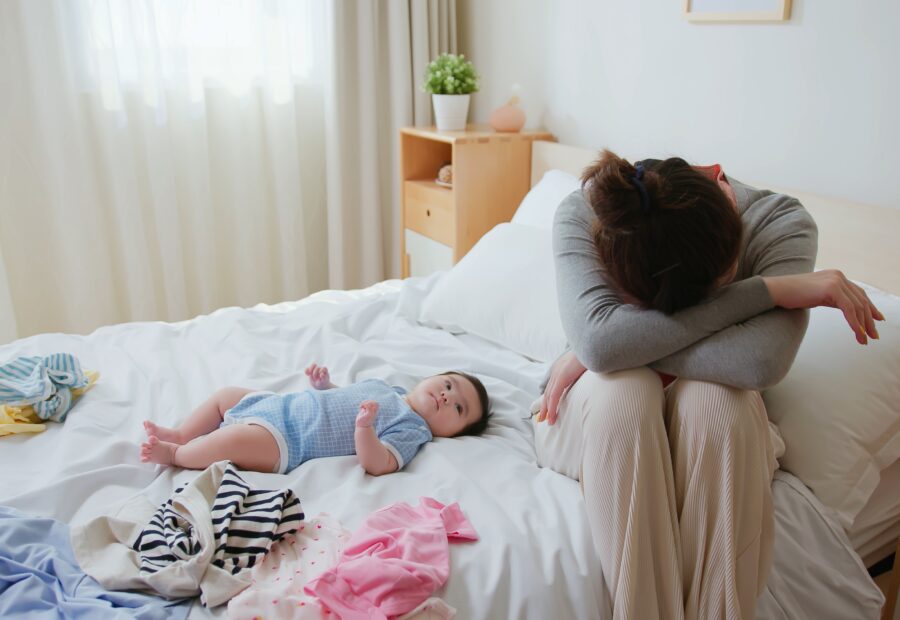
Laurel was stretched across the living-room sofa, completely still.
One arm hung off the cushion, her fingers hovering just above the carpet. Her long brown hair clung to her forehead, and her face was so pale that for a moment I forgot how to breathe.
Our son, Silas, was crying in the bassinet beside her.
His little face had turned bright red. He had kicked off his blanket, and the front of his onesie was damp. His tiny hands kept opening and closing, as if he had been reaching for someone for a very long time.
My mother sat at the dining table only a few feet away.
She was eating dinner.
Her plate held sliced chicken, rice, roasted carrots, and fresh bread, with a glass of iced tea within reach.
She glanced at Laurel’s motionless body, took another bite, and shook her head.
“She has always been dramatic,” Mom said.
Something inside me went completely quiet.
The Woman on the Sofa
I crossed the room and lifted Silas out of the bassinet.
Once I held him against my chest, his cries softened, but his small body kept trembling. He buried his face in my shirt and made a weak, broken sound I would remember for the rest of my life.
I knelt beside Laurel and placed my hand on her cheek.
Her skin felt strangely cool.
“Laurel, can you hear me?” I asked. “Please open your eyes.”
For several seconds, she didn’t respond.
Then her eyelids fluttered.
She took a shallow breath and whispered my name.
“Graham…”
Hearing my name in that faint voice scared me more than any shouting could have.
I reached for my phone, but Mom put down her fork with an irritated sigh.
“You are making this worse,” she said. “She needs to stop expecting everyone to panic every time she feels tired.”
I stared at her.
“She is barely conscious.”
“She had a baby,” Mom replied. “Women have been doing that forever.”
I looked around the room once more.
The grocery bags.
The laundry.
The pots and pans stacked in the sink.
A cutting board buried under vegetable peels.
A half-prepared bottle sitting in a cup of warm water.
It all told the same story.
Laurel had been trying to feed our son, cook dinner, put away groceries, do the laundry, and finish whatever other chores my mother had demanded.
She had pushed on until her recovering body had nothing left to give.
“Did you make her cook this meal?” I asked.
Mom lifted her napkin and carefully patted the corner of her mouth.
“I did not make her do anything. I told her that a home cannot stop functioning simply because she feels uncomfortable.”
Laurel’s fingers drifted weakly toward mine.
I took her hand.
“She told me you said I had to prove I could manage the house,” Laurel whispered.
My mother’s expression turned hard.
“Do not twist my words,” she said. “I was trying to help you become more responsible.”
The Truth I Had Avoided
For thirty-five years, I had told myself my mother was simply a strong woman.
I said she had high standards.
I said she was just honest.
I said she showed love through discipline rather than warmth.
Those explanations had protected me from a truth I wasn’t ready to face.
My mother didn’t always help people.
Sometimes she controlled them.
When I was a child, she chose my friends, my clothes, and almost every activity I joined. If I disagreed, she reminded me how much she had given up to raise me after my father left.
As I got older, she found fault with every woman I dated.
In her eyes, they were too lazy, too ambitious, too emotional, too quiet, or too interested in my money.
Then I met Laurel.
Laurel was patient, thoughtful, and independent. She worked as a librarian at a neighborhood elementary school and knew the name of every child who came through the doors. She never raised her voice to my mother, even when Mom remarked on her cooking, her clothes, or her family.
I had mistaken Laurel’s silence for peace.
In truth, she had been sparing me from conflict.
When we learned she was expecting our first child, Mom grew even more involved. She criticized the nursery colors, the stroller we picked, and the hospital Laurel had chosen.
I told myself she was simply excited to become a grandmother.
I should have looked more closely.
Control can hide behind helpful language.
Criticism can pass for “guidance.”
A person can walk into your home carrying groceries and still leave everyone inside feeling powerless.
That evening, I finally understood that good intentions meant nothing when the outcome was fear.
What Laurel Had Been Hiding
I helped Laurel sit up a little while I held Silas against my shoulder.
“Tell me what happened,” I said.
She glanced toward my mother before answering.
That small movement told me more than any explanation could.
Laurel was afraid of her.
“Your mother arrived this morning and said the kitchen was embarrassing,” she whispered. “She said guests might visit and think I was incapable of caring for my own family.”
“No one was coming,” I said.
“I know.”
Mom folded her arms.
“The house was a disaster.”
I ignored her.
Laurel continued.
“She said the baby needed a proper schedule. She took my phone because she said I was spending too much time reading messages instead of working.”
I turned my head toward Mom.
“You took her phone?”
“I placed it in the bedroom so she could focus,” Mom replied calmly.
Laurel swallowed and closed her eyes for a moment.
“She asked me to unpack the groceries, start the laundry, clean the guest bathroom, and prepare dinner. I told her I felt dizzy. She said I was using the baby as an excuse.”
My grip tightened around the phone.
“Why didn’t you stop?”
Laurel looked at me with tired, tearful eyes.
“Because she said you were already under enough pressure, and if I could not manage one afternoon, maybe you had chosen the wrong person to build a family with.”
Those words hurt more than anything my mother had ever said to me directly.
She had used my name to frighten my wife.
She had made Laurel believe my love depended on how well she performed while still recovering.
“I never said that,” I told Laurel. “I would never say that.”
“I know that now,” she whispered.
The Final Excuse
Mom slid her chair back from the table.
“This conversation has become ridiculous,” she said. “Laurel is sensitive, and you are encouraging her. I came here to help because neither of you knows how to manage a newborn.”
I stood up slowly.
Silas rested against my chest, finally quiet except for small hiccups. Laurel sank back into the sofa cushions, struggling to keep her eyes open.
I looked at the woman who had raised me.
She hadn’t apologized.
She hadn’t asked whether Laurel was all right.
She hadn’t picked up her crying grandson.
She cared more about defending herself than about the condition of the people in front of her.
“You sat here eating while my wife was unconscious,” I said.
“I thought she was pretending.”
“You heard Silas crying.”
“Babies cry.”
“You saw the medical instructions on the table.”
“I am not a doctor.”
Every answer was another locked door.
There was no concern behind her words.
There was only pride.
I realized I could argue all night, and she would still find a way to paint herself as the wounded one.
So I stopped trying to make her understand.
“You need to leave,” I said.
Mom blinked.
“Excuse me?”
“Leave our house.”
She let out a short laugh, as though I had made a childish threat.
“You are emotional right now. Once you calm down, you will realize how unreasonable you are being.”
“No,” I said. “For the first time, I am seeing this clearly.”
The Call That Changed Everything
I called for medical help and described Laurel’s condition.
While I spoke, my mother collected her handbag and sweater, moving in sharp, offended jerks.
“You will regret humiliating me,” she said.
I kept my voice steady.
“Laurel was the one humiliated today.”
“After everything I have done for you?”
That sentence had governed most of my life.
It had ended arguments before they began.
It had turned my boundaries into acts of betrayal.
But that evening, it had lost its hold on me.
“Raising me did not give you permission to mistreat my wife,” I said.
Mom stared at me, speechless.
It may have been the first time I had ever spoken to her without trying to soften the truth.
Within minutes, trained medical professionals arrived. They examined Laurel, asked questions, and decided she should go to the hospital for observation and fluids.
One of them told me quietly that exhaustion, dehydration, and a lack of proper rest could turn dangerous after childbirth.
I looked at my mother.
She looked away.
Before leaving, I found Laurel’s phone tucked inside a drawer in the guest bedroom. It showed six missed calls from her sister and two unsent messages she had tried to write to me.
The first said, “I do not feel well.”
The second cut off mid-sentence.
I saved both.
Then I packed a small bag for Silas and followed Laurel to the hospital.
My mother left without saying goodbye.
The Night at the Hospital
Laurel received treatment while Silas slept in my arms.
The hospital room was dim and quiet. Machines hummed softly beside the bed, and a nurse came in regularly to check on Laurel.
Just after midnight, she finally opened her eyes fully.
“Is Silas okay?” she asked.
“He is fine,” I said. “He is sleeping right here.”
Her eyes filled with tears.
“I tried to reach him when he started crying, but I could not get off the sofa.”
I rested my hand over hers.
“You do not have to explain anything.”
“Your mother will hate me now.”
“This is not your fault.”
“She is your family.”
I looked down at our son asleep against my chest, then at the woman who had carried him and brought him safely into the world.
“You and Silas are my family,” I said. “And I should have protected both of you sooner.”
Laurel began to cry quietly.
I apologized for every time I had waved off my mother’s comments as harmless. I apologized for asking Laurel to be patient when I should have been asking Mom to be respectful.
Most of all, I apologized for mistaking silence for harmony.
Laurel didn’t immediately tell me everything was fine.
She shouldn’t have.
Trust doesn’t come back just because someone finally says the right words.
It comes back when those words are backed by steady action.
The Boundary My Mother Never Expected
The next morning, I sent my mother a message.
I told her she could not visit our home, contact Laurel, or come near Silas until she took responsibility for what had happened and agreed to respect our boundaries.
Her reply arrived in under a minute.
She accused Laurel of turning me against her.
She said I was abandoning the one person who had always stood by me.
Then she reached out to several relatives and told them I had thrown her out after she “spent an entire day caring for an ungrateful daughter-in-law.”
For the first time, I didn’t defend myself to everyone.
I sent one short reply.
“Laurel required medical care after being pressured to cook and clean two days after leaving the hospital. Silas was left crying while she was unconscious. Those are the facts.”
Some relatives believed me.
Others didn’t.
I learned that peace doesn’t come from convincing everyone you made the right choice.
Sometimes peace comes from knowing the people who matter most are finally safe.
A Different Kind of Home
Laurel recovered slowly over the following weeks.
I took extended leave from work. Her sister stayed with us for several days, and friends from the school library dropped off meals without expecting anything in return.
They washed dishes quietly.
They folded laundry without criticism.
They held Silas so Laurel could sleep.
No one asked her to prove she was a good mother.
No one measured her worth by the state of the kitchen.
Watching them showed me what real help looks like.
Real help leaves a person feeling lighter.
Real help listens.
Real help never demands gratitude from someone who is struggling to stand.
My mother eventually sent a letter, but it was full of excuses instead of an apology. She said she had only been trying to “build character” and insisted Laurel had misunderstood her intentions.
I didn’t respond.
Months later, Laurel asked whether I missed her.
I answered honestly.
“I miss the mother I believed she was.”
Laurel squeezed my hand.
That distinction mattered.
I could grieve the relationship without opening the door to the same behavior again.
The Lesson I Will Teach My Son
Silas is almost two years old now.
He zooms around the house with toy cars and giggles whenever Laurel sings while she cooks. The kitchen is often messy. Laundry sometimes sits unfolded overnight. Dinner occasionally comes out of a cardboard box.
Our home isn’t perfect.
It is safe.
That matters more.
I often think about the evening I came home early.
If the meeting had run as planned, Laurel might have been alone for several more hours. That thought still fills me with guilt, but it also reminds me never to ignore the quiet warning signs again.
One day, Silas may ask why he rarely sees his grandmother.
When that day comes, I won’t fill his heart with bitterness.
I will tell him that love requires kindness, accountability, and respect.
I will teach him that sharing someone’s last name doesn’t give them the right to cause fear.
I will teach him that a strong man doesn’t stay silent to keep everyone comfortable.
A strong man protects the people who trust him.
Most of all, I will teach him that when someone is crying for help, we put down whatever is in our hands and listen.
A person who truly loves you will never make you prove your value while you are exhausted, vulnerable, or struggling to recover.
Family ties can matter, but no family title should ever excuse disregarding another person’s dignity, health, or emotional safety.
Real support doesn’t come with criticism, impossible expectations, or reminders of how grateful someone should be to receive it.
Silence may head off an argument for a day, but it can also allow unhealthy behavior to continue until someone is deeply hurt.
Protecting your spouse doesn’t mean rejecting your parents; it means refusing to let anyone disrespect the family you have chosen to build.
An apology without responsibility is just another excuse, and real change begins when a person stops defending their behavior and starts facing its consequences.
Children learn what love looks like by watching the adults around them, so the boundaries we set today may shape the relationships they accept tomorrow.
A peaceful home isn’t one where no one disagrees; it is one where everyone can speak honestly without fear of punishment, humiliation, or rejection.
Sometimes the bravest choice isn’t raising your voice, but calmly closing the door on behavior that has been excused for far too long.
When someone you love is silently asking for help, don’t wait until the situation becomes undeniable before choosing to stand beside them.






Leave a Reply