
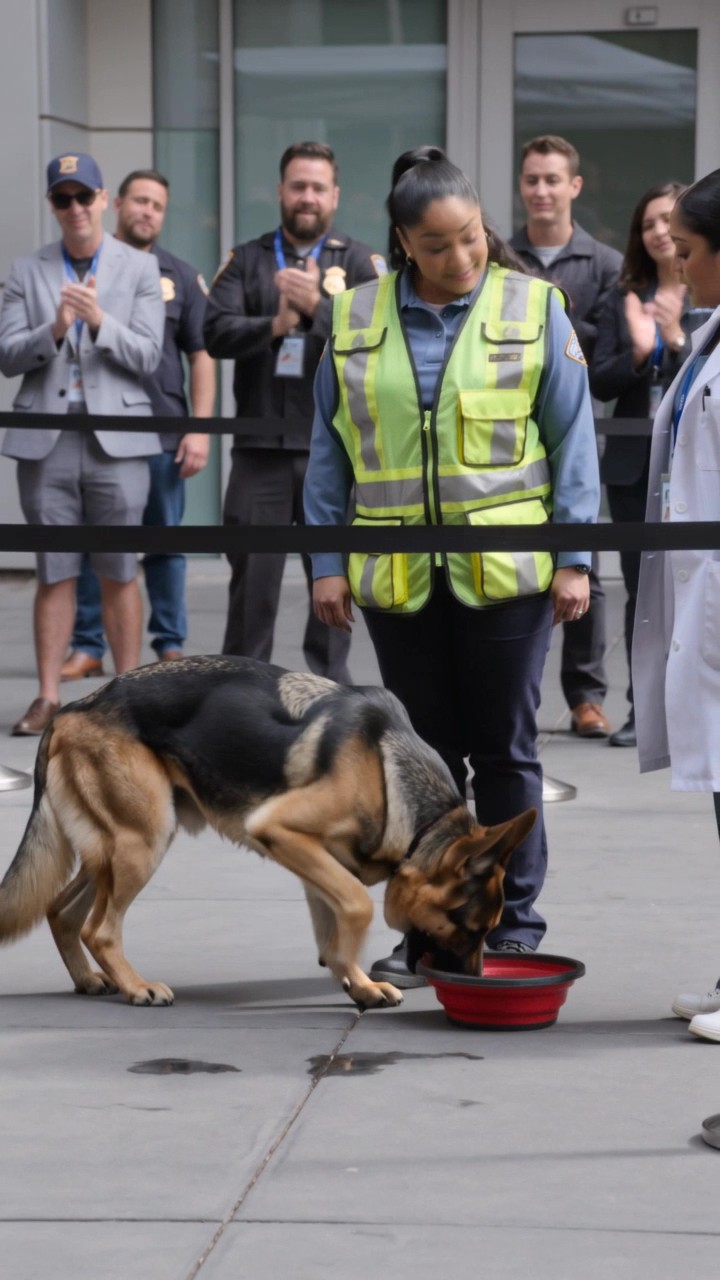
Atlas did not understand medals.
He did not understand public statements, property citations, or the difference between a police officer and a parking attendant.
He understood scent.
Voice.
The red bowl.
And the person beside him when the inside of the vehicle became harder to survive.
Three years earlier, the Westbridge Police Department held a summer safety fair in the city plaza.
Police vehicles lined one side.
Fire engines and ambulances lined the other.
Children met K9 teams, climbed into parked equipment, and collected plastic badges.
Atlas was six years old.
A German shepherd trained for tracking and evidence searches.
His handler, Officer Preston Hale, was scheduled to give two demonstrations.
Between demonstrations, Atlas rested inside a climate-controlled patrol SUV.
The rear compartment had a heat-monitoring system.
If the temperature rose above a set point, the system was supposed to start a fan, activate an alarm, lower windows slightly, and send a notice to the handler’s device.
The system had passed a maintenance test that month.
During the fair, a temporary radio installation drew power from the same auxiliary circuit.
A loose connection caused the monitoring unit to reset repeatedly.
The fan stopped.
The alert signal never reached Preston’s phone.
An exterior alarm began chirping.
Most people assumed it was part of a vehicle demonstration.
Elena Morales worked city parking enforcement.
Her assignment was traffic flow around the plaza.
She wore a fluorescent vest and carried a radio connected to municipal dispatch.
Elena had no police authority.
She did have eight years of experience volunteering at an animal shelter before taking the city job.
She knew the difference between a dog barking at noise and a dog losing strength in heat.
At first, Atlas stood near the screened window.
Then he lowered himself.
Elena called police dispatch.
She reported the unit number and asked for the handler.
Dispatch tried Preston’s radio.
He was onstage beside loud speakers.
The message did not reach him.
Elena asked for permission to open the vehicle.
Dispatch said a supervisor was coming with a master key.
Estimated time:
Several minutes.
Elena looked at Atlas again.
The dog tried to stand.
His legs slipped against the compartment floor.
She removed the red collapsible bowl from the K9 supply bag attached outside the vehicle.
The bag was accessible for public demonstration.
She poured water near the screen.
Atlas could not reach it.
Elena called dispatch again.
“I am breaking the rear side glass.”
The dispatcher told her to wait for the supervisor.
Elena did not.
She used the emergency window tool from the city parking van.
The glass broke inward behind the protective cargo divider, away from the dog.
She cleared the edge with her heavy work glove and opened the rear hatch from inside.
Event medics arrived as she moved Atlas into the shaded equipment tent.
They began emergency cooling and monitoring.
Elena stayed near the dog’s head because he became agitated whenever uniformed strangers approached quickly.
She tapped two fingers against her vest.
Atlas placed one paw against her shoe.
The small contact gave him a stable target while medics worked.
Preston reached the tent after hearing his unit number over the stage radio.
He helped identify Atlas’s medical history, contacted the veterinary hospital, and accompanied the dog during transport.
His actions mattered.
Atlas recovered.
The public account changed during the following week.
The police department faced questions.
Why had the cooling system failed?
Why had the handler not received the alert?
Why was a dog left inside during a crowded summer event?
Why did a parking attendant have to break the window after dispatch told her to wait?
The first department statement said:
“Officer Hale and event personnel responded quickly when a vehicle-monitoring malfunction was identified.”
That was accurate enough.
Then a local television segment described Preston as the officer who “smashed into his own patrol vehicle to save his partner.”
Preston did not correct the reporter.
At a later K9 fundraiser, he told the story in first person:
“When I saw Atlas going down, I knew the window did not matter.”
Elena watched the video from her apartment.
Those were her exact words from the incident report.
The city had issued Elena a property-damage citation before canceling it quietly.
Her supervisor also placed a warning in her file for leaving the assigned traffic zone.
The police department sent her a private thank-you email.
No public correction followed.
Elena did not pursue one at first.
She believed the dog’s recovery mattered more.
She also needed the city job.
Preston received praise for choosing his partner over equipment.
Elena received a warning for making the same choice without the correct uniform.
The retirement ceremony was held when Atlas developed arthritis and could no longer perform full patrol work.
The city displayed equipment from his career:
Tracking harness.
Training sleeve.
Red water bowl.
A section of the replaced vehicle screen.
Elena attended because the former event medic invited her.
She stood behind the barrier.
Atlas saw the bowl.
Then Elena.
The dog’s response did not legally prove the rescue timeline.
It made witnesses unwilling to keep accepting the easier story.
The former medic, Leah Brooks, requested the original dispatch audio.
A local reporter submitted a public-records request.
The plaza security camera showed Elena beside the patrol SUV twelve minutes before Preston reached the equipment tent.
Parking-radio logs recorded both calls.
The incident report listed the broken window time.
Veterinary intake notes identified Elena as the person who removed Atlas from the vehicle.
The evidence had always existed.
Status determined which version received the microphone.
At the ceremony, Preston looked at Atlas leaning against Elena.
“I did not ask the reporter to say I broke the window.”
Elena answered:
“You repeated the story after you knew.”
He lowered his eyes.
“Yes.”
“Why?”
Preston looked toward the crowd.
“Because I was his handler. People expected it to be me.”
“That is not why you let them believe it.”
He waited.
She continued:
“You liked what the story said about you.”
Preston did not argue.
The department suspended the ceremony.
It opened an ethics review into the public statements and the original vehicle procedures.
The review found Preston did not intentionally endanger Atlas.
He followed the department’s approved rest protocol.
The equipment failure was not visible to him.
His misconduct came afterward:
Accepting and repeating credit for the window rescue despite reading the reports.
The department removed him from public-affairs assignments and issued formal discipline.
He remained a K9 officer with a new partner after retraining and review.
Some people believed accepting false credit should have ended his career.
Elena did not decide that question.
She focused on the systems that made the emergency likely.
The city separated the K9 cooling unit from auxiliary electronics.
Handlers physically checked dogs between public appearances instead of depending only on remote alerts.
A second staff member remained within direct view of any resting K9 at large events.
Dispatchers received clear authority to approve emergency access when monitoring failed.
And city employees who intervened in good faith could not receive property-damage discipline before safety review.
The warning disappeared from Elena’s personnel file.
The police department publicly corrected the record:
Parking attendant Elena Morales identified the vehicle alarm, notified dispatch, opened the patrol vehicle, and removed Atlas before Officer Hale arrived. Event medics and Officer Hale then provided and coordinated further care.
Elena refused a medal shaped like a police shield.
“I am not a police officer.”
The city instead gave her a civilian safety commendation naming the exact actions.
More importantly, it paid for advanced animal-emergency training for parking and event personnel who regularly encountered animals inside vehicles.
Elena attended.
She did not leave parking enforcement to become a celebrity animal rescuer.
She liked her route.
She knew which loading zones blocked wheelchair ramps.
Which elderly drivers needed time to read signs.
Which restaurant workers moved cars before ticket deadlines.
Her job did not become worthy only because a police dog recognized her.
Atlas retired to live with Preston.
That decision surprised some people.
They expected the dog to choose Elena permanently.
Animal recognition is not a custody ruling.
Preston had been Atlas’s daily partner for years.
He fed him.
Worked with him.
Cared for him through injury.
The false rescue story did not erase their bond.
Elena did not want it to.
She visited twice during Atlas’s first retirement year.
On the first visit, the dog ran toward her and brought a tennis ball.
On the second, he remained asleep until she sat nearby.
When he woke, Elena tapped two fingers against her jacket.
Atlas placed one paw against her shoe.
Then returned his head to Preston’s knee.
Both relationships fit inside the room.
Months later, Preston spoke at a K9 safety training.
He told the story correctly.
“I was responsible for Atlas,” he said. “That did not make me the person who saw the failure first.”
Elena sat in the back.
He pointed toward her.
“She acted while the system and I were still catching up.”
That was not redemption by speech.
It was one corrected behavior after an uncorrected period.
The red bowl stayed with Atlas.
When the dog died years later, Preston mailed it to Elena with her permission.
She kept it in the parking office beside the canceled property citation.
One object showed the moment she helped.
The other showed how institutions often treat help when it comes from the wrong person.
At the next summer safety fair, no dog rested unseen inside a vehicle.
A parking attendant stood beside every K9 unit.
No cameras noticed.
Atlas’s recognition had returned one name to the story.
The reforms made sure another animal would not need to identify the overlooked protector in front of a crowd.


Leave a Reply