
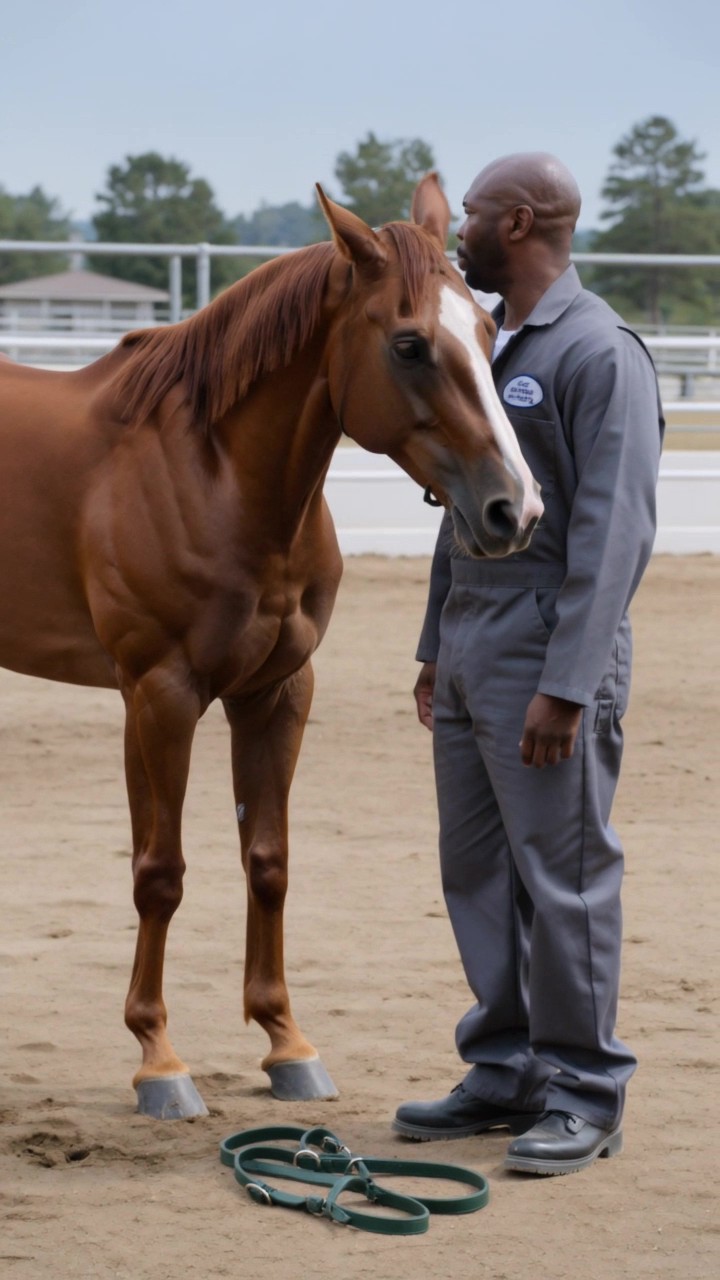
Jonah Reed placed one hand against the horse’s cheek.
Comet’s breathing slowed.
The arena crowd remained silent.
For most of them, the scene looked emotional.
For the stable staff, it looked specific.
The green halter.
The whistle.
The three-part response.
Those details belonged to one night the city’s public rescue story had simplified beyond recognition.
Two years earlier, Comet was housed in the west barn of the Westbridge Mounted Unit.
He was a large chestnut gelding trained for parades, crowd control, and search operations.
He trusted routines.
The same stall.
The same mounting block.
The same sequence of voice cues before a gate opened.
The barn fire began after an electrical heater in the feed room overheated.
Smoke moved through the rafters before flames became visible.
A construction project had temporarily disconnected part of the alarm loop.
The repair order was still open.
Jonah was working the overnight cleaning shift.
He removed bedding, washed buckets, and checked floor drains after the mounted officers left.
His job description did not include horse handling beyond basic stall safety.
But he spent more quiet hours near the animals than most visitors ever saw.
He knew Comet disliked flashing emergency lights.
Knew the horse backed away from the west aisle when metal doors slammed.
Knew a low two-note whistle brought his attention without startling him.
When Jonah smelled burning insulation, he called the emergency number and opened the nearest stalls.
Two horses moved into the outdoor paddock.
Comet would not.
Smoke had entered his aisle.
The main barn door was partly blocked by a maintenance cart.
The west side gate, listed as repaired, remained chained because its latch had warped and could not hold securely.
Jonah used bolt cutters from the utility cabinet.
The chain fell.
The opening led to a narrow service passage between the barn and equipment shed.
Comet had never used it during a real emergency.
Jonah took the green halter from the stall hook.
He stood where the horse could see the color through the smoke.
Two low whistles.
Pause.
One short.
Comet moved one step.
Jonah repeated the pattern.
Another step.
When the horse began backing away, Jonah did not pull hard.
He moved closer.
Touched the halter strap to his own chest.
Whistled again.
The horse followed.
They reached the service passage before the fire crews arrived at the west side.
Preston Hale was the mounted unit’s senior trainer.
He responded from home after receiving the emergency alert.
When he arrived, he helped firefighters move the remaining animals, checked Comet for smoke exposure, and coordinated veterinary care.
His work mattered.
The public information office needed a short explanation.
It released:
“Senior trainer Preston Hale led Comet from the smoke-filled barn before firefighters contained the blaze.”
At first, Jonah assumed the record would be corrected later.
A young groom, Lily Brooks, submitted a statement naming him.
The maintenance supervisor confirmed Jonah cut the west-gate chain.
Firefighters noted that Comet was already outside when Preston reached the barn.
Still, the official story remained.
Why?
The city’s legal office worried that admitting an unlicensed night cleaner handled a police horse during a fire could expose the unit to criticism.
The mounted division worried that the unrepaired gate would become the headline.
The public relations office wanted one recognizable spokesperson.
Preston was visible.
Jonah was hourly contract staff.
The rescue gradually became Preston’s.
He accepted interviews.
A commendation.
A promotion into training administration.
He never said Jonah had done nothing.
He used phrases like:
“My unit responded.”
“We got Comet out.”
“I led the effort.”
Each sentence left room for technical truth while allowing listeners to imagine the wrong person holding the halter.
Jonah objected once.
His contract supervisor told him:
“You still have your job. Do not turn a good ending into a fight.”
Jonah stayed quiet.
He needed the health insurance for his wife.
He also doubted whether the horse’s behavior would matter against an official report.
Then came the anniversary ceremony.
For the public demonstration, staff placed several recovered fire items near the arena entrance.
The burned green halter had been kept for safety training.
Comet saw it before the ceremony began.
He pulled toward the rail.
A groom moved the halter away.
Comet followed.
When Jonah arrived for the night shift early, the horse recognized both the object and the person.
The animal did not understand medals.
He understood patterns.
The halter had once appeared through smoke.
The whistle had meant move toward safety.
The chest beneath his forehead belonged to the person who stayed close without dragging him.
Lily stepped onto the arena floor.
She was no longer a teenage groom.
She had become an assistant mounted officer.
“I wrote Jonah’s name in my statement,” she told the mayor.
Preston answered before anyone asked him.
“The city attorney determined all public communication should identify the unit lead.”
Jonah looked at him.
“The unit lead was not in the barn yet.”
Preston’s face tightened.
“You violated animal-handling protocol.”
“Yes.”
“You cut a secured gate.”
“Yes.”
“You could have released horses into a road.”
Jonah nodded.
“That is why I used the service paddock, not the street gate.”
He did not turn himself into a flawless hero.
Handling a frightened horse in smoke was dangerous.
Cutting any chain during an emergency carried risk.
The correct review should have examined those decisions.
It should not have erased them.
The city paused the ceremony and opened an independent review.
Barn radio logs, time stamps, fire-department records, grooming statements, and maintenance reports confirmed the sequence.
Jonah discovered the fire.
Opened the side route.
Guided Comet out.
Preston led the later animal-care response and managed the remaining evacuation.
The revised incident report named both roles.
The silver plaque was removed.
Not handed directly to Jonah.
He refused a replacement individual award.
“The groom opened the outdoor paddock. The dispatcher sent the crews. The firefighters stopped the building from burning. The vet kept the horses healthy afterward.”
He pointed toward Comet.
“And the horse had to choose to move.”
The city created a team recognition instead.
Preston lost his position as public safety spokesperson and received formal discipline for allowing an inaccurate personal narrative to continue after seeing internal reports.
He remained an experienced trainer.
The decision divided the unit.
Some officers believed accepting the award required dismissal.
Others believed he had done real emergency work and could remain after public correction.
Jonah did not decide Preston’s career.
He asked for changes.
Contract cleaners, feed workers, grounds staff, and maintenance crews were added to mounted-unit emergency drills.
Night workers received basic horse-evacuation training.
Every gate listed as repaired required a physical sign-off by someone who used it on the night shift.
Incident reports could not be reduced to the highest-ranking person before all witness statements were reviewed.
And any worker whose emergency action fell outside ordinary authority received an accountable safety review—not automatic punishment and not automatic glorification.
Jonah was offered a full-time stable operations role.
He accepted after the city agreed to recognize his existing years of service.
He did not become a trainer.
He became the person responsible for night readiness, gates, lighting, water systems, and emergency routes.
The work matched what he actually knew.
The burned green halter remained in the training room.
Comet continued working for three more years.
Whenever Jonah entered the west barn, he whistled two low notes.
Pause.
One short.
Comet usually answered by shifting one front hoof.
Not always.
Animals are not machines built to perform human memories on command.
That made the moments more meaningful.
On Comet’s retirement day, cameras returned.
Preston attended but stood outside the main photograph.
Jonah wore a clean stable jacket, not his old gray uniform.
He placed the green halter over the rail.
Comet took it.
Then turned toward the transport paddock.
For one second, Jonah wondered whether the horse would come to him again.
Comet did not.
He walked calmly toward the new handler waiting beside the trailer.
Jonah smiled.
Being remembered was not the same as being needed forever.
The rescue had done its job.
The animal had learned another safe path.
The truth no longer required Comet to keep proving it.





Leave a Reply