
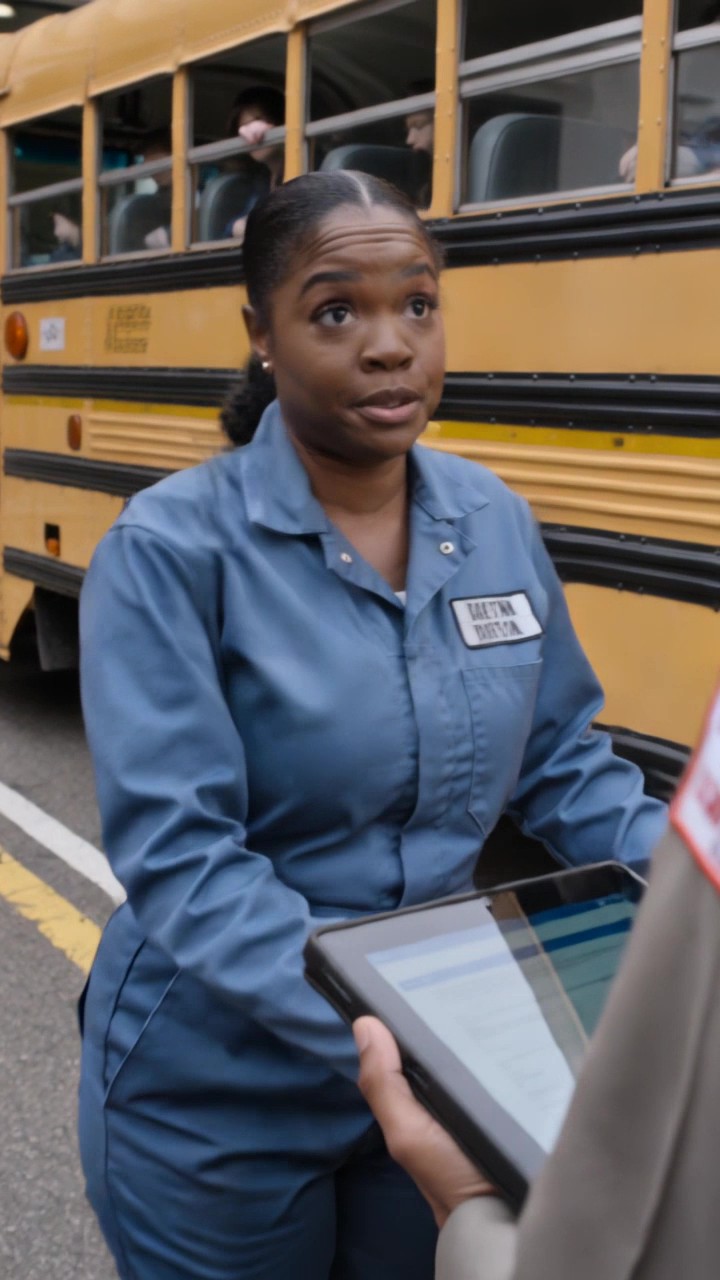
Bus 214 never reached the public road.
That fact kept the incident inside a depot investigation instead of turning it into a roadside emergency involving thirty-eight children.
The bus moved only five feet.
The rear wheel assembly shifted far enough to expose several damaged studs, but the remaining hardware held until the driver stopped.
No one was injured.
The students missed the opening round of the state science competition.
The school rented another bus, but it arrived too late for their first scheduled presentation.
Several children cried.
One team lost eligibility for a timed category.
Preventing a disaster did not make those losses imaginary.
It made them the worst things that happened.
Denise Carter had worked the overnight wash and fueling shift for four years.
Her official duties were simple on paper:
Refuel each returning bus.
Check fluid levels visible from the service panel.
Remove trash.
Wash the exterior.
Record obvious body damage.
Park the vehicle in its assigned lane.
The job placed her beside every bus after the drivers, students, and daytime supervisors had gone home.
She heard doors that closed differently.
Saw leaks before sunlight dried them.
Found pieces of rubber, metal flakes, broken reflectors, and loose seat hardware during cleaning.
Most of those observations entered a maintenance box labeled “operator comments.”
Mechanics reviewed them when the schedule allowed.
Before joining the school district, Denise had spent eleven years at a commercial truck-tire shop.
She mounted heavy tires, cleaned wheel faces, replaced damaged studs under supervision, and performed torque checks after service.
She left when her mother developed a progressive illness and could no longer remain alone overnight.
The bus depot offered a steadier schedule and health insurance.
Her title changed.
The mechanical signs did not.
Bus 214 received rear-brake service the evening before the field trip.
A technician removed the right-side dual wheels to reach the brake components.
When the wheels were reinstalled, the technician used the required torque wrench and recorded the final value electronically.
The tablet showed every lug nut met specification.
That record convinced Kyle the assembly was safe.
The investigation later found the number itself was probably accurate at the moment it was entered.
The failure happened because the process ended too early.
Rust scale remained between the inner wheel and the hub mounting surface.
A thin layer of old paint also remained around part of the contact area.
When the bus was lowered and moved across the yard, the material compressed and broke away.
That settling reduced the clamping force holding the wheels tightly against the hub.
Several lug nuts began loosening.
Two wheel studs had also been stretched during previous service.
They looked normal from the outside but no longer held load evenly.
The depot’s maintenance policy required a second torque check after the bus traveled fifty miles.
Bus 214 had not yet traveled fifty miles.
It was scheduled to carry children on a highway before returning for the recheck.
Nothing in the policy required a short controlled yard roll followed by immediate inspection after the wheels were installed.
The white torque lines had been applied after the first tightening.
They were designed to reveal movement.
Denise washed the bus at 2:10 in the morning.
At that time, the lines appeared aligned.
A driver moved Bus 214 twice before sunrise—once to clear a fueling lane and once to position it near the school loading zone.
When Denise returned to collect a forgotten wash nozzle, she saw the marks had shifted.
Three lines no longer matched.
One lug nut showed fresh silver metal around its edge.
A narrow trail of metallic dust curved along the rim.
Denise placed her hand near the hub.
It felt warmer than the opposite side even though the bus had traveled only across the depot.
She reported the condition through the wash-team tablet.
The system offered several categories:
Body damage.
Fluid leak.
Tire damage.
Cleaning issue.
Other.
Denise selected tire damage and wrote:
Torque marks shifted after yard movement. Silver dust at right rear wheel. Do not dispatch before physical inspection.
The report entered the daytime maintenance queue.
Field-trip buses were already being loaded.
Kyle saw the report but did not call a mechanic immediately.
He reviewed the previous night’s digital torque record.
Every value appeared correct.
He believed Denise had mistaken ordinary paint movement caused by washing for mechanical loosening.
He also knew canceling the trip would anger the school, require another driver, and create overtime costs.
The maintenance tablet offered certainty.
Denise offered a warning from a worker holding a wash hose.
Kyle chose the more comfortable evidence.
At the formal review, he said:
“I relied on documented maintenance completed by a certified technician.”
The investigator answered:
“You relied on yesterday’s condition after receiving evidence that today’s condition had changed.”
That distinction became central.
Procedures are necessary.
Records matter.
A completed inspection does not guarantee equipment remains unchanged afterward.
Denise was not qualified to certify the bus safe.
She did not claim she was.
She was qualified to identify signs that made another inspection necessary.
When Kyle removed the red out-of-service flag, Denise faced a decision.
She could step aside.
The report would prove she had warned management if something happened.
Her employment record might remain clean.
Or she could physically prevent departure.
Denise pushed the wash cart across the gate.
That action violated traffic-flow rules and created its own risk.
A moving bus could have struck the cart.
She positioned it while the bus remained stopped and stood to the side, not directly in front of the vehicle.
She repeatedly asked that the children be unloaded before any movement.
The principal initially resisted because every minute threatened the competition schedule.
Denise looked through the bus windows and saw students carrying model bridges, solar panels, and handmade robots.
She imagined the rear wheel separating at highway speed.
Documentation would not bring the bus back.
She refused to move.
Kyle took her badge.
The principal finally ordered the children off because the argument itself had become unsafe.
That decision mattered.
When Kyle moved the empty bus five feet, the weakened assembly shifted.
One lug nut fell.
Another stud fractured.
The outer wheel moved away from the hub.
Engineers later concluded the wheel might have remained attached for several more miles.
It also might not have.
No honest investigator could identify the exact point of separation.
The visible movement proved only that the assembly was already failing.
Denise’s warning did not require predicting the precise mile where failure would become catastrophic.
It required recognizing that a bus full of children should not be the test.
The district suspended Kyle and the technician during investigation.
The technician admitted he had not fully cleaned the mating surfaces because another bus was waiting for the bay.
He believed the remaining rust was minor.
He followed the torque sequence.
He did not falsify the tablet record.
The failure came from incomplete preparation, weakened studs, and a recheck policy that assumed fifty miles was an acceptable waiting period.
The review did not make him the sole villain.
The depot scheduled too many overnight repairs for one bay.
Technicians were measured partly by how quickly vehicles returned to service.
Cleaning and fueling workers could submit comments but had no formal stop authority.
Supervisors could remove an out-of-service flag placed by a non-mechanic without documenting an inspection.
Every part of the system told Denise:
You may notice.
You may report.
You may not stop.
The district changed that.
Any employee could place a temporary safety hold for wheel movement, brake concerns, steering changes, fuel odor, smoke, structural damage, or unusual mechanical sound.
The hold did not declare the vehicle defective.
It required a qualified inspection before release.
Supervisors could not remove it based only on an earlier record.
Wheel-service procedures added full cleaning of mating surfaces, stud-condition checks, an independent torque witness, and a controlled yard movement followed by immediate visual inspection.
A later mileage recheck remained required.
Torque lines were photographed after installation and again before passenger service.
Washers, fuelers, drivers, and aides received training on visible wheel-end warning signs.
Not to turn them into mechanics.
To make sure the people closest to the equipment knew what required a stop.
Kyle lost fleet-dispatch authority.
He remained with the district in route planning after discipline and retraining.
Some drivers believed he should have been fired.
Others argued the district had rewarded on-time departure and low cancellation rates for years.
Denise did not excuse his decision.
She also refused to let the district pretend replacing one supervisor solved the problem.
“You taught him a canceled trip was a failure,” she said at the board meeting.
“Then you acted surprised when he treated a warning like an obstacle.”
The district revised performance measures.
Verified safety holds no longer counted against dispatch reliability.
The technician returned under a supervised improvement plan after completing additional wheel-service certification.
He apologized to Denise.
“I torqued every nut.”
“I believe you.”
He looked at the failed studs displayed on the workbench.
“That makes it worse.”
“No,” Denise said. “It makes it specific. You did one part correctly and skipped another part that mattered.”
Accountability became more useful when it described the failure accurately.
Denise’s badge was restored.
She received back pay for the suspension period.
The district offered her a ceremonial “Bus Safety Hero” plaque.
She accepted only after the board removed the word instinctive from the citation.
What she saw was not a mysterious feeling.
It was knowledge.
The final wording read:
DENISE CARTER
FOR RECOGNIZING POST-SERVICE WHEEL MOVEMENT AND PREVENTING PASSENGER DISPATCH UNTIL THE CONDITION WAS VERIFIED.
The district also offered her a daytime fleet-inspection assistant position.
Denise hesitated.
The schedule would complicate her mother’s care.
The district adjusted the hours and funded updated technical training.
She accepted.
She did not become the chief mechanic overnight.
Her prior truck experience needed renewal.
School-bus systems had different requirements.
She studied braking regulations, accessibility equipment, inspection records, and fleet-specific hardware.
She failed one section of the certification exam.
Passed on the second attempt.
Her new role included inspecting buses after major wheel or brake work and training non-mechanical employees to report changing conditions clearly.
She still worked one overnight wash shift each week for several months.
Not because the district demanded it.
Because she wanted the training program to remain connected to the people using the reporting system at two in the morning.
The students returned from the delayed science trip disappointed but safe.
One group had built a bridge model designed to show how small cracks distribute force.
Their teacher later invited Denise to speak.
She carried the fallen lug nut.
A student asked:
“Did you know the wheel would fall off?”
“No.”
“Then how did you know to stop the bus?”
Denise placed the lug nut beside the model bridge.
“I knew something that was supposed to stay still had moved.”
She pointed at the torque line.
“You do not always need to know the final disaster. Sometimes you need to respect the first change.”
The students added that sentence to their presentation board.
They competed again the following year.
Their project focused on inspection markers and human reporting.
They won second place.
Denise attended in her clean inspection uniform.
Kyle watched from the back of the auditorium.
Afterward, he approached her.
“I thought the tablet protected me from making a subjective decision.”
Denise answered:
“You still made one.”
He nodded.
“You decided the record mattered more than the person standing beside the wheel.”
“Yes.”
There was no dramatic forgiveness scene.
Only an accurate sentence he could carry into the next job.
The failed wheel assembly remained in the depot training bay.
The fallen lug nut sat inside a clear case.
Beneath it were two photographs:
Torque lines aligned at 2:10 a.m.
Torque lines shifted at 6:34 a.m.
The label read:
BOTH PHOTOGRAPHS WERE TRUE.
ONLY ONE DESCRIBED THE BUS BEFORE CHILDREN BOARDED.
Months later, a fueling worker noticed one torque line on another bus appeared uneven.
She placed a temporary hold.
A mechanic inspected the wheel.
Nothing was loose.
The paint had been applied crookedly after routine service.
The bus departed twenty-five minutes late.
Nobody removed the worker’s badge.
Nobody called the inspection a waste.
Denise watched it leave.
The first bus had required her to risk her job.
The safer system proved itself when the next worker could be wrong about the defect and still be right to ask for a check.







Leave a Reply