
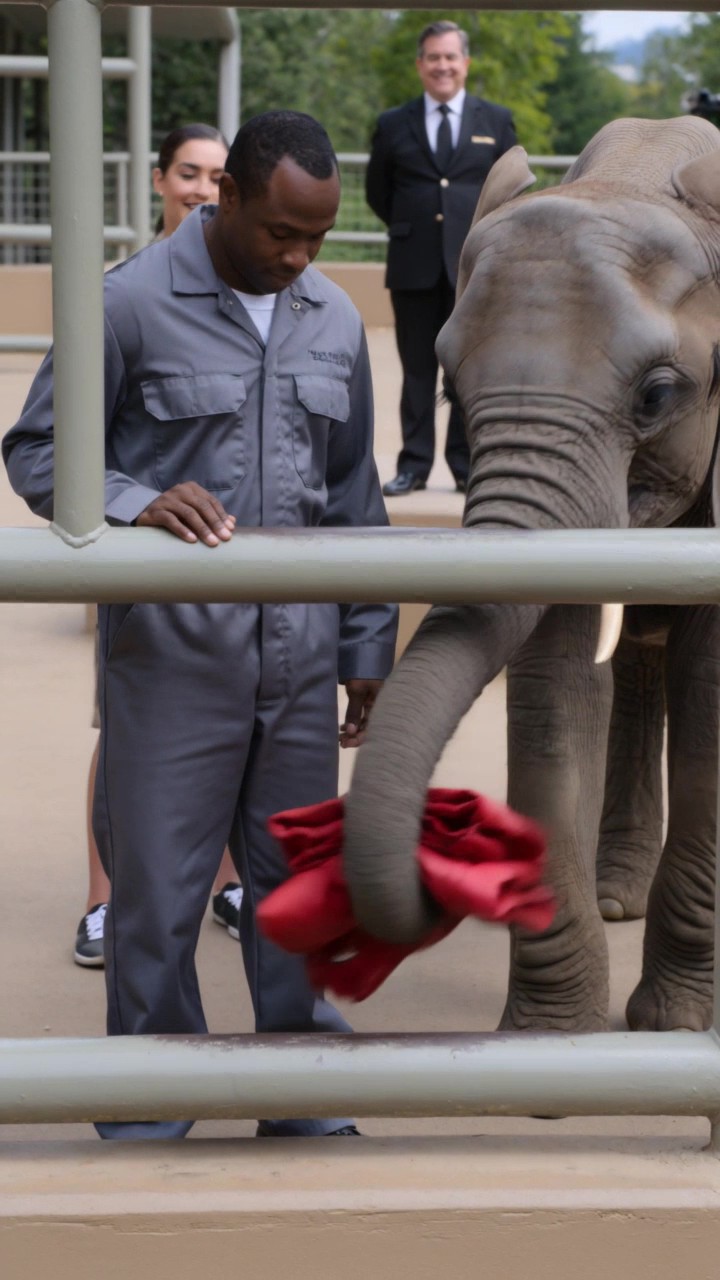
Elias Grant did not pull his wrist away.
Mara’s trunk rested lightly around it.
An elephant could crush bone without effort.
This was not force.
It was recognition.
The donor ceremony had been built around a simple story:
Floodwater entered the lower barn.
Trainer Preston Hale stayed calm.
Mara followed him to safety.
The zoo’s professional systems worked.
The truth was more complicated.
And therefore more useful.
Three years earlier, a severe storm overwhelmed the old drainage channel beneath Westbridge Zoo.
Water entered the elephant service barn after debris jammed a metal sluice gate.
Mara was in the lower stall.
Her calf had recently been transferred to another accredited zoo, and she had become anxious in unfamiliar conditions.
The emergency lights failed.
The upper-yard door opened, but the connecting corridor was dark and filling with water.
Preston and the keepers called her from the safe side.
Mara refused to move.
She backed deeper into the stall and struck the wall.
Elias was repairing a broken pump in the maintenance tunnel.
He heard the impact through the pipe network.
When he reached the elephant barn, keepers were waiting for a portable floodlight.
The water was rising faster than the equipment team could arrive.
Elias knew the service corridor because he had installed part of its drainage line.
He also knew the emergency gate was not fully open.
The lower hinge had seized after years of mineral buildup.
He entered the maintenance channel from the outer side.
Not the animal stall.
Not at first.
He used a long wrench to release the hinge, but the corridor remained dark.
Mara still would not enter it.
Elias carried a red raincoat because maintenance staff used bright colors in storms.
He hung the coat over a pipe at the far end of the corridor and struck the railing twice, paused, then once.
The vibration carried through the wet concrete.
Mara looked toward the color.
Elias moved the raincoat several feet.
Repeated the rhythm.
Step by step, the elephant followed the only bright object she could see.
When water entered the corridor behind her, Elias crossed the final safety barrier and walked backward in front of her.
He had no formal elephant-handling certification.
That was dangerous.
The keepers were correct to worry.
But he also had exact knowledge of the gate, the drainage slope, and the path that remained passable.
Mara reached the upper yard before the lower stall flooded.
Preston helped close the barrier and coordinated veterinary checks.
His role was real.
The public story made it complete.
Why?
The zoo feared criticism for allowing a maintenance employee into the protected animal area.
Insurance lawyers warned that praising Elias might appear to endorse unauthorized contact with a large animal.
The communications team wrote:
“Under the direction of senior trainer Preston Hale, Mara moved safely to higher ground.”
Elias disappeared inside the phrase.
He objected once.
His supervisor told him:
“Be glad the animal is safe. Do not create a liability problem.”
Elias needed his job.
He stayed quiet.
The red raincoat remained in a maintenance locker until the anniversary ceremony.
That morning, staff gathered flood objects for an educational display.
A keeper placed the coat near the enclosure rail.
Mara reached for it before the event began and carried it across the yard.
She did not bring it to Preston.
She brought it to Elias.
In front of the crowd, the young keeper who identified the tapping rhythm was named Leah Brooks.
During the flood, she had been an intern.
She remembered Elias asking:
“Will she follow color?”
Leah answered:
“She follows consistency.”
That was when he created the rail signal.
At the ceremony, Leah faced the zoo director.
“I wrote his name in my incident statement.”
The director looked at the trainer.
“Why was it removed?”
Preston did not deny knowing.
He said:
“The legal department wanted one accountable lead.”
Elias answered:
“A lead is not the same as the only person there.”
Preston’s face tightened.
“You entered a stall zone without approval.”
“Yes.”
“You could have caused a fatal incident.”
“Yes.”
Again, Elias did not rewrite risk as pure virtue.
The rescue worked because multiple types of knowledge converged.
Animal behavior.
Drainage systems.
Gate mechanics.
Environmental cues.
The failure came when the zoo ranked those contributions according to status and removed the least prestigious worker.
The ceremony ended.
Mara released Elias’s wrist only after he tapped the rail twice, paused, and tapped once.
The zoo launched an independent review.
It confirmed the emergency timeline through keeper statements, maintenance radio logs, floodgate damage, and veterinary notes.
Elias had opened the seized gate, established the visual and vibration cue, and physically guided Mara through the final corridor.
Preston had directed the animal staff, closed the safety barrier, and supervised post-evacuation care.
The revised record named both.
Preston lost his role as public safety spokesperson for allowing an incomplete account to become a personal rescue story.
He remained a senior trainer, a decision that divided staff.
Elias did not ask for his dismissal.
He asked the zoo to stop treating maintenance workers as invisible around animal safety.
New flood drills included plumbers, electricians, groundskeepers, cleaners, and food-preparation staff.
Every incident review required statements from all departments present.
A worker’s lack of animal certification could be evaluated without erasing the mechanical skill that made the rescue possible.
The old drainage system was replaced.
The seized gate hinge was mounted in the staff-training room beside the red raincoat.
No heroic plaque.
Only a question:
WHAT DID THE PERSON CLOSEST TO THE FAILURE KNOW THAT THE REST OF US DID NOT?
Elias remained a plumber.
The zoo offered him a public animal-rescue title.
He declined.
“I know pipes,” he said. “That is why I reached her.”
Leah later became an elephant keeper.
She kept the tapping rhythm in Mara’s emergency training.
Two.
Pause.
One.
It no longer belonged only to Elias.
That was appropriate.
Safety signals should spread.
Recognition should remain accurate.
Years later, Mara moved to a larger sanctuary.
On her final morning at Westbridge Zoo, several staff members stood along the transfer path.
Preston carried fruit.
Leah held the training target.
Elias wore the red raincoat.
Mara walked past everyone, touched the coat once with her trunk, then entered the transport enclosure.
She did not refuse to leave.
Remembering a protector is not the same as being unable to trust anyone else.
The doors closed.
Elias tapped the metal side twice.
Pause.
Once.
From inside, Mara answered with one soft strike.
The animal was moving forward.
The truth remained behind.




Leave a Reply