
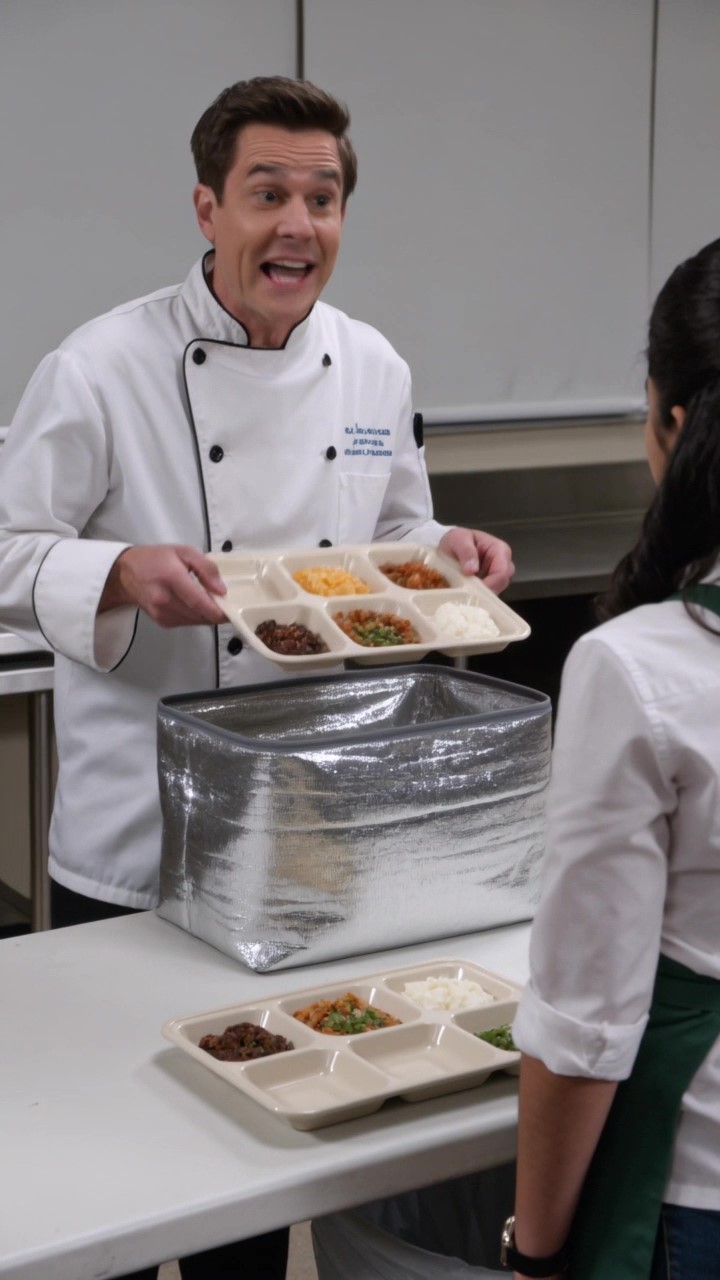
She won because the food met the assignment better than the other entries.
The humiliation forced everyone to confront why nobody had expected that result.
The Westbridge Youth Culinary Scholarship was sponsored by Hale Hospitality Group and the county’s senior-meal program.
Its public advertising showed elegant kitchens, white jackets, and young chefs plating colorful food.
The actual challenge was less glamorous.
Contestants had to prepare six complete meals for no more than eighteen dollars total.
Each meal had to:
Reheat safely after refrigeration.
Remain appealing after transport.
Stay within a specified sodium range.
Include protein, vegetables, and a soft fruit component.
Use ingredients available at ordinary supermarkets.
And be practical for older adults who might have limited strength, dental problems, or reduced appetite.
The winner would receive tuition for a community-college culinary program and a paid summer placement with the county meal service.
Elena understood the challenge immediately.
Her grandfather, Luis Morales, attended dialysis three mornings a week.
His medical team gave the family detailed food guidance.
Elena was not a dietitian.
She did not invent clinical rules.
She learned to follow the written limits, ask questions, and build meals around what her grandfather would actually eat.
Luis disliked food that looked like it had been processed into paste.
He also tired easily while chewing tougher meat.
Elena began making small patties from ground chicken, lentils, egg, herbs, and a measured amount of seasoning.
The lentils reduced the cost and kept the patty tender after reheating.
She roasted carrots until soft but still recognizable.
The rice used a light tomato base without the packaged seasoning her grandfather once preferred.
The apple compote came from bruised fruit discounted at the grocery store where Elena worked.
Nothing on the tray was accidental.
The meal cost $2.74 per serving.
That price included cooking oil, seasonings, packaging, and the portion of ingredients not used.
Elena knew because she had built the spreadsheet herself using grocery receipts.
She entered the competition after her school counselor saw the cost sheet attached to a class assignment.
Elena almost refused.
The registration fee was waived for students receiving meal assistance, but transportation, ingredients, and clothing still cost money.
Her mother worked hotel laundry.
Her father had died when Elena was eleven.
The family did not own professional knives.
Elena used two sharpened grocery-store knives and borrowed a thermometer from the school cafeteria.
Her insulated carrier came from a neighborhood church pantry.
One handle broke during practice.
Luis repaired it with silver tape and a small metal bracket.
Elena wanted to cover the repair before the final.
Her mother said:
“If it keeps the food at the correct temperature, the tape is doing a better job than decoration.”
Elena brought it as it was.
The finalists prepared their meals in a teaching kitchen.
Every tray received a number.
Names, schools, and family information were removed from the duplicate samples.
The judging panel consisted of a registered dietitian, a senior-meal kitchen director, a culinary instructor, and two older adults who regularly received delivered meals.
Preston Hale was the event host and sponsor representative.
He was not supposed to score the blind samples.
He was responsible for public presentation, student introductions, and photography.
During preparation, Elena followed every food-safety step.
She recorded temperatures.
Cooled the duplicate tray correctly.
Sealed it with Sample 14.
The second tray remained in her carrier for the public display.
The problem began when Preston saw the display area.
Other students had used colorful plates and herbs.
One finalist prepared salmon croquettes using a sponsor-donated ingredient.
Another created turkey roulade with individually piped vegetables.
Their food looked suited for cameras.
Elena’s tray looked like a meal someone might actually receive in a divided container.
That was the point.
Preston believed the sponsor brand needed ambition.
He told the students:
“The judges should see where cuisine is going, not where it has been.”
Then he saw Elena’s grocery apron and taped carrier.
The event staff had distributed white jackets, but the largest size ran out.
Elena’s assigned jacket would not close comfortably over her school shirt.
She chose the clean deli apron she had brought from work.
Preston interpreted the apron, carrier, and plain tray as one story:
A poor student had entered through a waiver and misunderstood professional standards.
He did not ask whether she had completed the technical brief.
He did not taste the food.
He tipped the tray into the waste bin.
The action violated competition rules.
Finalists’ displays could not be removed before scoring concluded.
It also exposed the belief beneath the polished scholarship language.
The organizers said they wanted practical meals for ordinary people.
The moment one appeared without decorative disguise, the sponsor called it embarrassing.
Inside the judging room, Sample 14 had performed well.
The patty reheated without becoming tough.
The vegetables remained intact.
The meal met the nutritional brief.
The cost sheet included every required expense.
The older judges said they recognized the food and could imagine eating it twice a month without becoming tired of it.
One judge disliked the apple compote’s texture.
Another thought the rice needed more acidity.
The tray was not perfect.
It still ranked first overall.
When the dietitian, Dr. Leah Brooks, entered to request the display sample, she found Preston beside the waste bin.
The duplicate saved Elena from losing the entire entry.
That did not make Preston’s action harmless.
Elena had watched food prepared with family money thrown away because it looked cheap.
Luis had helped test that meal through weeks of difficult appetite.
The tray carried labor, not symbolism.
Elena asked for the competition to continue.
She did not want the award granted as compensation for humiliation.
The organizers secured the remaining samples.
Preston was removed from the display area.
An independent staff member presented the finalists.
The judges completed scoring without names.
Sample 14 remained first.
Elena received the scholarship.
Second place went to the turkey roulade.
The salmon entry lost points because its true cost exceeded the limit once the donated ingredient was priced at retail.
That rule mattered.
A meal could not be called affordable only because a sponsor temporarily gave away the expensive part.
At the award presentation, Elena did not deliver a dramatic speech about becoming a famous chef.
She said:
“I want to learn how to make institutional food taste like someone expected the person receiving it to have preferences.”
The sentence spread online.
Preston issued an immediate apology.
His first version said he had acted out of concern that Elena’s display would weaken the professionalism of the event.
Dr. Brooks rejected the draft.
“That is an explanation of the prejudice, not an apology for it.”
The final statement was direct.
He admitted he judged Elena’s work by her clothing and equipment, discarded food without tasting it, and treated a low-cost meal as evidence of low standards.
Hale Hospitality funded replacement ingredients and contributed to the scholarship.
Elena insisted that the money not become a private gift to her.
The additional funds created an equipment library where future students could borrow insulated carriers, thermometers, knives, and correctly fitted jackets.
Borrowing equipment did not require proving poverty in front of classmates.
The scholarship program changed its presentation rules.
Blind judging remained blind through the final score.
Sponsor representatives could not remove or alter entries.
All ingredients were priced at ordinary local retail cost.
Practical packaging received equal respect with decorative plating.
Every student received clothing that fit or could wear a clean work uniform without penalty.
And the competition added a worker panel:
School cooks.
Home-care aides.
Meal-delivery drivers.
People who understood what happened after food left the photograph.
Elena began the community-college program that autumn.
The transition was difficult.
She knew home cooking and grocery preparation.
Professional knife speed, production planning, and written culinary terminology challenged her.
She failed one practical exam because her timing was poor.
She repeated it.
Passed.
The scholarship did not turn struggle into effortless destiny.
Her summer placement put her inside the county senior-meal kitchen.
She discovered that one excellent recipe could still fail at scale.
The chicken-and-lentil patties stuck to industrial trays.
The apple compote required too much labor.
Delivery containers trapped steam and softened the carrots.
Elena worked with the kitchen director to adjust the process.
The final menu used baked chicken-lentil meatloaf portions, roasted carrots, rice, and a simpler apple cup.
Luis tasted the institutional version.
He frowned.
“Yours is better.”
Elena laughed.
“It has to feed eight hundred people.”
“Then eight hundred people deserve more pepper.”
His medical guidance limited some seasonings but not every herb.
The kitchen adjusted the herb blend.
The meal entered a rotating menu after nutritional and safety review.
Not because Elena’s family story made it sacred.
Because older recipients rated it well and costs remained stable.
Preston visited the program once as part of the sponsor agreement.
He wore a hair covering and worked a packaging station under supervision.
Cameras were not allowed.
Elena did not need a scene where he tasted the meal and cried.
He needed to learn the repetitive labor behind one tray.
After the shift, he asked:
“Do you want to work in my restaurants after college?”
Elena answered:
“I do not know yet.”
The scholarship did not purchase her career.
She wanted experience in hospitals, schools, restaurants, and community kitchens before choosing.
Luis died two years later after a period of declining health.
Elena kept the dented carrier.
The silver tape dried and began peeling.
She did not put it in a museum.
She replaced the handle.
Tools are allowed to keep working after the story people attach to them becomes sentimental.
At graduation, Elena wore a white culinary jacket that fit.
Her mother arrived directly from the hotel laundry in a blue work uniform.
Nobody directed her toward a service entrance.
Elena carried one sealed Sample 14 tray into the family dinner afterward.
She placed it beside the roast chicken and salad.
Not as poverty food.
Not as award food.
As the meal her grandfather had helped her make practical.
Years later, Elena joined the county meal program as a menu-development cook.
During a student competition, she saw a boy arrive with a slow cooker wrapped in an old towel.
The event assistant whispered:
“That looks terrible on the table.”
Elena asked the boy:
“Does the towel keep the temperature stable?”
“Yes.”
“Then we judge the food and the data.”
The towel stayed.
The student did not win.
His recipe was too salty.
He received clear feedback and returned the next year.
That was the reversal Elena wanted to preserve.
Not that every poor student secretly had the best entry.
That no student’s work would be thrown away before anyone bothered to find out.




Leave a Reply