
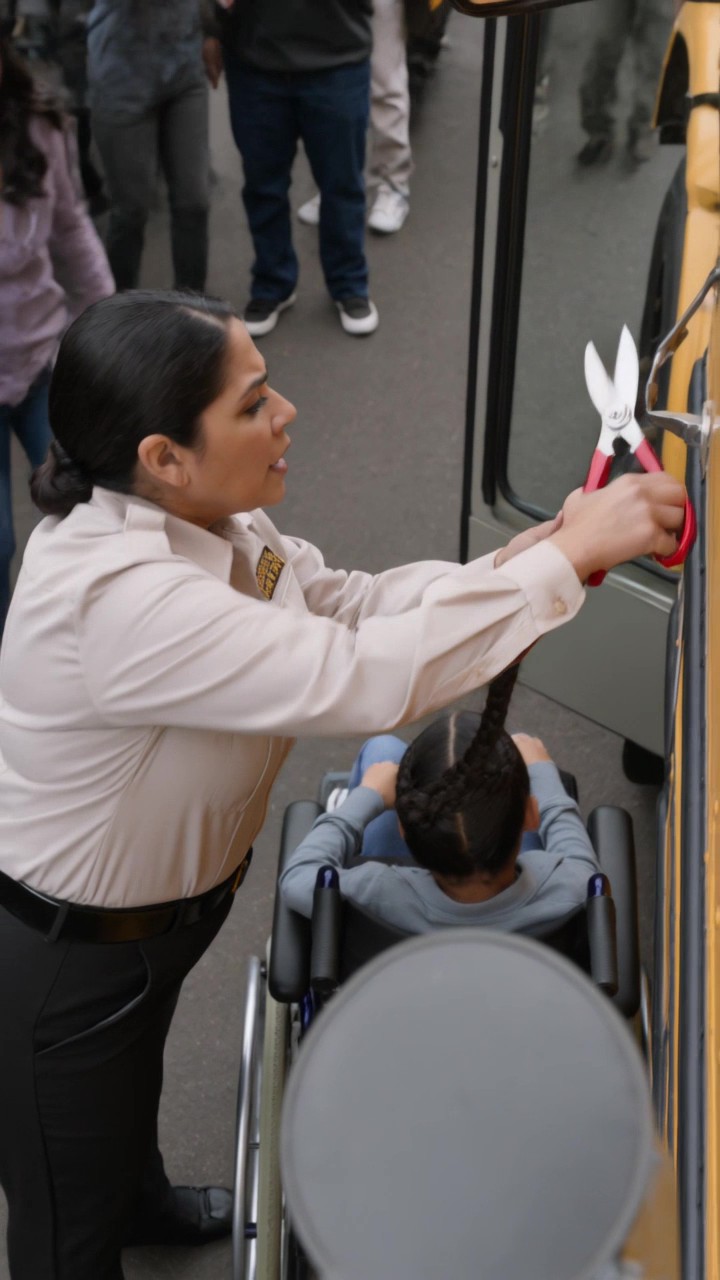
The wheelchair lift remained locked halfway between the pavement and the bus floor.
Ava’s severed braid was wrapped so tightly around the exposed drive shaft that the maintenance mechanic needed pliers to remove it.
Nobody in the loading zone had to imagine what would have happened if Marisol had waited.
The hydraulic motor had enough force to pull a wheelchair platform carrying hundreds of pounds.
Hair would not have stopped it.
Ava touched the side of her head.
Her hair was uneven.
Her scalp hurt where the braid had tightened.
But she was sitting upright.
Breathing.
Safe.
Vivian Brooks stood beside her daughter with tears on her face.
The anger had not disappeared.
It had changed direction.
She looked at Preston.
“Why was the guard missing?”
He stared at the exposed hinge.
“It was installed during the last inspection.”
Marisol shook her head.
“No. It was loose on Monday.”
Everyone turned toward her.
She had reported a rattling plate after the morning route. The transport office told her the bus would be checked after the school-photo schedule ended.
On Wednesday, the plate was gone.
Marisol reported it again and was told to keep long clothing clear of the lift until Friday maintenance.
The message treated loose fabric as the only risk.
Nobody considered hair.
Marisol did.
She had spent seven years assisting students who used mobility equipment. She checked belts, footrests, backpack straps, coat cords, and anything that could enter a moving hinge.
That morning, Ava’s braid had been tucked behind her shoulder when she boarded.
During unloading, she turned to answer a classmate.
The braid slid over the wheelchair handle and fell beside the lift joint.
Marisol saw the purple bead disappear beneath the metal edge.
She pressed stop.
The platform drifted another inch.
The braid tightened.
Ava’s head pulled backward.
Marisol took the emergency shears from the first-aid pouch.
There had been no time to explain the decision before making it.
Vivian looked at the cut hair trapped inside the motor.
“Why didn’t the lift stop completely?”
The mechanic tested the control.
“The hydraulic lock is also slipping.”
Preston went pale.
Two defects.
One bus.
Children loaded every day.
The transport supervisor arrived and tried to describe the problem as an unfortunate maintenance oversight.
Marisol answered:
“An oversight is something nobody saw. I reported this twice.”
Ava looked at her mother.
“She said the lift was making a bad sound yesterday.”
Vivian closed her eyes.
Her daughter had mentioned it at dinner.
Vivian had assumed school transportation would handle it.
Trust had moved through too many adults without stopping anywhere long enough to become action.
The district removed the bus from service.
Inspection found the missing guard, worn hydraulic lock, and incomplete maintenance follow-up. Three other accessible buses had unresolved lift reports.
The transport contractor suspended Preston for moving the platform after Marisol’s warning.
Marisol objected to making him the only problem.
“He followed the supervisor’s order because the lane was blocked,” she said. “The system teaches drivers that schedule pressure matters more than the aide beside the machine.”
Preston heard that statement during the review.
He later apologized to Ava and Marisol without asking them to defend him.
“I believed ‘child clear’ meant danger over,” he said.
Marisol replied, “Machines keep holding what people stop looking at.”
Vivian’s apology was harder.
She met Marisol in the school office after taking Ava to a salon.
Ava had chosen a short, uneven bob rather than cutting everything to the same length immediately. She wanted one side left slightly longer until she felt ready.
Vivian placed the purple bead on the table.
“I pushed you.”
Marisol nodded.
“I thought you were hurting her.”
“I know.”
“I also thought her hair mattered more than listening to you.”
Marisol looked toward Ava.
“The hair mattered to her. Saving her does not make the loss meaningless.”
That answer allowed Vivian to grieve without turning grief back into accusation.
Ava had grown the braid for years.
Her older sister made the purple bead from polymer clay and gave it to her on the first day she rode the accessible bus alone.
The bead meant independence.
After the accident, Ava asked Marisol to help attach it to a short cord on her wheelchair backpack.
Not as a memorial to lost hair.
As a reminder that independence includes people who know when to intervene.
The district rewrote lift procedures.
Accessible vehicles could not remain in service with missing guards, abnormal sounds, hydraulic drift, or unresolved aide reports.
Drivers, aides, students, and families all received clear emergency-stop guidance.
Every lift carried shears and a belt cutter within reach.
Most importantly, aides gained authority to remove a bus from service without waiting for supervisor approval.
Marisol returned to Bus 18 only after repairs were complete.
On the first morning, Ava waited at the curb wearing the purple bead on her backpack.
Her new hair moved freely above her shoulders.
Marisol lowered the lift and checked every guard.
Ava watched her.
“Nervous?”
“Yes,” Marisol said.
“Me too.”
Neither pretended safety meant fear disappeared.
Ava rolled onto the platform.
Before Marisol raised it, Ava gathered her backpack straps, checked her sleeves, and pointed at the hinge.
“Clear.”
Marisol nodded.
“Clear.”
The platform rose smoothly.
At school, another student asked Ava why she had cut her hair.
Ava corrected him.
“I didn’t.”
She looked at Marisol.
“She cut the part the machine had already taken.”
The sentence spread through the transportation team.
Not as praise.
As instruction.
When a machine has already begun pulling, saving someone may require damaging the thing everyone can see before it reaches the person they cannot replace.



Leave a Reply