
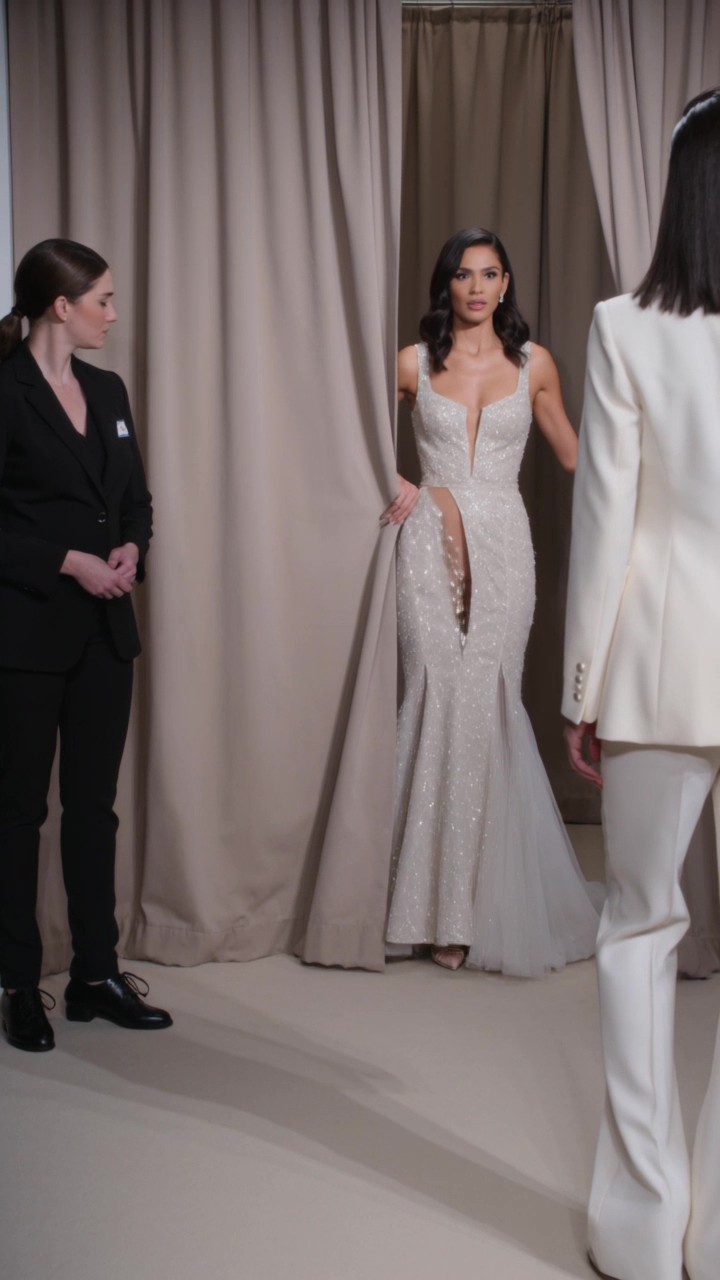
The runway music continued for fourteen seconds without a bride.
Behind the curtain, Rosa Bell tightened the final support stitch and stepped back.
The gown remained upright.
The bride, Grace Whitmore, breathed carefully.
“Can I walk?”
Rosa checked the waist tension.
“Short steps. Do not twist until you reach the center mark.”
Celeste Hart stared at the opened lining.
The dress still looked beautiful from the outside.
Silver vines climbed across ivory silk.
Pearls gathered around the waist.
A long train flowed behind it like light on water.
Inside, the structure told another story.
No support band.
No reinforced waist stay.
No distribution strap carrying the weight of the beading.
The dress had copied a shape without understanding what made the shape possible.
Grace looked at Celeste.
“Did she design this?”
Celeste answered:
“This is not the time.”
Rosa stood.
“That is what you said eight years ago.”
The stage manager called:
“Twenty seconds.”
Grace looked toward the runway entrance.
Then at Rosa.
“What happens if I wait?”
“The live show fails.”
“What happens if I walk?”
“The dress should hold.”
“Should?”
Rosa did not offer false certainty.
“I repaired a major structural omission in less than one minute.”
Grace nodded.
“Then you walk beside the curtain.”
Celeste objected.
“This is my presentation.”
Grace held the bodice.
“It was almost my public humiliation.”
She stepped onto the runway.
Rosa remained in the wing, watching the silver train.
One step.
Two.
Three.
The hidden ribbon carried the bead weight.
At the center mark, Grace stopped beneath the cameras.
The gown held.
The audience applauded.
Celeste’s collection survived the moment that could have ended it.
That was the rescue.
What came afterward was not forgiveness.
Eight years earlier, Rosa had worked as a senior sample seamstress in Celeste’s first bridal studio.
She did not attend design school.
Her mother taught her patternmaking in a small alterations shop.
Rosa understood how fabric behaved after hours of wear.
Where weight gathered.
Which seams looked decorative but carried the body of a garment.
Celeste was talented at silhouette, color, and presentation.
Rosa was skilled at translating drawings into clothing a person could actually move inside.
During one winter collection, Rosa developed the silver-vine bridal concept.
A fitted bodice.
Pearl vines.
A floating train supported by an internal ribbon structure that moved weight away from the back seam.
She marked the first sample with one blue basting stitch inside the lining.
Her mother had used blue thread whenever a hidden structure mattered.
“Beauty is what they see,” her mother said. “Blue is what keeps it standing.”
Celeste presented the concept to investors.
She called it her breakthrough design.
Rosa objected privately.
She asked for construction and design credit.
Celeste accused her of copying sketches from the studio office.
Because Celeste owned the company, the contracts, the photographs, and the public name, people believed her.
Rosa was fired.
Other fashion houses received warnings that she mishandled proprietary designs.
For years, Rosa found only small alterations jobs.
Uniform hems.
Zippers.
Emergency hotel repairs.
She kept her mother’s silver thimble and stopped sketching.
Celeste’s brand grew.
The silver-vine motif became her signature.
But the original internal ribbon structure required time and handwork.
To reduce production cost for the televised collection, the studio removed it and relied on fusible support inside the bodice.
That held during fittings.
It failed beneath the full pearl weight and runway movement.
Celeste had taken the visible design.
The part she never understood was the part that broke.
After Grace completed the runway, reporters crowded backstage.
Celeste began a statement about “an unexpected technical adjustment.”
Grace interrupted.
“Name the technician.”
Celeste looked at Rosa.
Cameras turned.
Rosa did not smile.
She did not use the moment to humiliate Celeste while the dress was still on Grace’s body.
“Get the bride changed safely first,” she said.
That choice mattered.
Rosa would not turn another woman into evidence during a public fight.
In the dressing room, she removed the gown and showed Grace how close the seam had come to complete failure.
Grace was more than a celebrity bride used for promotion.
She sat on the hotel carpet in a robe and asked:
“What do you want me to do?”
Rosa answered:
“Tell the truth about tonight.”
“And eight years ago?”
“That truth needs more than my word.”
The proof arrived from people Celeste had assumed would remain silent.
Emma Cole, a junior patternmaker, had worked in the old studio. She kept photographs of the original muslin because Rosa taught her how to build the support ribbon.
Marcus Bell, a retired cutter, remembered Rosa stitching the blue marker into the first sample.
And Nora Chen, Celeste’s former production manager, had saved an email in which Celeste ordered the sample relabeled before the investor presentation.
The story did not depend on one readable screen during a dramatic scene.
It depended on people who finally agreed to testify when Rosa was no longer alone.
Celeste met Rosa in a private hotel office.
“You saved the show.”
“Yes.”
“You could have let it fail.”
“Yes.”
“Why didn’t you?”
Rosa placed the silver thimble on the desk.
“Grace did not steal my design.”
Celeste looked down.
“And me?”
“You did.”
The answer remained between them.
Celeste offered Rosa money.
Then a creative-director title.
Then public co-credit on the next collection.
Rosa refused all three.
“You are offering me a place inside the company that erased me.”
“What do you want?”
“A correction.”
Celeste’s face tightened.
“A public accusation will destroy the brand. Hundreds of employees depend on it.”
Rosa understood.
That was the hardest part.
Accountability would not affect only Celeste.
Pattern cutters.
Pressers.
Receptionists.
Warehouse staff.
People who had never known the original theft.
Rosa did not want revenge disguised as justice.
She proposed a structured correction.
Celeste would publicly identify Rosa as the original co-creator of the silver-vine design.
The company would compensate her for eight years of use.
The studio would establish written credit and royalty rules for sample makers, cutters, embroiderers, and construction specialists whose technical work materially shaped a design.
An independent labor representative would review disputes.
And Celeste would step away from sole creative control while the board investigated past attribution practices.
Celeste agreed only after Grace refused to endorse the collection otherwise and the witnesses prepared formal statements.
The correction damaged the brand.
Several sponsors left.
Sales fell for one season.
Some employees lost overtime.
Those costs were painful.
They were also not Rosa’s responsibility to absorb forever so the company could preserve a profitable lie.
Celeste remained a shareholder but resigned as chief creative officer.
She did not become Rosa’s friend.
She did begin naming construction collaborators in later independent work.
Whether that change came from remorse, necessity, or both did not matter as much as the structure that made credit harder to steal.
Rosa used part of the settlement to open Blue Thread Atelier.
Not a luxury house centered on her name.
A worker-owned studio where every garment listed the people who designed, patterned, cut, embroidered, fitted, and finished it.
The first object mounted above the cutting table was her mother’s silver thimble.
Under it were the words:
SAVE THE PERSON.
SAVE THE WORK.
DO NOT SAVE THE LIE.
Grace commissioned her actual wedding gown from the atelier.
She did not ask for silver vines.
Rosa designed something simpler.
Soft ivory fabric.
No pearls.
A visible blue line inside the hem naming every person who made it.
At the wedding, Celeste attended as a guest.
She and Rosa exchanged one quiet nod.
No embrace.
No performance of reconciliation.
Celeste had once destroyed Rosa’s career.
Rosa had later saved Celeste’s runway from collapsing.
Neither action canceled the other.
Rescue revealed Rosa’s character.
Accountability revealed whether Celeste was willing to change after being rescued.
Years later, young seamstresses asked Rosa why she repaired the gown instead of letting the stolen design fail publicly.
Rosa always answered:
“Because the bride was wearing it.”
Then she held up the silver thimble.
“You never punish the innocent body inside the garment to teach the thief outside it a lesson.”





Leave a Reply