
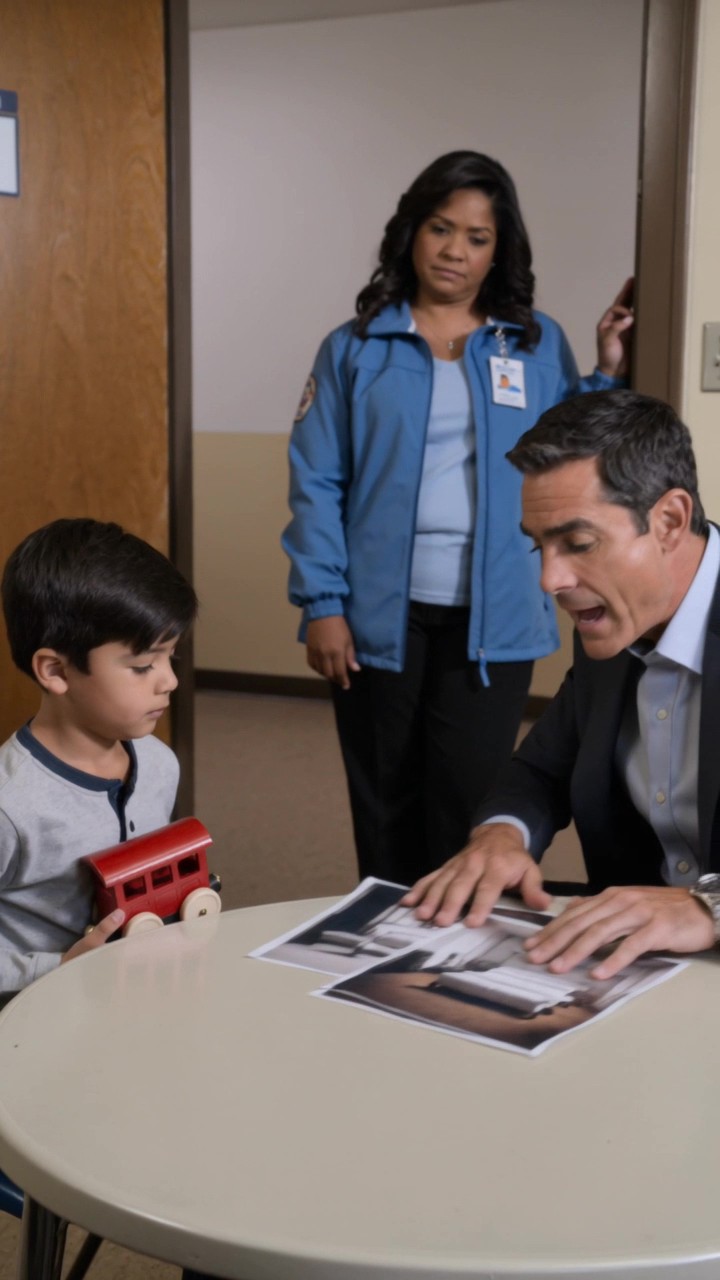
Nobody in the placement room moved.
Eli stood against Marisol Vega with his face pressed into the blue school-bus jacket.
The red wooden train rested in her open palm.
Charles Whitmore looked at the photographs of his house.
For the first time, they appeared to be photographs of rooms rather than proof of love.
Dana Brooks closed her notebook.
She did not declare Marisol the legal guardian.
A child’s choice matters.
It does not erase background checks, home studies, family law, or safety review.
But it changes what responsible adults are required to notice.
Dana spoke calmly.
“Eli will remain with the temporary caregiver he identifies as safe while we complete the assessment.”
Charles stood.
“You are allowing an eight-year-old in acute grief to make a legal decision?”
“No,” Dana said. “I am refusing to force an immediate placement with an adult he barely knows while he is showing clear distress.”
Marisol crouched slowly.
“Eli, may I hold the train?”
He tapped once.
Not yet.
She kept her palm still.
Charles watched.
“What did that mean?”
Marisol looked at him.
“He is not ready for me to move it.”
The uncle’s face changed.
Not because the signal was complicated.
Because nobody had taught him that Eli’s smallest actions contained answers.
Charles sat down.
“When did he start doing that?”
“On the bus.”
“Why?”
“Rachel said he used to tap the window when noise became too much. We turned it into a signal so he would not have to explain while upset.”
Charles looked at his nephew.
“I did not know.”
Marisol answered without cruelty.
“You were not there enough to know.”
The sentence hurt.
It was also true.
Charles had paid some of Rachel’s medical bills.
He had sent grocery cards.
He had offered to move her into a private facility two states away.
Rachel refused because it would have separated Eli from school and routine.
Charles interpreted refusal as stubbornness.
He solved problems with distance, money, and plans.
Marisol solved them by being at the bus stop at 4:12.
Both forms of help had value.
Only one had taught Eli where safety lived.
Dana asked Charles to describe his most recent afternoon alone with Eli.
He could not.
She asked what Eli ate before school.
He guessed cereal.
Marisol knew it was dry toast cut into narrow strips.
She knew he wore socks inside out because the seams bothered him.
She knew the red train was not simply a comfort toy.
Rachel had bought it at a hospital gift shop during Eli’s first long wait. Whenever they returned home, she rolled it across the kitchen table and said:
“Next stop, home.”
That was why Eli had chosen the word.
Charles looked at the train differently.
“I thought buying a new set would help him move forward.”
Marisol shook her head.
“Moving forward does not require throwing away the thing that got him here.”
The temporary placement went to Marisol.
Not forever.
For ninety days while the court reviewed Rachel’s wishes, Marisol’s home, Charles’s petition, and Eli’s adjustment.
Charles was granted structured visits.
The first one went badly.
He brought a large electric train set.
Eli stayed in his room.
Marisol did not rescue Charles from discomfort.
She said only:
“He did not ask for a replacement.”
The next week, Charles returned with no gift.
He sat at the kitchen table.
Marisol placed the red train between them.
Charles tapped once.
Eli watched from the hallway.
Charles waited.
After several minutes, Eli came closer.
That was the first real visit.
The court eventually appointed Marisol as Eli’s guardian, with Charles maintaining family visitation and financial responsibility.
The decision did not declare Charles unfit or evil.
It recognized that guardianship is not a prize awarded to the adult with the largest house.
It is a commitment to learn the child who actually exists.
Charles funded the repair of the red train through a local woodworker.
Eli refused a new wheel.
He wanted the original peg left visible.
The woodworker added a small removable wheel that could turn around it without hiding the damage.
Marisol approved.
“The repair should help it move,” she said, “not pretend it was never broken.”
Years later, Eli kept the train on his desk.
He spoke more.
Some days easily.
Some days not.
The double-tap remained.
At school assemblies, family dinners, doctor appointments, and crowded rooms, Marisol still listened for it.
Knock.
Knock.
Nobody is asking you to answer yet.
Charles learned too.
He never became the person Eli chose first.
That loss stayed with him.
But he became an uncle who arrived on time, sat without filling silence, and understood that love does not become false because it was learned late.
Near the front door of Marisol’s apartment, the red train sat on a narrow shelf.
Beneath it was a handwritten card:
HOME IS THE PERSON WHO KNOWS WHEN TO STOP ASKING AND STAY.






Leave a Reply