
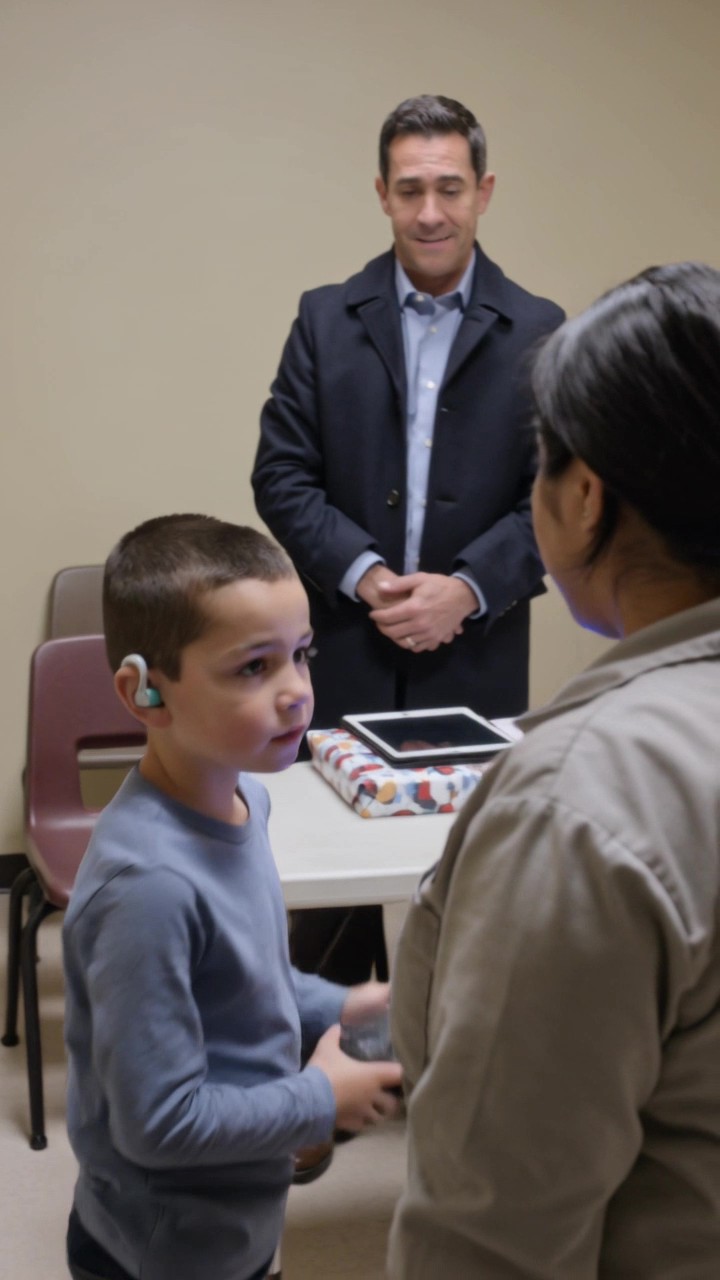
Maria did not wrap her arms around Jonah immediately.
She looked at Ms. Reed.
The caseworker nodded.
Only then did Maria kneel and let Jonah lean into her shoulder.
That small pause told Ms. Reed more than Victor’s home study folder had told her in forty pages.
Maria did not treat Jonah’s fear as proof he belonged to her.
She treated his consent as something worth waiting for.
Victor stood beside the table, humiliated.
“He is attached because she has had unrestricted access for four months.”
Maria looked up.
“He is attached because his mother died.”
The room went silent.
She continued gently.
“Attachment is not a trick. It is what children build when the world stops feeling stable.”
Victor looked at Jonah.
“I can learn the signals.”
Maria nodded.
“You should.”
The answer surprised him.
She did not want to erase him.
She wanted him to stop treating blood as proof of competence.
Ms. Reed asked Jonah whether he wanted the hearing aid turned back on.
He nodded.
Maria opened the small battery case clipped inside his backpack, replaced the battery, and waited while he adjusted the volume himself.
Victor watched every movement.
“You carry spare batteries?”
“Three sets.”
“You know how to program it?”
“No. I know when to call the audiologist and when not to pretend.”
That answer mattered too.
Real protection was not acting like an expert in everything.
It was knowing what the child needed and who to ask when you did not.
The placement review continued for weeks.
There were home visits.
Interviews.
Medical consultations.
A sign-language evaluation.
Victor’s house was larger.
His finances were stronger.
His school district had better statistics.
But he had never visited Jonah’s classroom.
He did not know the child removed his hearing aid when overwhelmed.
He did not know humming refrigerators made sleep difficult.
He did not know Jonah ate apple slices only if the skin was left on because Elena used to call them “red moons.”
Maria knew.
Not because she was naturally more loving.
Because she had done the daily work of paying attention.
Victor began doing it too.
At first, badly.
He learned Jonah’s name sign.
He took a beginner signing class.
He stopped buying expensive tools before asking whether Jonah wanted them.
He visited the bicycle shop and sat on an overturned milk crate while Jonah sorted colored reflectors.
One afternoon, Victor admitted the truth to Maria.
“I thought taking him proved I had not failed my sister.”
Maria tightened a wheel nut.
“Children are not proof.”
He nodded.
“I know that now.”
The final arrangement was not the winner-takes-all ending Victor expected.
Maria became Jonah’s permanent guardian.
Victor received structured family visitation that expanded as he learned to communicate and show up consistently.
The decision did not say Maria was better because she was poor and he was rich.
It said Jonah’s existing secure attachment should not be broken simply because a wealthier relative appeared late.
Victor helped pay for a second bedroom above the bicycle shop.
Maria resisted at first.
Then Jonah signed:
More room for wheels.
So they accepted.
The blue bicycle light was mounted beside Jonah’s bed.
A second matching light was installed in Maria’s room.
A third went to Victor’s house.
One night, during another winter blackout, all three lights blinked across a video call.
Three slow flashes from Jonah.
Three from Maria.
After a pause, three from Victor.
He was learning.
Not replacing.
Learning.
At the bicycle shop, Maria placed a small sign near the repair counter:
SAFETY IS NOT WHO ARRIVES WITH THE BIGGEST PROMISE. IT IS WHO LEARNS THE SIGNAL AND ANSWERS.
Jonah grew older.
The blue light eventually became unnecessary.
But he kept it in a drawer.
Not because he still feared darkness.
Because it reminded him that when adults asked him to choose, the right person did not pull him closer.
She waited for him to cross the room himself.





Leave a Reply