
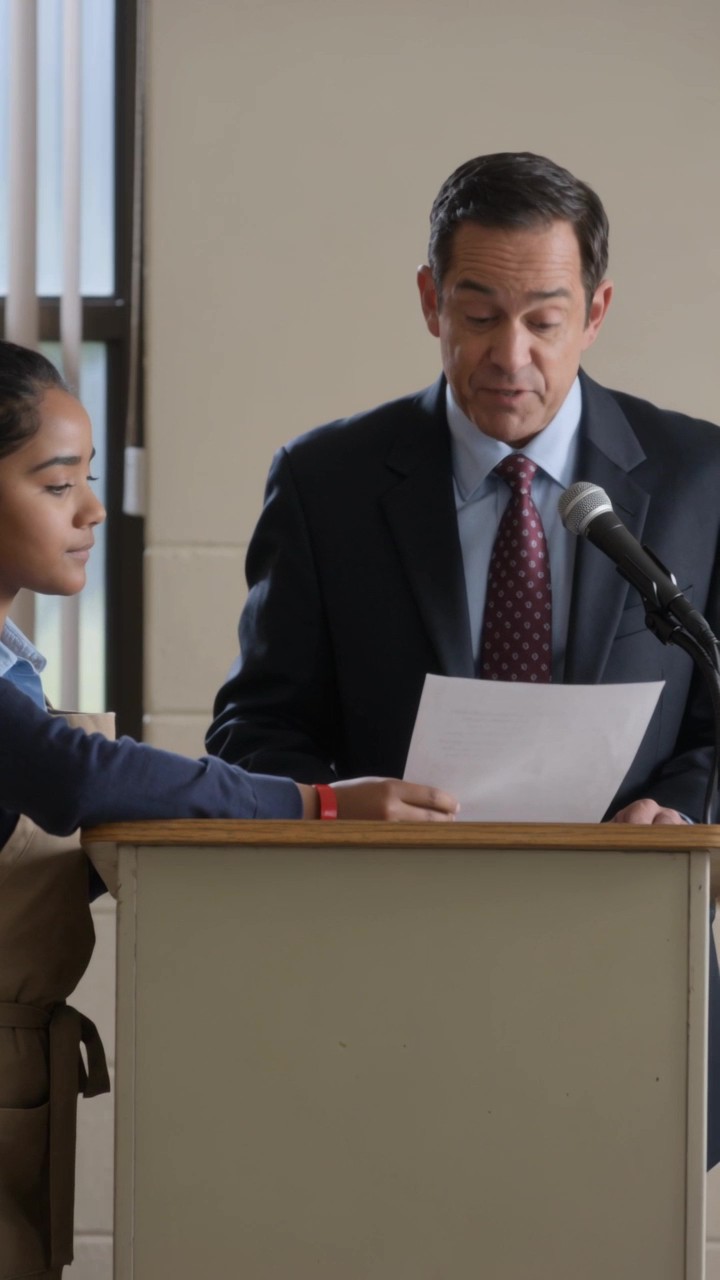
Nora Bell did not handle the situation perfectly.
She raised her voice in front of children.
She pulled the cupcake box away so abruptly that several students cried.
She told Caleb, “Do not touch that,” with more force than an eight-year-old could understand.
Those facts were true.
They were not the same as the apology Charles Whitmore wanted her to read.
The after-school club had received cupcakes from a local bakery owned by a parent sponsor. The bakery sent a card stating the cupcakes were nut-free. That card was wrong. A temporary employee had used almond flour in one batch and placed the wrong allergen sticker on the box.
The school’s allergy procedure required three checks before outside treats reached students: donor label, classroom list, and visible student allergy marker for younger children whose parents requested one.
Caleb’s parents had requested the red bracelet because after-school activities involved rotating staff and volunteers. The bracelet was not meant to shame him. Caleb liked it at first because it had a small rocket sticker. Later he found it itchy during hot days and sometimes tried to remove it.
On sponsor photo day, Charles wanted clean images for the district newsletter. Caleb stood beside the bakery donor holding a tray. The red bracelet showed clearly in the photo. Caleb scratched at it. Charles removed it, intending to return it after the photographs.
Then a board member arrived.
Then a phone call.
Then the bracelet stayed in his pocket.
Later, Charles placed it in his desk drawer with donor envelopes and forgot it.
That mistake alone could have been corrected.
Instead, when Nora stopped Caleb from eating the cupcake, Charles protected the image of control.
Nora had worked food service for twenty years. She knew Caleb’s allergy because she prepared his alternate snacks twice a week. When she saw the bakery box, she checked the club list and noticed the bracelet missing. She asked the student volunteer whether Caleb’s parent had updated his allergy status. The volunteer did not know.
Nora lifted one cupcake and smelled almond.
That was not a formal test.
It was enough to stop service and call the nurse.
Before she reached the office phone, Caleb picked up a cupcake because other children were already eating. Nora shouted and pulled the box away.
Caleb was startled and embarrassed. His father heard the story from another parent before the nurse completed the review. Charles saw the sponsor becoming upset and the father demanding an explanation.
The fastest story was:
A cafeteria aide overreacted.
The more difficult story was:
The principal removed a safety bracelet for photos, the donor label was wrong, and the school’s outside-food procedure failed.
Charles chose the fast story.
He placed Nora on administrative review and drafted the apology. He did not mention the missing bracelet in the first incident summary. He wrote that Caleb “had no visible allergy marker at the time.” Technically true. Deceptive by omission.
The custodian, Maria Alvarez, discovered the bracelet because she repaired a loose drawer glide in Charles’s office after school. She photographed the open drawer before moving contents, as maintenance policy required when working near private documents. The red bracelet appeared clearly in the image.
Maria also remembered seeing Charles remove the bracelet during photos. She had been replacing a trash liner in the hallway. She did not understand its importance until she heard Nora was being made to apologize.
At the parent council meeting, Maria did not intend to create drama. She planned to hand the photo quietly to the school nurse. But when Charles demanded Nora read the full statement, Maria spoke.
The room shifted because the evidence was physical and immediate.
The nurse confirmed the bakery error through ingredient records. Caleb had not eaten the cupcake. He was frightened, but medically safe. The father’s anger turned from Nora to the adults who allowed the wrong situation to exist.
Charles tried to describe it as a chain of misunderstandings. The district investigation called it a preventable safety failure followed by an inaccurate disciplinary narrative.
The bakery accepted responsibility for the labeling error. Its owner retrained staff, added two-person allergen verification, and suspended donation deliveries until the system was reviewed.
The school changed more.
No safety marker could be removed for photographs unless a parent approved and an immediate replacement indicator was used. Outside food had to remain unopened until the nurse or trained designee checked it. Donor events could not bypass health procedures. Incident summaries had to include who removed, changed, or failed to replace safety identifiers.
Nora received a written correction and back pay for the review period. The district removed the proposed apology from her file. She still chose to apologize privately to Caleb for frightening him.
“I was loud because I was scared,” she said.
Caleb nodded.
“My bracelet was in the drawer.”
“Yes.”
“Did you know?”
“No. I knew something was wrong.”
His father apologized to Nora publicly at the next council meeting. He did not make a speech about forgiving her. He said:
“I blamed the adult who stopped the cupcake before asking who removed the warning.”
That sentence mattered.
Charles lost authority over student health and sponsor events for the rest of the year. He remained principal under corrective supervision after the district board considered termination. Some parents thought that was too lenient. Others believed the documented discipline, retraining, and loss of authority were proportionate. Nora did not decide his punishment.
She requested one thing:
“No apology statement should be written before the facts are complete.”
The district added that line to staff training.
Maria, the custodian, received criticism from one administrator for speaking out in a public meeting. The superintendent rejected the complaint. Maintenance documentation had preserved evidence. Speaking when a false apology was being forced was protected.
The parent council also changed its meeting practice. Employees accused in incidents could bring a representative. Public apologies involving student safety required completed fact review. Families still had the right to receive explanations and accountability, but not a staged confession built to protect a sponsor.
Caleb continued wearing a new bracelet with softer material. He chose a dinosaur sticker instead of a rocket. On the first day back at after-school club, Nora placed a sealed fruit cup on the table and asked him to check the label with her.
“What if it says wrong?” he asked.
“Then we stop,” she said. “Stopping is allowed.”
That became the lesson.
The apology on the podium had tried to make stopping sound like the harm.
The bracelet in the drawer showed that stopping was the only reason the harm remained a meeting instead of an ambulance call.







Leave a Reply