
Miles Carter was not taken from school that afternoon.
The real Eli Brooks remained inside the office until staff corrected the paperwork and verified his emergency placement.
Celeste Hart, the retired caseworker assisting the county as a temporary transport aide, did not drive the wrong child away.
That outcome depended on a detail most adults had stopped seeing.
A backpack.
Leah Brooks had grown up in the foster system. At fourteen, she reported that a foster parent’s adult son entered her room at night and threatened her if she told anyone. Her assigned caseworker at the time was Celeste.
Celeste was overloaded.
She carried too many cases.
She had known the foster parent for years.
The home looked clean during visits.
School attendance was good.
Leah’s grades were unstable, and previous reports from another placement had described her as oppositional.
Celeste wrote in one note that Leah appeared “attention-seeking and resistant to placement stability.”
That phrase followed Leah.
It delayed her removal from the home by six weeks.
Another child’s report finally triggered a full investigation. Leah was moved. The foster parent’s license was suspended. The adult son left the household before investigators interviewed him. The case outcome was messy and incomplete.
Celeste later admitted privately she had misread the situation.
She never found Leah to apologize.
Leah carried the sentence “attention-seeking” for years.
It appeared in files people used to decide whether she was credible.
She eventually became a reading tutor and later a family-support advocate, not because one injustice transformed her neatly into a rescuer, but because she understood how much weight small official words could carry.
On the day of the pickup-lane incident, Leah was at Westbridge Elementary for a tutoring meeting.
The school had two emergency child-welfare pickups scheduled within the same hour.
Eli Brooks was being transferred to a temporary kinship placement because his mother was hospitalized and no approved adult could stay overnight.
Miles Carter was supposed to remain at school until his mother arrived with a protective-order copy. His father’s associate had attempted to contact the school earlier that day.
Both boys were nine.
Both had brown hair.
Both were frightened.
Both were sitting in the office while staff handled phone calls, forms, and a printer jam.
The school printed emergency packets from two different systems.
One packet contained Eli’s release authorization, medical notes, and a red backpack description because Eli’s medication traveled in that bag.
The other packet contained Miles’s no-release alert and a note that unauthorized adult contact had been attempted.
During the printer jam, pages came out mixed.
A front-office clerk matched the top sheet to the wrong packet.
Celeste arrived to transport Eli.
She checked the form, saw a name, signed the pickup log, and brought the child to the car.
The boy did not correct her.
Children in custody and safety situations often learn that correcting adults makes things worse. Miles had been told to wait quietly. When Celeste called “Eli,” he looked at the aide. The aide nodded because the packet said Eli.
Miles obeyed.
Leah saw him in the back seat while crossing the pickup lane.
She did not know Miles personally.
She had tutored Eli for eight weeks.
Eli carried a red backpack with a white inhaler tag clipped inside the front pocket. He showed it to Leah every session because his mother reminded him constantly not to forget it.
The boy in Celeste’s back seat held a blue dinosaur backpack.
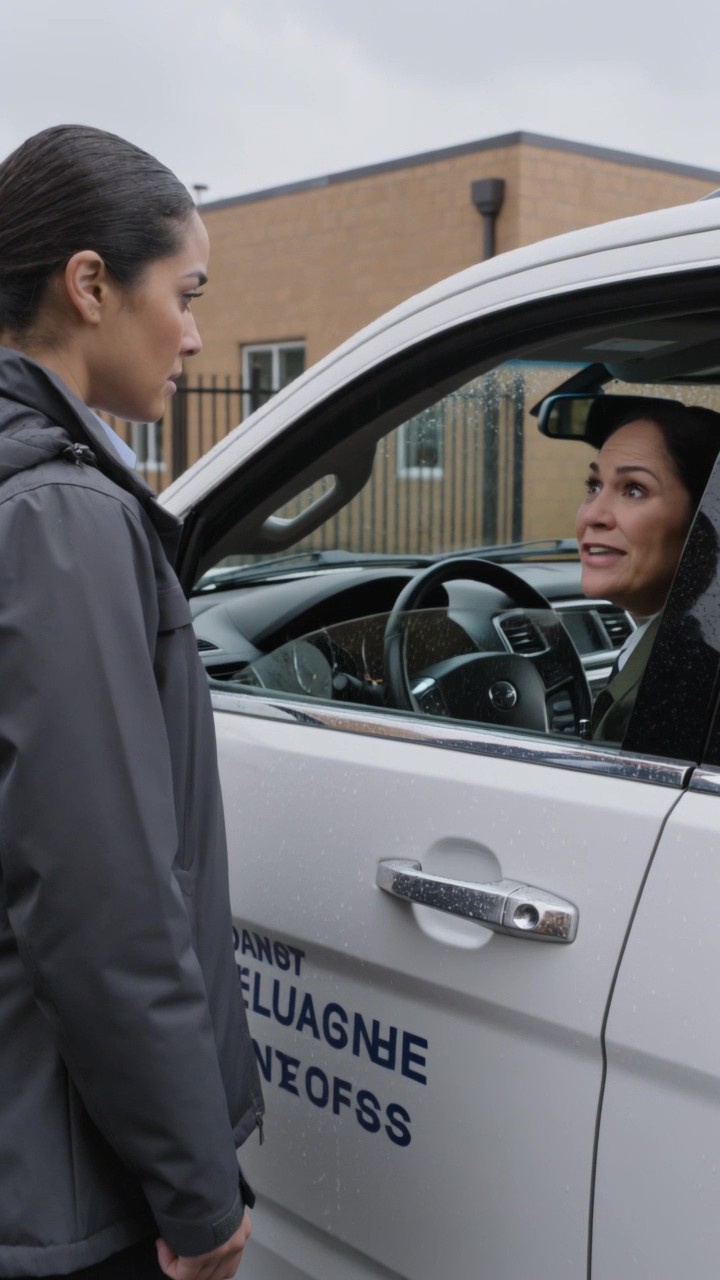
Leah stepped in front of the sedan.
It was not dramatic bravery.
The car had barely begun moving.
The risk was confrontation, not impact.
Celeste recognized Leah after a few seconds.
The old file lived between them immediately.
Celeste’s first response was defensive because she heard challenge from the person she had once labeled unreliable.
Leah did not argue history in the pickup lane.
She asked for the inside tag.
That specific request changed the moment.
The tag said Miles Carter.
The school aide began checking the office.
The real Eli was found in the counseling room with the red backpack. His emergency placement worker had not yet arrived, so he remained safe.
The danger for Miles became clearer when staff reviewed the no-release alert. A man seen near the parking fence matched the description of the father’s friend who had previously attempted contact. Whether he intended to approach the sedan that day could not be fully proven. But if Celeste had driven away with Miles under the wrong name, the school and county might have moved him through a process without immediately realizing the protective alert had been bypassed.
The county opened an incident review.
The school’s paper system had failed.
The county transport check had failed.
Celeste had relied on the release form without asking the child to state his name privately or comparing backpack, medication, and no-release notes.
The office aide had trusted a packet she did not assemble.
No single person planned harm.
The result could still have harmed a child.
Celeste requested to speak with Leah after the review.
Leah almost refused.
She had not stopped the car to receive an apology. She had stopped it because a child’s backpack was wrong.
They met at the school district office with a supervisor present.
Celeste brought a copy of Leah’s old case note.
The phrase was highlighted.
Attention-seeking.
“I wrote this,” Celeste said.
Leah looked at the paper.
“I know.”
“I was wrong.”
“Yes.”
“I thought I was being objective.”
“You were making my fear sound like behavior.”
Celeste nodded.
The apology did not repair the six weeks Leah remained in the home.
It did not remove every file copy from history.
Celeste worked with the county records office to attach a corrective statement to Leah’s archived file:
Subsequent investigation substantiated safety concerns at the placement. Earlier characterization of the youth as attention-seeking was unsupported and should not be used to assess credibility.
Leah asked why it took twenty years.
Celeste answered:
“Because I did not want to reopen the part of my career where I harmed a child while believing I was managing a difficult case.”
That sentence mattered more than a polished apology.
The school changed pickup procedures.
Emergency release packets could not be assembled during printer failures without second-person page verification.
Children in protective situations were asked privately to state their full name and identify their belongings before leaving.
No-release alerts printed on colored cover sheets.
Medication bag descriptions appeared on the top page.
Drivers and case aides verified at least two identifiers beyond paperwork: child statement, photo, backpack tag, classroom teacher confirmation, or medical item.
And any adult in the building who noticed a mismatch could call a release stop without being dismissed for lacking formal custody authority.
The county changed its training too.
Celeste volunteered to participate in a session on credibility bias, but Leah insisted the training not become a redemption show.
The module used anonymized records and focused on how labels like attention-seeking, manipulative, dramatic, and defiant can cause later workers to discount safety reports.
Celeste spoke only after Leah approved the outline.
She said:
“I once believed a clean file and a familiar foster parent were more reliable than a child whose behavior frustrated me. Years later, I almost drove away with the wrong child because the paper looked correct. In both cases, a small mismatch was there. I ignored the first one. Someone else stopped the second.”
Leah did not forgive Celeste in a single scene.
She did allow the corrective file statement.
She also agreed to serve on a youth-advocate advisory panel because the pickup incident proved procedural details still failed under pressure.
Miles returned to school after two days at home.
He received counseling support because being called the wrong name and nearly moved by strangers frightened him deeply.
Eli teased him once about the dinosaur backpack saving the day.
A counselor corrected the joke gently.
The backpack did not save the day.
An adult noticed it and stopped the process.
Miles later chose a new tag for the inside.
Large letters.
MILES CARTER.
The school purchased durable identity tags for students with emergency transport plans, but it made the design ordinary enough that no child looked marked or singled out.
Leah continued tutoring Eli.
One afternoon, Eli asked whether she hated Celeste.
Leah paused.
“I hate what she wrote about me.”
“Do you hate her?”
“Some days.”
“Then why did you help her not make a mistake?”
Leah looked toward the pickup lane.
“Because Miles was in the car.”
That answer was the core of the rescue.
Leah did not save Celeste because Celeste deserved comfort.
She stopped a harm happening in front of her, even though the person about to make the mistake had once refused to stop harm for her.
Later, Celeste sent Leah a handwritten letter.
Leah read it once and placed it in a drawer.
She did not frame it.
The corrective file mattered more.
Apologies live in feelings.
Records live in systems.
At the next county training, every worker was given a scenario:
A form is correct.
A child is quiet.
One object does not match.
What do you do?
The required answer was simple.
Stop the movement.
Open the file again.
Ask the child safely.
Verify before the car leaves.
That answer came from a blue dinosaur backpack on a rainy afternoon.
And from a former foster child who had learned, painfully, that paperwork can be wrong even when adults sound certain.







Leave a Reply