
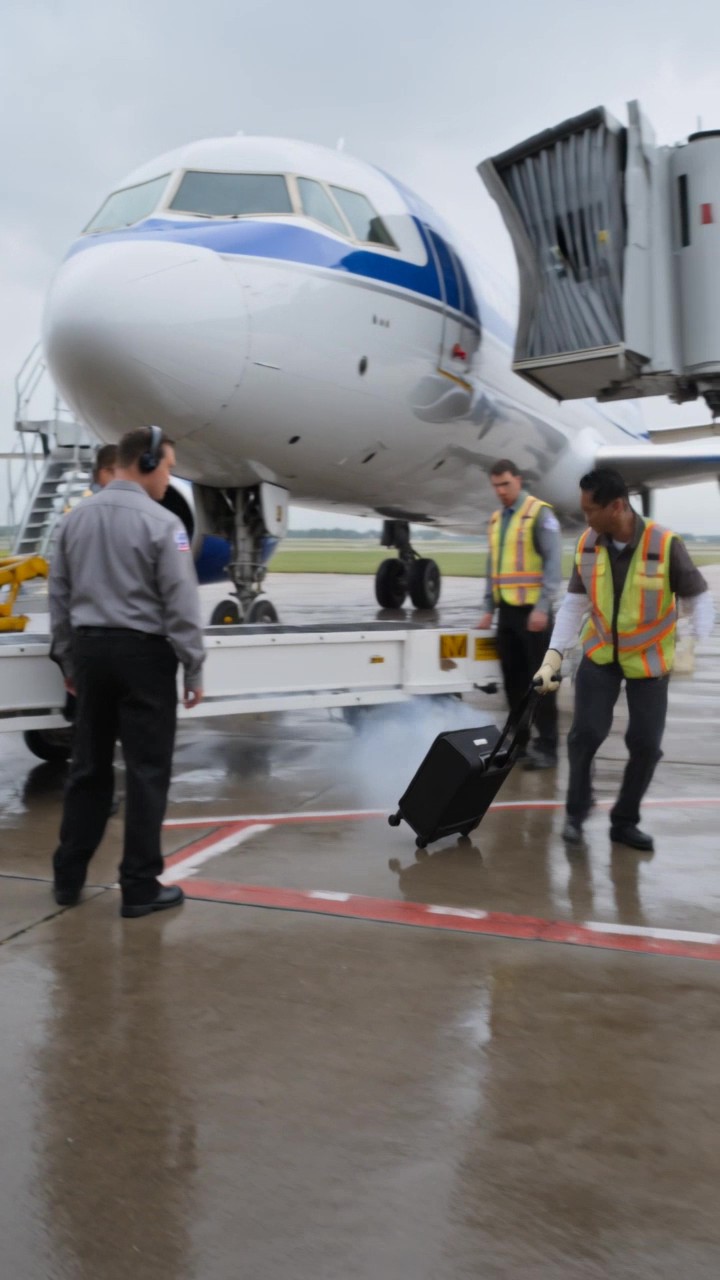
The flight did not depart on time.
Passengers complained.
Connections were missed.
The airline paid for meals and rebooking.
A first-class traveler threatened legal action because her suitcase was damaged during the emergency response.
Those consequences were real.
So was the smoke rising from the bag before it ever entered the cargo hold.
Airport fire personnel moved the suitcase into a containment unit and cleared the ramp.
Inside was a damaged electric mobility-device battery packed beside clothing and a charger. The passenger said the equipment had been dropped by a courier two days earlier but appeared normal afterward.
She had not tried to break a rule.
She did not know the battery casing had cracked beneath the fabric cover.
The investigation later found internal damage consistent with impact.
Heat had begun building while the suitcase traveled through the baggage system.
Daniel noticed the moving ribbon because pressure was escaping through the zipper.
He heard the clicking because the case rested briefly against the metal loader frame.
To everyone else, it looked like luggage.
To Daniel, it behaved like a sealed electronics bin moments before thermal failure.
Preston stood in the airport operations room while officials reviewed the ramp video.
“You had no temperature scanner,” the safety investigator said.
Daniel nodded.
“No.”
“No visible flames when you removed it.”
“No.”
“You stopped the entire load based on touch, sound, and a moving ribbon?”
“Yes.”
Preston folded his arms.
“That is exactly the problem. We cannot let individual baggage handlers make aircraft-safety decisions from intuition.”
Daniel looked at him.
“It was not intuition.”
He explained his previous work.
For six years, he processed damaged laptops, e-bike packs, tools, and medical-equipment batteries at an electronics recovery center.
He learned that dangerous batteries often announced themselves quietly.
A sweet chemical odor.
Heat in one corner.
Pressure swelling a case.
Faint ticking as damaged layers shifted.
He left the warehouse after repetitive injuries and took airport work with better health coverage.
His old experience disappeared from his job title.
The investigator asked whether the airline knew about it.
Daniel laughed once.
“The application asked whether I could lift seventy pounds.”
That answer exposed a larger problem.
The airline trained baggage staff to identify prohibited labels and visible damage.
It did not teach them to report subtle signs from devices that had passed screening but changed during handling.
Workers had authority to stop a belt for a mechanical jam.
They did not have clear authority to isolate a suspicious bag without a supervisor.
That gap nearly moved the suitcase into the hold.
The cargo compartment had fire-detection and suppression systems.
Those systems reduced risk.
They did not make an overheating battery harmless beneath hundreds of bags during flight.
The airline’s safety board concluded that Daniel’s intervention prevented a serious in-flight cargo event.
Preston argued that he had followed departure procedure and believed the suitcase had already passed security screening.
The board agreed that screening created reasonable confidence.
It did not excuse ignoring new evidence on the ramp.
Safety clearance is not a permanent promise.
Conditions can change after the checkpoint.
Preston was removed from ramp supervision while the airline reviewed prior pressure-related complaints.
The review found several instances where workers were discouraged from reporting damaged luggage near departure time.
He was later reassigned to a non-operational role rather than fired.
Some employees believed the consequence was too light.
Others believed the culture rewarded on-time metrics so strongly that replacing one supervisor would change little.
Daniel supported the second view.
“If the next manager loses a bonus for delaying a flight but loses nothing for ignoring a warning, the same argument will happen again.”
The airline changed the performance system.
Safety holds no longer counted as personal delay failures when supported by documented observations.
Ramp staff received training on heat, swelling, odor, sound, and pressure indicators.
Every loading zone gained a thermal scanner and a clearly marked isolation area.
Any worker could stop baggage loading long enough for a safety check without surrendering their badge.
Daniel was offered a promotion to safety trainer.
He accepted part-time.
He wanted to remain on the ramp.
“People teaching the signs should still see real bags,” he said.
The first training session included supervisors, handlers, gate staff, and security screeners.
Daniel tied an orange ribbon to an empty suitcase.
Then he placed a small air pump inside for demonstration, producing gentle pressure against the zipper.
The ribbon moved.
Several managers missed it.
Baggage handlers noticed first.
They watched luggage for a living.
That was the lesson.
Expertise does not always arrive wearing a technical title.
Sometimes it wears rain gloves and knows exactly how a suitcase should behave on a moving belt.
The passenger whose bag caused the evacuation later wrote Daniel.
She apologized for shouting at the gate and thanked him for preventing the damaged device from traveling beneath the aircraft.
Daniel did not blame her.
He asked the airline to improve passenger information about devices that had been dropped, crushed, or recently repaired.
The airline added guidance at booking and check-in.
Not every damaged item became dangerous.
Every changed condition deserved attention.
Flight 714 departed five hours late on another aircraft after the cargo load was rechecked.
One month later, Daniel worked the same gate.
A black suitcase with an orange ribbon moved toward the loader.
For one second, every nearby worker looked at it.
The ribbon remained still.
The case felt cool.
Daniel nodded.
The belt continued.
Safety was not stopping everything forever.
It was knowing when ordinary movement had become a warning.







Leave a Reply