
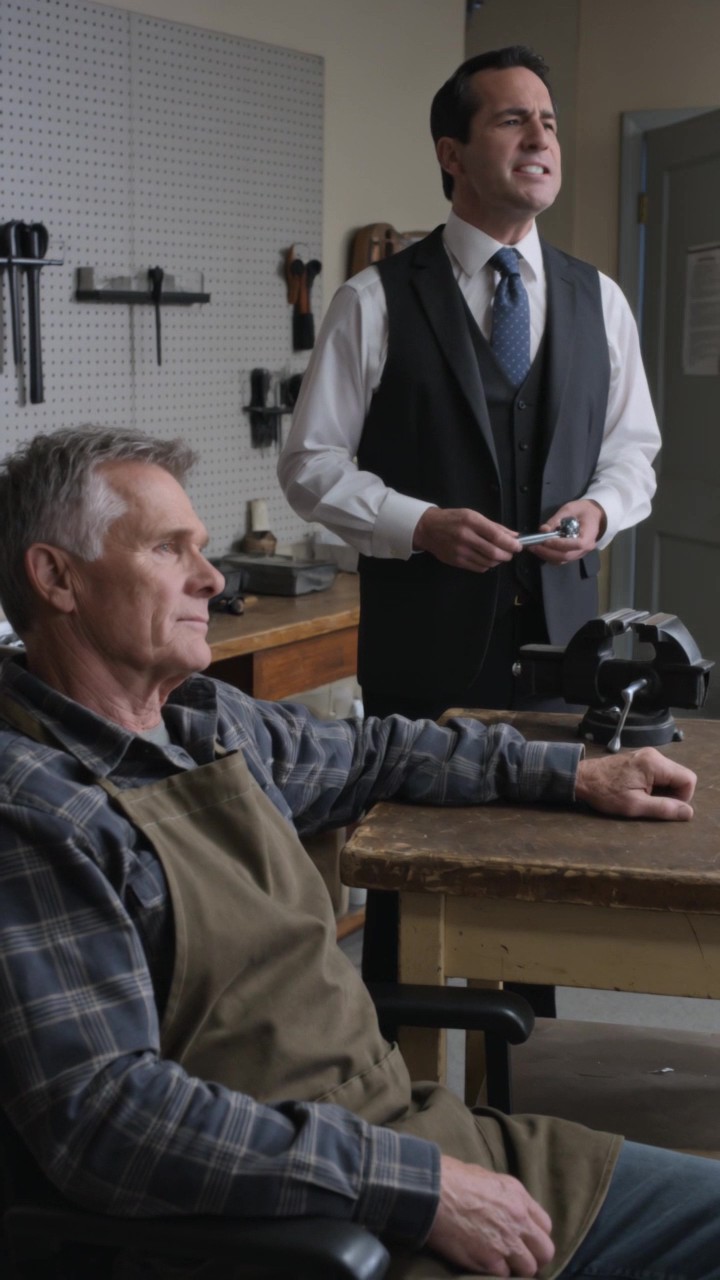
The auction paused.
Not because Lena Morales had become wealthy enough to wave away every problem.
She had not.
She was an occupational therapist and adaptive-equipment designer for a rehabilitation hospital. She earned a stable salary, carried student debt, and had spent three months gathering grants before returning to Henry’s shop.
The blue bell brought memory.
The equipment case brought a plan.
Lena rolled beside the workbench and unpacked each tool.
A clamp that locked a bicycle frame with a foot pedal.
A magnetic tray that held screws where one hand could reach them.
A ratcheting stand that allowed torque to be applied through body weight instead of grip strength.
A digital camera mount so Henry could magnify small parts.
The auctioneer looked unimpressed.
“He still cannot perform the work required to maintain the lease.”
Lena turned toward Henry.
“Can you diagnose a bent derailleur by sound?”
Henry nodded.
“Can you teach someone to true a wheel?”
“Yes.”
“Can you tell when a bearing is dry before it fails?”
He almost smiled.
“Most people can if they stop talking.”
Lena faced the room.
“Then the shop did not lose its mechanic. It lost the old method.”
Henry looked at his right hand.
For six months, everyone had spoken about his future in past tense.
Former mechanic.
Former shop owner.
Former independent man.
His daughter Rachel wanted him to retire.
She was not cruel.
She was exhausted from driving him to appointments, sorting bills, and watching him attempt tasks that ended in frustration.
She believed selling the tools would protect him from disappointment.
Henry believed losing them would remove the only place where his knowledge still had weight.
Lena did not promise he could return to the life he had before the stroke.
She said something harder:
“The shop must change.”
The landlord’s representative showed her the numbers.
Three months of unpaid rent.
Insurance increase.
Accessibility work needed at the entrance.
The building owner planned to lease the space to a coffee chain.
Lena had already contacted the county vocational-rehabilitation program.
A grant would fund adaptive tools and wages for one apprentice if the shop trained workers with disabilities.
A neighborhood nonprofit would cover half the ramp renovation.
Former customers had pledged the remaining overdue rent—but only if Henry agreed to a business manager so invoices and appointments no longer depended on his handwriting.
Henry frowned.
“You arranged all of this without asking me.”
Lena met his eyes.
“I arranged options. You decide.”
That distinction made him quiet.
Twenty-one years earlier, Henry had not told Lena what kind of life a child in a wheelchair should accept. He had fixed the wheel she asked him to fix.
Now she refused to turn gratitude into control.
Henry asked the auctioneer to leave the socket set on the bench.
Then the wrenches.
Then the wheel-truing stand.
The sale was canceled before the first major tool left the shop.
The coffee chain threatened legal action over the pending lease.
The landlord ultimately extended Henry’s agreement for one year because the rehabilitation grant guaranteed payment and the neighborhood campaign brought attention he did not want to fight.
The shop reopened under a new name:
BELL & MORales ADAPTIVE CYCLES.
Lena refused to be called co-owner.
She lived two counties away and had her own career.
Her name appeared because the shop now repaired bicycles, wheelchairs, walkers, hand cycles, and mobility devices while training apprentices.
Henry’s first apprentice was Marcus, a nineteen-year-old who had lost partial use of one arm after an accident.
Henry was impatient.
Marcus was stubborn.
Their first week ended with both men arguing over chain tension.
Lena returned on Friday.
“Good,” she said.
Henry stared at her.
“That did not sound good.”
“You are treating him like a mechanic, not a charity project.”
Marcus smiled.
Henry did too, reluctantly.
The adaptive tools did not solve everything.
Some mornings Henry’s balance was poor.
He dropped parts.
Fatigue shortened his hours.
Rachel still drove him home when he pushed too far.
He grieved the speed he had lost.
But he began teaching through language, demonstration, sound, and touch.
He learned to place a student’s fingers against a wheel hub and ask:
“Feel that vibration?”
The shop became known not for inspirational speeches but for repairs other businesses refused.
A child’s wheelchair brake adjusted the same day.
A delivery rider’s hand cycle rebuilt after a crash.
An elderly man’s walker fitted with quieter bearings.
Near the register, Lena framed the original one-dollar receipt.
Below it hung the blue bell.
Henry objected.
“You still use that.”
“I replaced it.”
“Then why keep the old one here?”
Lena rang it softly.
“Because this is where I first learned adaptation was not a favor.”
Henry looked at the receipt.
He remembered a thin child sitting beside a red wheelchair, watching him turn a bicycle bearing into something no catalog listed.
“I only fixed a caster.”
Lena shook her head.
“You fixed the idea that I had to wait until somebody important decided I was worth moving.”
One year later, the landlord offered Henry a five-year lease.
The shop’s revenue had stabilized.
The training program brought funding.
The ramp outside was painted with a blue line leading to the door.
Henry signed using his left hand.
The signature was slow and uneven.
He did not apologize for it.
At the reopening anniversary, no mayor came.
No cameras.
Lena arrived after work and found Henry teaching three teenagers to listen for a dry bearing.
He struck the blue bell once.
Every head turned.
“Customer coming,” he said.
Lena rolled through the doorway.
The small kindness had returned.
Not as a debt.
Not as rescue from a powerful stranger.
As a new method built from the same principle Henry had used twenty-one years earlier:
Do not ask whether the old part still works.
Ask what can be changed so the person can keep moving.






Leave a Reply