
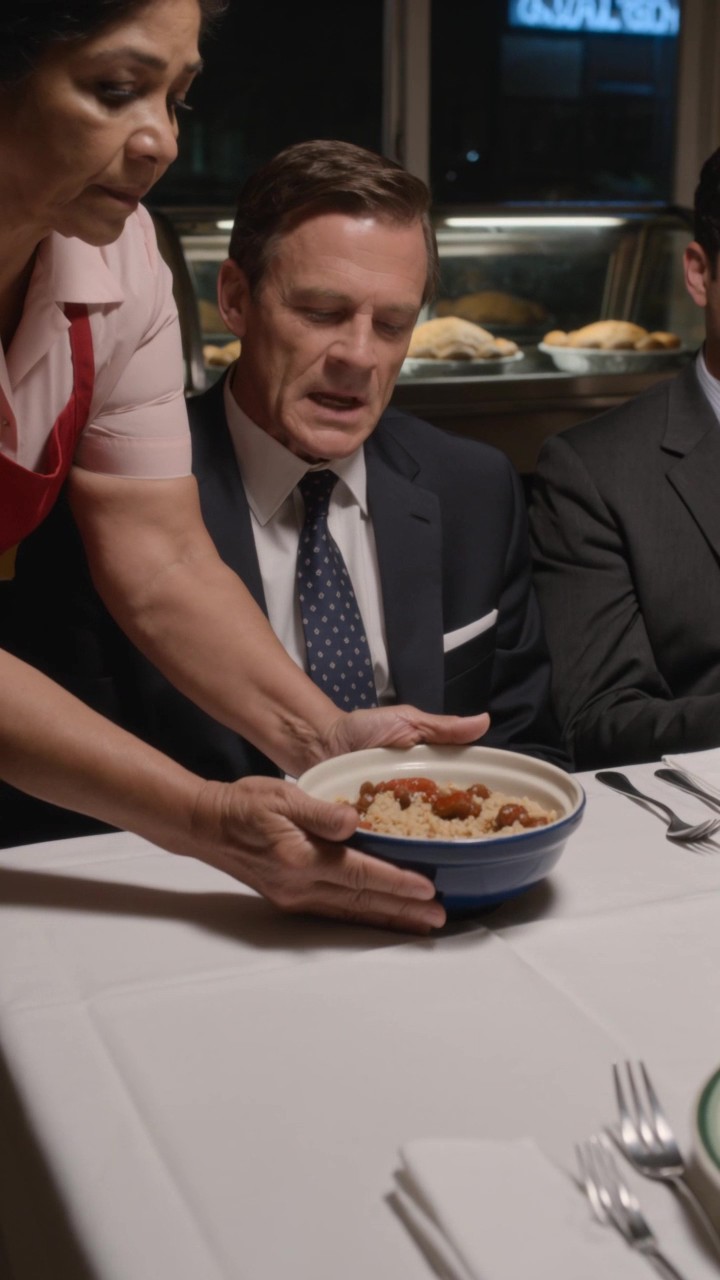
For several seconds, nobody moved.
Eleanor Whitmore sat beneath the diner’s warm ceiling lights with tomato broth on the tablecloth and one grain of browned rice against her thumb.
Her memory had become unreliable over the previous two years.
Some mornings she forgot whether her husband was alive.
Some afternoons she remembered the price of coffee in 1973 but not the name of the nurse beside her.
Charles had learned to protect himself by treating every sudden statement as confusion.
That night, the statement threatened the sale of a valuable corner property.
He treated it as confusion faster than usual.
“Mom,” he said, “Dad bought this diner before Rosa’s family worked here.”
Eleanor looked at the broken blue bowl.
“No.”
Then the clarity began fading.
She asked where Marisol had gone.
Rosa answered softly:
“She died nineteen years ago.”
Eleanor’s shoulders lowered.
The room returned to her in pieces.
The family wanted to end the dinner.
Rosa did not.
She knelt beneath the pie case and opened a narrow cabinet nobody had used since the register system changed.
Inside were old menus, tax receipts, handwritten recipes, and one metal cash box without a key.
Eleanor watched.
“Wall,” she whispered.
Rosa looked behind the pie case.
A section of paneling carried two small nail holes beneath a framed photograph of the diner’s grand reopening.
The photograph showed Eleanor and her husband Daniel cutting a ribbon in 1982.
Marisol stood at the edge wearing an apron.
Her name did not appear in the caption.
Rosa removed the frame.
Behind it was a shallow wall recess covered by brown paper.
Inside lay an envelope darkened by age.
Charles reached for it.
Rosa held it against her chest.
“You just broke the bowl because you did not like what she remembered.”
The family attorney, who had attended the dinner to discuss the sale, stepped forward.
“We open it together.”
The envelope contained a photocopy, not an original deed.
At the top were the words:
ALDER STREET DINER — PARTNERSHIP AND LEASE ASSIGNMENT, 1968.
Two names appeared beneath:
ELEANOR WHITMORE.
MARISOL ALVAREZ.
The signature section was incomplete.
One page was missing.
The document did not instantly give Rosa half the building.
It did something Charles had resisted.
It made Eleanor’s memory specific enough to investigate.
The story began during a winter when the diner was not yet a Whitmore family institution.
Eleanor was twenty-six.
Her husband Daniel had recently lost a factory job.
They rented a narrow lunch counter on Alder Street and planned to serve breakfast to mill workers.
They had cooking equipment but little cash.
Two weeks before opening, a pipe burst above the kitchen.
Insurance denied most of the claim because the landlord blamed old plumbing and tenant installation.
Daniel wanted to abandon the lease.
Marisol Alvarez worked evenings at a hotel kitchen and cleaned offices at night.
She had saved money to open a small food counter of her own.
She and Eleanor met while waiting at the same wholesale market.
Eleanor needed capital.
Marisol needed an English-speaking partner willing to navigate the lease and permits.
They made an agreement.
Marisol contributed nearly half the repair money.
Eleanor handled the front counter and books.
Marisol built the first menu around food both women knew people would buy repeatedly:
Eggs.
Bean soup.
Roast chicken.
Tomato rice cooked until the bottom browned.
The browned layer was not waste.
Marisol loosened it with broth and served it in a blue ceramic bowl at the end of long shifts.
She called it the kitchen meal.
The workers ate what could not be sold but should not be thrown away.
The diner opened.
It struggled.
Then a blizzard stranded factory workers and bus passengers for two days.
Marisol stretched the tomato rice with beans and broth.
Eleanor served it through the night.
The local paper photographed the crowded counter.
Business grew.
The kitchen meal never appeared on the printed menu.
It remained the food eaten after closing by the women who had built the place.
Daniel disliked the partnership.
Not at first.
He appreciated Marisol’s money and labor.
As the diner became profitable, he began referring to her as “the cook.”
He told suppliers Eleanor and he owned the business.
Marisol’s name remained on the early lease assignment and partnership papers, but the building purchase occurred later under a company Daniel formed with Eleanor.
Marisol believed her interest would transfer.
Daniel delayed.
He said banks preferred one married couple on the loan.
Then immigration paperwork involving Marisol’s husband became complicated.
She feared legal attention and trusted Eleanor to protect the arrangement.
Eleanor did not.
That was the truth she had carried.
She did not forge a signature or physically remove Marisol from the building.
She allowed Daniel to create new records that reduced a partner to an employee.
When Marisol objected, Daniel offered back wages and a small annual bonus.
She remained because leaving meant losing both income and the business she had helped build.
Rosa grew up in the diner kitchen.
She believed her mother was a longtime cook.
Marisol never told her the full story.
Pride and shame had become tangled.
She kept the original documents in a metal cash box.
After Daniel died, Eleanor considered correcting the ownership.
By then, tax records, corporate filings, and decades of payments all named the Whitmore company.
Marisol was ill.
She told Eleanor:
“Do not give me a plaque. Protect Rosa’s job.”
Eleanor did that.
She made Rosa kitchen manager.
Paid her better.
Gave annual bonuses.
None of those choices repaired the erased ownership.
They made it easier for Eleanor to postpone saying the truth aloud.
The blue bowl remained.
Whenever Eleanor and Marisol ate the kitchen meal, they remembered the first winter.
After Marisol died, Eleanor stopped ordering it.
Until the final dinner.
The family attorney paused the building sale.
He hired an independent business historian and forensic accountant.
The old lease office still held microfilm records.
The first assignment named both women.
A bank archive contained Marisol’s cashier’s checks used for repairs.
Supplier correspondence referred to “the Whitmore-Alvarez counter.”
The missing partnership page was eventually found inside the locked metal cash box after a locksmith opened it with the family present.
It stated that profits and any later property interest connected to the diner would be divided equally unless both partners signed a new agreement.
No signed replacement existed.
The legal problem remained complex.
The building had been purchased through a later company.
Marisol had accepted wages and bonuses for decades.
Limitation rules and estate law made a perfect fifty-percent claim uncertain.
Rosa did not become half-owner in one dramatic evening.
She did gain something the family had denied her mother:
Negotiating power grounded in evidence.
Charles wanted the sale completed quickly.
Rosa and Marisol’s estate could delay it through litigation.
The parties entered mediation.
Rosa refused the first offer.
It treated Marisol’s contribution as an unpaid loan plus interest.
“My mother did not lend them a stove,” she said. “She built the business.”
The final settlement acknowledged Marisol as co-founder and resolved the disputed historical ownership through three measures.
Her estate received a substantial portion of the sale proceeds.
Rosa received the right to continue operating the diner name and recipes at another location.
And the original corner unit could not be demolished until its history was documented and the community had an opportunity to purchase it.
The developer withdrew.
A local cooperative bought the property with preservation financing.
The diner did close for six months.
Eleanor moved to the care residence.
Rosa opened a smaller temporary counter inside a community market.
She served the kitchen meal every Friday in blue bowls made by a local potter.
Not as a trendy “burned rice special.”
As staff food shared with anyone still working after closing.
Charles apologized to Rosa.
At first, he said:
“I did not know.”
Rosa answered:
“You knew my mother had been here from the beginning. You chose the version where that meant less.”
He had to sit with that.
Eleanor’s role was harder.
Memory loss did not erase responsibility from earlier decades.
It also made a conventional confrontation impossible.
Some days Eleanor remembered Marisol clearly and cried.
Other days she introduced Rosa as a new waitress.
Rosa visited twice.
The first time, Eleanor asked whether the diner was busy.
The second time, she looked at Rosa’s face and said:
“Your mother should have been on the sign.”
Rosa answered:
“Yes.”
That was the only apology Eleanor could consistently give.
It was not enough.
It was still true.
The reopened diner used a new sign:
WHITMORE & ALVAREZ
ALDER STREET KITCHEN
Charles’s surname remained.
Rosa insisted.
“Erasing the people who did wrong is not the same as telling the whole story.”
Inside, the ribbon-cutting photograph stayed on the wall.
The caption changed:
ELEANOR WHITMORE, DANIEL WHITMORE, AND CO-FOUNDER MARISOL ALVAREZ AT THE 1982 REOPENING.
Beside it sat the repaired blue bowl.
The cracks were visible beneath gold-colored joining lines.
Rosa disliked the idea at first.
Too decorative.
Too eager to turn damage into beauty.
Then she agreed because the repair did not hide where the bowl had broken.
On Eleanor’s eighty-fifth birthday, the family brought her to the diner before opening.
Rosa served tomato rice, beans, and broth.
Eleanor tasted it.
For one moment, her face became younger.
“Marisol needs more salt,” she said.
Rosa smiled despite herself.
“My mother always said you used too much.”
Eleanor laughed.
Then forgot why.
The meal did not cure her memory.
It restored one buried fact long enough for other evidence to survive.
The diner’s final dinner had almost ended with a broken bowl and another sale signed over a missing name.
Instead, one piece of browned rice brought the first partner back into the room.





Leave a Reply