
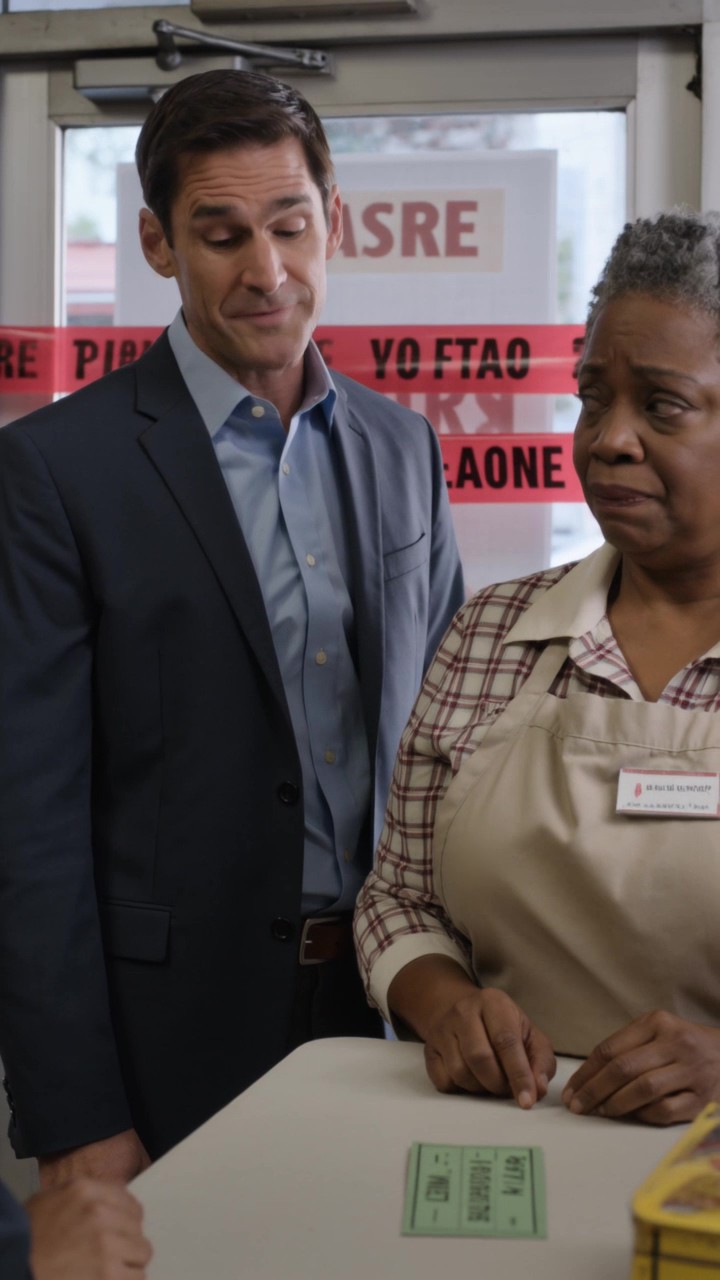
The closure tape stayed across the door.
For the next two hours, nobody entered the store.
That frustrated customers.
It frightened Nora.
But Lena Morales refused to reopen the building until the entire safety system was examined.
A good reversal did not mean ignoring the original risk because a childhood memory appeared.
The fire alarm had been disabled.
The question was who did it, when, and why.
Lena called the city fire investigator and requested the last three inspection records.
The system passed six weeks earlier.
Since then, only two contractors had signed into the utility room.
One repaired a drain.
The other worked for the building owner.
Nora’s landlord, Preston Hale, had spent months pressuring her to surrender the lease.
The neighborhood was changing.
A development company wanted the corner for a luxury market and apartment entrance.
Nora’s grocery paid below current market rent because her father negotiated a long lease decades earlier.
The lease could be terminated if the business remained closed for more than thirty consecutive days due to code violations attributable to the tenant.
The disabled sprinkler created exactly that possibility.
Preston arrived while investigators were photographing the cut wire.
He looked at Lena.
“This is an old building. Systems fail.”
Lena held up the wire.
“Copper does not create a clean tool mark by aging.”
He turned toward Nora.
“Did one of your employees tamper with it?”
Nora’s face tightened.
The store had four employees.
Two were relatives.
One was a high-school student.
One was a father working mornings after losing a warehouse job.
The easiest defense for Preston was to redirect suspicion downward.
Lena did not accept it.
She asked for the utility-room access records.
The building used a keypad.
Logs showed an entry at 11:47 p.m. two nights earlier using the landlord contractor’s code.
Security footage from the alley showed a van.
The contractor denied cutting the wire.
Then admitted Preston had instructed him to “make sure the old system could not pass a stress test.”
He claimed he thought the work was part of a planned replacement.
The investigation expanded.
Nora sat behind the taped door holding the green card.
“Why was it inside the panel?” Lena asked.
Nora explained.
After several false alarms years earlier, repair workers kept confusing the grocery zone with the upstairs apartments.
Nora began placing green cards behind panels and writing the protected area on them.
The lunch punch card happened to be the first piece of thick paper she found.
She had forgotten the name written across it.
Lena had not.
At eleven, Lena’s mother cleaned two office towers and could not collect her until evening.
Their apartment had no heat for one winter because the landlord ignored a broken radiator.
Lena did homework on a milk crate beside Nora’s canned-goods aisle.
She tried not to eat because she knew money was short.
Nora noticed.
Instead of asking publicly whether the girl was hungry, she made the green card.
Seven circles.
One lunch per circle.
When all seven were punched, Nora handed her a new card and said:
“Your mother settles it on Friday.”
Her mother rarely could.
Nora never mentioned the balance.
The card protected more than hunger.
It protected dignity.
Lena eventually moved in with an aunt.
She studied fire science after an apartment fire damaged the building next door.
She remembered watching residents argue with an inspector who dismissed their smoke complaints.
Lena wanted to become the person who opened the wall instead of blaming the tenant.
Nora smiled.
“So the soup made you an inspector?”
“No.”
Lena looked at the cut wire.
“The soup taught me not to confuse somebody needing help with somebody causing the problem.”
That distinction saved the store.
The city issued an emergency repair order against the property owner.
Because the tampering occurred after a passed inspection and outside Nora’s control, the lease closure clause could not be triggered against her.
The fire department repaired the system temporarily that night.
The store reopened the next morning with a fire watch until permanent work was complete.
Preston faced criminal and civil proceedings for safety-system tampering and attempted lease interference.
The court process lasted more than a year.
He did not lose every property instantly.
The development company withdrew from the corner deal after the investigation became public.
The building was later sold to a community land trust.
Nora could not afford to buy it alone.
She became one of several members who helped secure financing.
The grocery lease was renewed at a sustainable rate.
The upstairs apartments received heating, alarms, and safe electrical work.
Lena did not personally purchase the building.
The small kindness returned through professional attention, not a fairy-tale fortune.
The city reviewed other closures tied to Preston’s properties.
Three tenants had been blamed for repeated alarm faults that building contractors failed to repair.
One restaurant recovered part of its losses.
Another had already closed permanently.
Not every harm could be reversed.
Nora changed the green-card system too.
For years, she had quietly covered food for children, older neighbors, and workers between paychecks.
The privacy helped.
The secrecy also meant the burden rested only on her.
The community land trust created a formal pantry fund.
Customers could add one dollar at checkout.
No names were posted.
No photographs of recipients.
Green cards remained available at the counter.
They no longer carried debt totals.
They carried only a question:
WHAT DO YOU NEED UNTIL FRIDAY?
Lena kept the original card.
Nora protested.
“It belongs with the alarm records.”
Lena made a certified copy for the file.
The original stayed inside a clear sleeve in her inspector’s notebook.
Not as proof she owed Nora.
As a reminder that codes protect people best when officials remember why the building matters.
Years later, Nora retired.
On her final day, Lena came to the store during lunch.
A boy sat on the milk crate near the canned goods, eating soup while his father filled out a job application.
Nora nodded toward him.
“Card number four this week.”
Lena looked at the green card in the boy’s hand.
No circles were punched.
The new system did not count meals like favors.
It counted time until stability returned.
Nora locked the store that evening and handed the key to the employee cooperative taking over operations.
Lena stood beside the alarm panel.
Behind its cover was a new green card.
This one read:
PANTRY, APARTMENTS, STORE.
CHECK THE PEOPLE BEFORE BLAMING THE BUILDING.
The original help had been small.
Soup.
A chair.
A piece of green cardboard.
Its return was larger only because Lena had spent years learning how to turn attention into protection.







Leave a Reply