
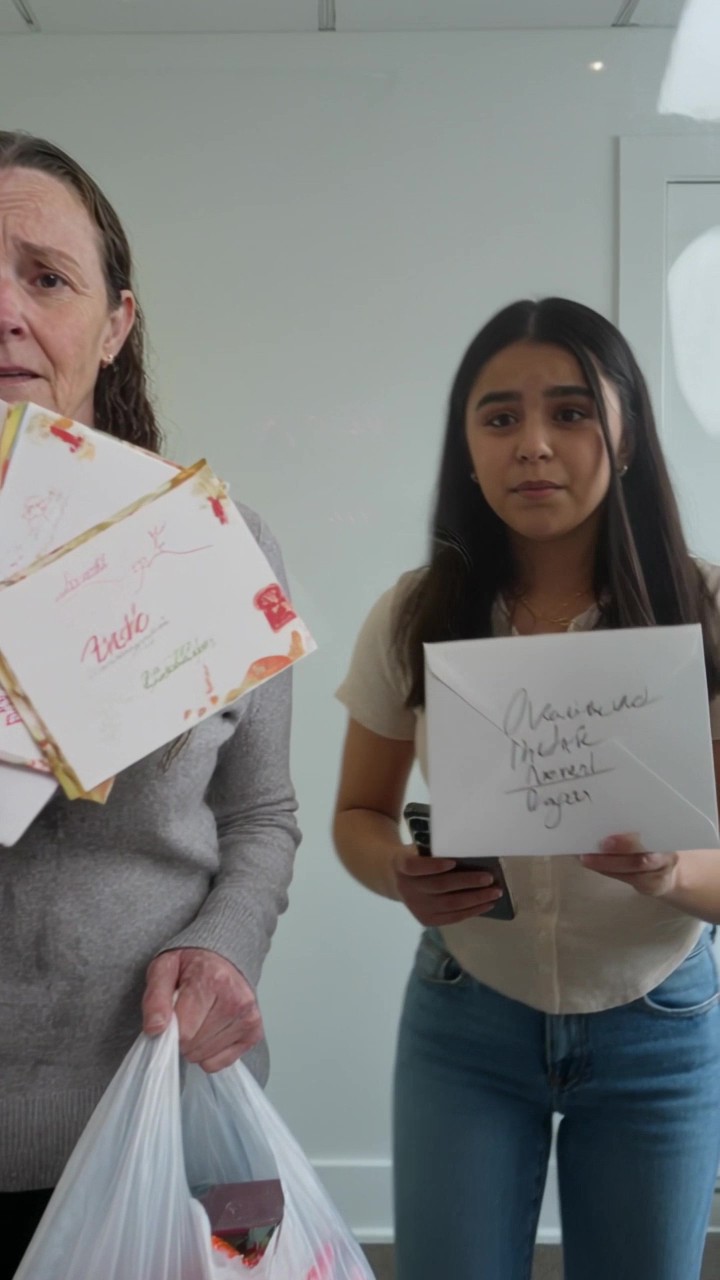
Marissa ended the livestream with one shaking hand.
For the first time in her career, she did not say:
“Love you guys.”
The screen went black.
But the damage was already public.
Clips were spreading before she even sat down.
Kayla locked the studio door.
Elena stood near the hallway wall, clutching the grocery bag like she expected to be thrown out anyway.
Marissa stared at the returned cards.
Every year.
Age eleven.
Twelve.
Thirteen.
Fourteen.
All the way to twenty-six.
“Why did you bring them tonight?” Marissa asked.
Elena wiped her face.
“Because your father is releasing his memoir tomorrow.”
Marissa froze.
“What?”
“He writes that I abandoned you. That he raised you alone. That your anger made you successful.”
Kayla searched quickly on her phone.
There it was.
A preorder page.
RAISING A SURVIVOR: How I Saved My Daughter From Her Mother’s Chaos
Author: Richard Vale.
Marissa sat down slowly.
Her whole brand had been built on that story.
The abandoned daughter.
The toxic mother.
The father who stayed.
She had told it in podcasts.
Brand interviews.
Panels.
Caption after caption.
And people loved her for surviving it.
Elena pushed the stack of cards toward her.
“I’m not asking you to forgive me tonight.”
Marissa looked up.
“Good.”
Elena nodded.
“I don’t deserve quick forgiveness.”
That made Marissa cry.
Because again, the answer was wrong.
Her father always answered with speeches.
Elena answered with bruised truth.
Kayla opened the top birthday card.
Inside was a photo.
Marissa at ten, holding a cheap camcorder.
Elena standing behind her, both of them laughing.
On the back:
Missy’s first movie. She made me play the villain three times.
Marissa touched the photo.
“I remember this camera.”
Elena smiled through tears.
“You made a horror movie about a haunted toaster.”
A broken laugh escaped Marissa.
Then stopped.
Because memory returned in pieces.
Her mother making popcorn.
Her father angry about the mess.
A door slamming.
Elena leaving for “a little while.”
Then never being allowed to say her name again.
Kayla found more.
Money order receipts for dance class.
Returned school letters.
A rehab completion certificate.
Court filings Richard had withdrawn before hearing.
Not enough to make Elena perfect.
Enough to prove Richard had lied.
Marissa looked at her mother.
“You did leave.”
Elena nodded.
“Yes.”
“You were gone when I needed you.”
“Yes.”
“You let him win.”
Elena closed her eyes.
“Yes.”
That was the hardest answer.
Marissa wanted one clean villain.
Instead she got two adults:
one who manipulated her,
and one who was too broken to fight hard enough.
The next morning, Richard Vale went live to promote his memoir.
He smiled into his camera.
“My daughter’s strength came from the pain her mother caused.”
Then Marissa joined the livestream.
Not with makeup.
Not with perfect lighting.
Just her face, tired and swollen from crying.
“Dad,” she said, “why did you write ‘she performs better angry’ on Mom’s returned cards?”
Richard’s smile disappeared.
The comments exploded.
Marissa did not cry this time.
She held up the envelope.
Then the photo.
Then the money order receipts.
“I am not defending everything my mother did,” she said. “She left when I needed her. That hurt me.”
Elena watched from Marissa’s kitchen table, silent.
“But you used that hurt as content before I even knew what content was.”
Richard tried to speak.
Marissa cut him off.
“You did not protect me from my mother. You protected your version of me from the truth.”
The livestream ended his book launch.
Not legally.
Not instantly.
But publicly.
Brands paused.
Podcasts canceled.
Viewers argued for days.
Some said Elena did too little.
Some said Marissa was brave.
Some said Richard was the worst kind of parent.
Some said children should never become a parent’s brand.
That was the comment war.
A week later, Marissa posted one video.
No music.
No filter.
Just the stack of cards on her table.
She said:
“I built a career talking about the mother who abandoned me. I am now learning the story was true, but incomplete. I am not ready to forgive. I am ready to stop selling the version that made me useful to my father.”
Millions watched.
But for once, Marissa did not care about the view count.
Elena moved into a small motel nearby.
Not Marissa’s home.
Not yet.
Maybe never.
But every Sunday, they met at a diner.
At first, they talked like strangers.
Weather.
Food.
Traffic.
Then memories.
Then anger.
Then silence.
Some Sundays ended badly.
Some ended with Elena crying in her car.
Some ended with Marissa taking the birthday cards home one by one.
On the first anniversary of that livestream, Marissa opened the old camcorder battery on camera.
Inside, taped under the loose cover, was a tiny folded note from when she was ten.
Her own handwriting.
When I grow up, I will make movies with Mom.
Marissa read it twice.
Then looked into the camera.
“I don’t know if that little girl gets everything back.”
Her voice shook.
“But she gets the truth now.”
The video ended there.
No sponsor code.
No healing quote.
No pink neon sign.
Just a daughter, a mother, and a stack of returned cards that proved one painful thing:
sometimes the person you built your story against was never the whole story at all.





Leave a Reply