
Noah Brooks recovered quickly in the ambulance.
The paramedic cooled him, checked his breathing, and kept him under observation.
He had been inside the locked van for less than twenty minutes.
The afternoon was warm, not the hottest day of summer.
That made the mistake easier to imagine and more dangerous to dismiss.
The van’s interior temperature had already climbed sharply.
Noah had fallen asleep beneath the dinosaur blanket during the return trip from a park.
When the children unloaded, one classroom aide believed another employee had carried him inside.
The second employee believed Noah had walked with the older group.
At the drill assembly point, a teacher called his name.
Another child answered while talking.
The teacher marked the box.
Every adult completed one step.
Nobody completed the whole chain.
Marcus Bell knew what a closed van looked like from the road.
His tow company handled lockouts, breakdowns, and parking-lot calls.
He had learned to scan vehicles before attaching equipment.
Movement.
Condensation.
A seatbelt still buckled.
A small object shifting where no person should remain.
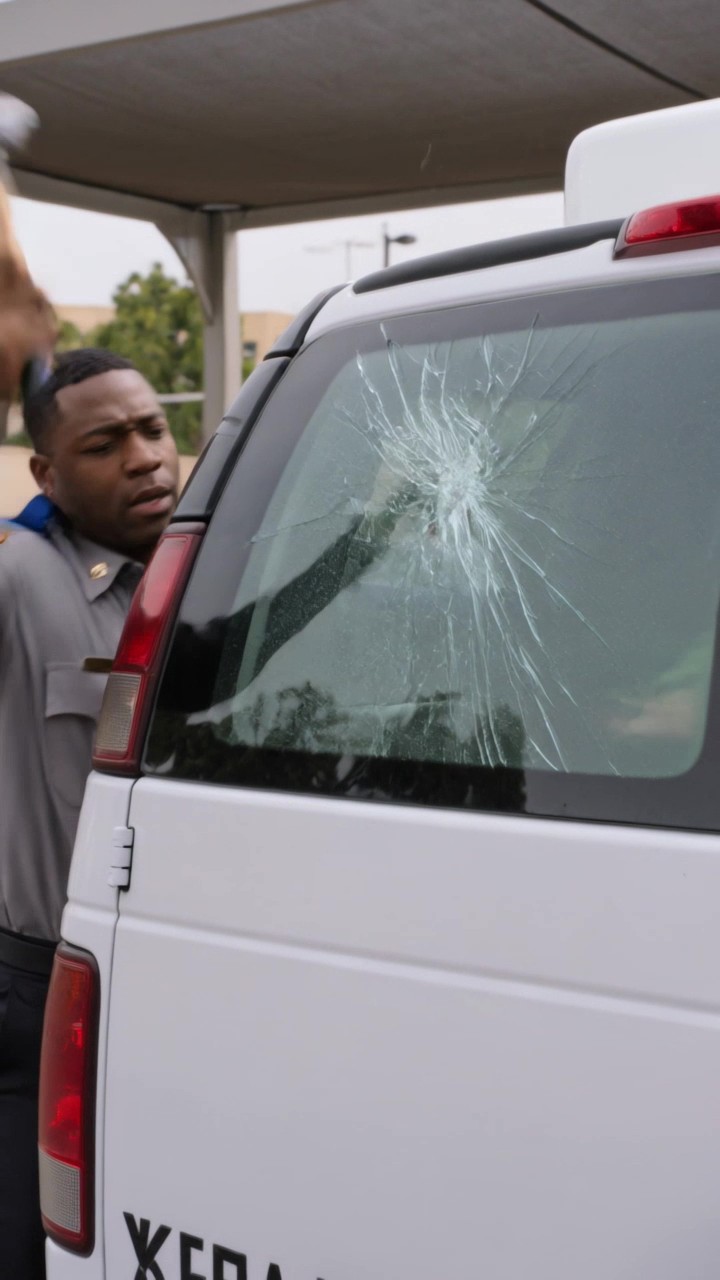
At the light beside the daycare, he noticed the fogged patch on the rear glass.
Then the hand.
He turned into the lot.
The front office doors were open, but everyone had gathered behind the building for the evacuation drill.
Marcus tried the van doors.
Locked.
He shouted.
No one answered quickly enough.
The rescue hammer came from his tow-truck emergency kit.
By the time Celeste reached him, he had already decided the cost of one window mattered less than the possibility that the hand would not appear again.
The parking-lot video spread online before the daycare issued a statement.
The first angle showed a rough-looking man in work clothes smashing a school van and reaching toward a purse.
The caption said:
TOW DRIVER TRIES TO BREAK INTO DAYCARE VEHICLE.
The second angle—recorded by a parent—showed him carrying Noah out.
By evening, Marcus had become a hero to strangers.
He disliked both versions.
The first made him a criminal from six seconds of incomplete footage.
The second made the daycare failure seem corrected by one dramatic man with a hammer.
The real problem began before he arrived.
Noah’s mother, Rachel Brooks, met Marcus at the hospital.
She hugged her son first.
Then stood in front of Marcus with tears in her eyes.
“I do not know how to thank you.”
“You do not have to.”
“I watched the video. They grabbed you.”
“They saw broken glass.”
“They heard you say there was a child.”
Marcus did not defend the daycare.
He also did not want Rachel to believe every person in the lot had ignored Noah intentionally.
“Panic makes people protect the explanation they already have,” he said.
“They had a list saying everyone was outside.”
Rachel looked at the attendance sheet sealed inside an evidence bag.
“Then the list was wrong.”
“Yes.”
The daycare initially described the event as an isolated human error.
The state licensing review found more.
The center used name-only attendance during transitions.
Teachers checked children by hearing responses rather than making face-to-name confirmation.
Transport drivers did not complete a physical sweep of the van after unloading.
The emergency drill started seven minutes after arrival, creating pressure to move quickly.
And the child count at the canopy was copied from the classroom sheet instead of rebuilt independently.
Noah was marked safe three times without one adult placing eyes on him.
Celeste had also instructed security to restrain Marcus after he said a child was inside.
She explained that the purse and broken window made his intention unclear.
The licensing investigator asked:
“What verification did you perform before treating the rescuer as the threat?”
Celeste had no answer.
She was suspended during the review and later returned as an administrator without transport or emergency authority.
Some parents demanded she be fired.
Others believed the failure involved too many people and procedures to place entirely on one director.
Rachel wanted accountability, not a single public villain.
“If firing one person lets every checked box stay the same, another child will disappear inside the paperwork.”
The daycare changed its system.
Every vehicle received a physical end-of-route sweep with a bright marker moved from the back row to the dashboard.
Two adults signed the empty-vehicle check.
Transitions required face-to-name confirmation.
Emergency counts were rebuilt from the children physically present rather than copied from previous lists.
Any discrepancy triggered an immediate building and vehicle search before a drill continued.
And any person reporting a child in a closed vehicle was treated as a safety witness until the vehicle had been checked.
Marcus received a bill for the broken window by mistake.
The daycare’s insurer generated it automatically under property damage.
Rachel brought the letter to the licensing hearing.
The room went silent.
The insurer withdrew the charge and paid for damage to Marcus’s glove and jacket.
Marcus refused an award ceremony.
He agreed to speak at one transport-safety training.
He placed the rescue hammer on the table.
“People keep asking how I knew,” he said.
“I did not know.”
The room waited.
“I saw enough that being wrong would cost a window. Being right could cost more if I waited.”
That was the lesson.
Emergency action often happens before proof becomes complete.
The person acting should still be reviewed.
The action should still be proportionate.
But uncertainty cannot always become an excuse for delay.
Noah remembered little about the van.
He remembered the dinosaur blanket.
The bright sound of breaking glass.
A man’s work glove clearing the edge.
For several weeks, he became frightened whenever a vehicle door locked.
His mother and therapist helped him practice.
Open.
Close.
Unlock.
Exit.
Control returned through repetition.
Marcus visited once with a new toy tow truck.
He did not tell Noah he had saved him.
He asked the child to inspect the truck.
Noah opened every small plastic door.
Then placed the dinosaur figure in the back seat.
“Check him,” Noah said.
Marcus looked through the tiny window.
“Seen.”
Noah smiled.
The daycare mounted no photograph of Marcus.
At his request, it placed a simple sign inside every transport van:
EMPTY IS SOMETHING YOU VERIFY, NOT SOMETHING YOU ASSUME.
Months later, Marcus stopped at the same traffic light.
The white van was parked in the daycare lot.
A driver walked to the final row, bent beneath every seat, and carried a bright orange marker toward the dashboard.
A second employee watched.
No child waited behind the glass.
Marcus drove on.
Being mistaken for a bad man had lasted several minutes.
A child being mistaken for a checked box could have lasted far longer.






Leave a Reply