
The applause stopped.
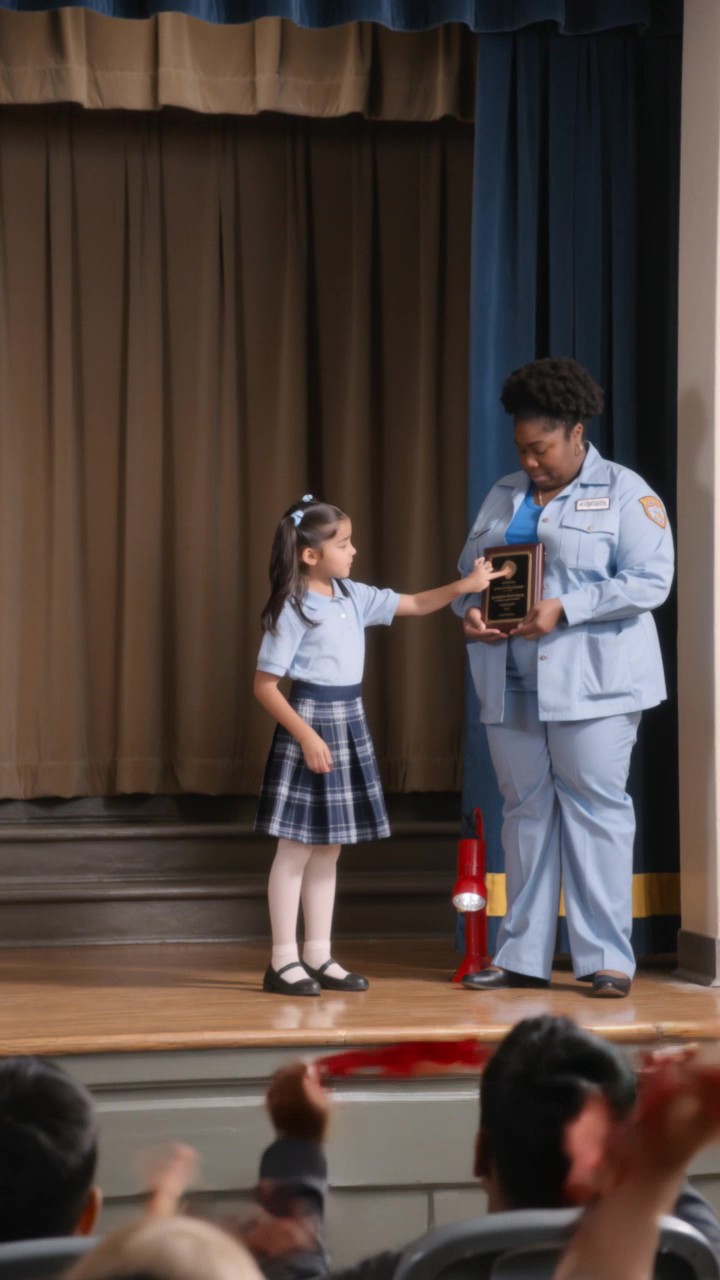
Rosa Bell stood beside the stage curtain holding an award she had never been told existed.
The red flashlight in her other hand was scratched along one side and wrapped with electrical tape near the battery cap.
It had guided children through darkness.
Now it exposed a story polished for daylight.
Four months earlier, Westbridge Elementary remained open during a severe-weather watch.
The district expected the storm line to pass north.
Parents were told students would shelter in place if conditions changed.
At 2:41 p.m., the tornado warning sounded.
Principal Charles Whitmore directed teachers toward the main interior hallway.
That route followed the school’s written plan.
Rosa was cleaning the science wing when she heard something the alarm could not explain.
A repeating metal pop above Room 4.
She had worked in building maintenance before taking the custodian position.
The sound came from roof fasteners lifting under pressure.
The main interior hallway sat beneath the widest roof span.
Rosa knew it was not the safest place anymore.
She entered Room 4.
Twenty-one first-graders were already crouched beneath desks, waiting to move into the hallway.
Rosa told teacher Leah Brooks:
“Keep them low. We are going through the cafeteria service corridor.”
Leah hesitated.
“That is not the tornado route.”
“The roof over the route is moving.”
Rosa pointed upward.
Another metal pop sounded.
Dust fell from a ceiling seam.
Leah trusted the person who knew the building from above the tiles and beneath the floors.
They moved.
Rosa used the red flashlight because the power failed before the children reached the cafeteria.
She attached strips of reflective tape to every third door so teachers behind them could follow without losing the route.
Sophie panicked when the lights went out.
She crawled beneath a serving table and refused to move.
Rosa crawled under with her.
She tapped the flashlight twice against the floor.
“Two taps means I am still here.”
Sophie answered with two fingers.
Rosa remained beneath the table until the child could move.
The group reached the low concrete service corridor seconds before part of the main hallway ceiling collapsed.
The roof did not fully cave in.
The falling tiles and metal supports still made the written route unsafe.
Charles had already moved several classes through the main hall before the damage.
When he saw debris begin falling, he ordered the remaining groups toward the gym exits.
That decision helped.
He coordinated reunification outside.
He spoke to emergency crews.
He did real work.
But he did not lead Room 4 through darkness.
The first district statement said:
“Principal Whitmore successfully directed the evacuation of all students.”
Rosa’s name appeared only in a staff list.
Leah submitted a correction.
No change followed.
The district wanted one spokesperson.
One leader.
One photograph.
Charles accepted the community praise without explaining that a custodian had changed the route and stayed with the youngest children.
At the hero ceremony, Sophie had been selected to present the plaque because her photograph beneath an emergency blanket had appeared in local news.
Nobody asked whom she wanted to honor.
She decided anyway.
The strips of red reflective tape held by the children came from the damaged corridor.
Leah had saved them.
Before the ceremony, she quietly gave one to each child from Room 4 and said:
“If you remember who helped you, hold this.”
She did not tell them to interrupt.
Children are capable of organizing truth without adults scripting every movement.
Charles looked at the raised strips.
“I never claimed Rosa did nothing.”
Leah stood.
“You accepted a plaque saying you led the children she redirected.”
The superintendent stepped forward, embarrassed by the public conflict.
Rosa spoke for the first time.
“Do not take away what he did outside.”
Everyone turned.
She continued:
“And do not use what he did outside to erase who was inside.”
That sentence prevented the event from becoming a simple villain story.
Charles had not hidden in safety.
He had followed the district plan until the building changed.
His failure came after.
He allowed leadership to mean ownership of every successful action beneath him.
Sophie still held Rosa’s hand.
“Were you scared?” she asked.
Rosa looked at the children.
“Yes.”
“Then why did you stay under the table?”
“Because you were there.”
Sophie nodded as if that answer were obvious.
The district suspended the ceremony and opened the incident review.
Building audio, teacher statements, emergency photographs, and maintenance damage confirmed Rosa’s account.
The main route had become unsafe.
Her decision to use the service corridor likely prevented injuries.
Charles received formal discipline for approving incomplete public materials and failing to correct the record after staff objections.
He remained principal under a performance plan, a decision that divided parents.
Some demanded removal.
Others believed his emergency work and later admission justified a chance to change.
Rosa did not decide his employment.
She asked for a different reform.
Emergency plans had to include building-service staff.
Custodians, maintenance workers, cafeteria staff, and bus teams knew physical details administrators often did not.
Every drill now required at least one alternate route chosen with those workers.
Incident reports listed actions by person and department instead of assigning all outcomes to the highest-ranking leader.
At the rescheduled ceremony, there was no single hero plaque.
The district placed the original award on a table.
Beside it were the red flashlight, reflective tape, the classroom attendance sheet, and the principal’s emergency radio.
The display read:
SAFETY WAS A CHAIN OF PEOPLE.
NO ONE PERSON OWNS THE WHOLE RESCUE.
Sophie objected.
“She still needs something.”
Rosa laughed.
Sophie gave her a handmade paper medal with a flashlight drawn in red crayon.
It said:
SHE STAYED UNDER THE TABLE.
Rosa wore that one.
Charles publicly corrected the story.
He did not call Rosa “one of my staff.”
He named her.
He said:
“Rosa Bell heard the roof changing before I did. She chose the safer corridor. I should have corrected the record the first time a teacher told me.”
The admission did not erase the months of silence.
It created a standard for what came next.
Rosa remained the night custodian.
The district offered her a building-safety coordinator position.
She accepted a hybrid role that allowed her to continue working inside schools rather than move entirely into an office.
Sophie visited her flashlight during every storm drill.
Two taps.
Pause.
Two taps.
The signal spread to other classrooms.
It did not mean one custodian would always arrive.
It meant:
Someone is here.
Someone is listening.
We move together.
Years later, Sophie no longer remembered every detail of the tornado.
She remembered darkness.
A red circle of light.
And the adult who became small enough to crawl beneath a table instead of standing outside the story and calling herself a leader.




Leave a Reply