
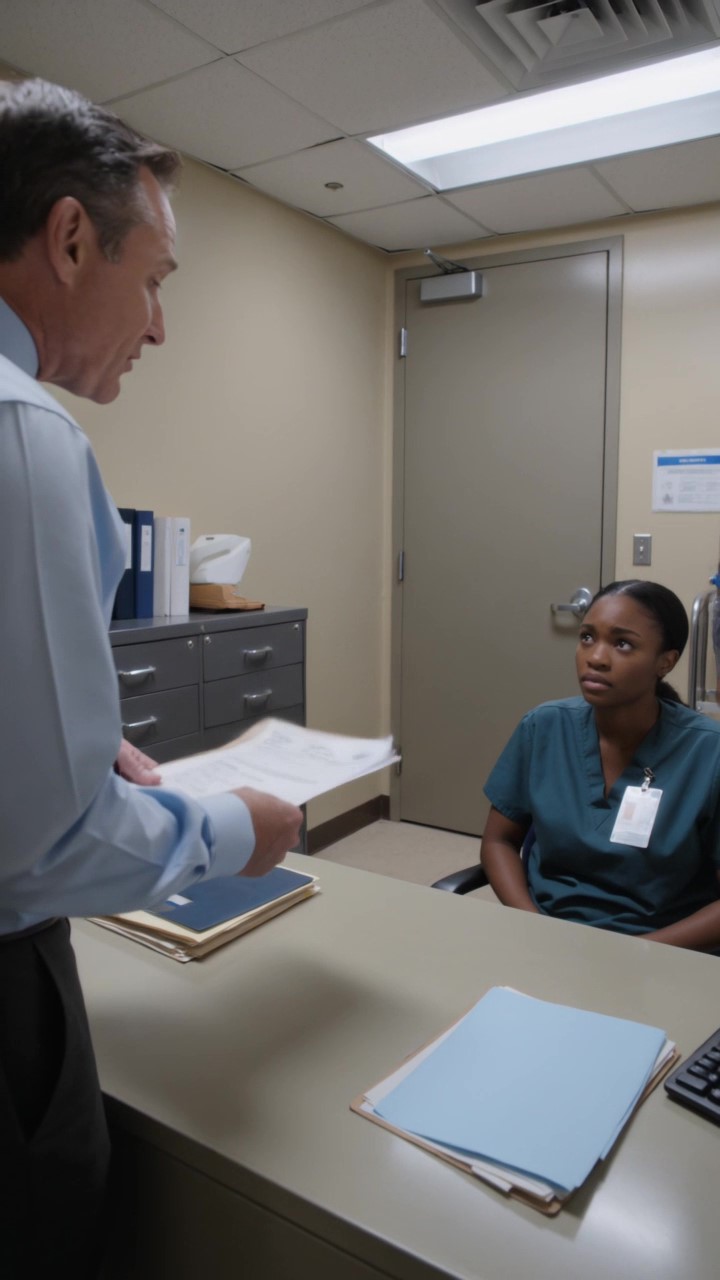
Thomas Bell survived because Maya Cole recognized the failure quickly.
That did not make the night harmless.
Thomas spent six hours in the emergency department.
His breathing remained difficult during transport.
His daughter Rachel believed the one person inside the house had failed to protect him.
Maya believed her nursing career might end because every visible sign on the cylinder said the equipment should work.
The truth required separating three questions:
What did Maya check?
What did the cylinder actually contain?
How did the wrong equipment enter a patient’s home?
Thomas lived alone in a small ranch house.
He had chronic lung disease and used prescribed supplemental oxygen.
Most of the day, an electric concentrator supplied the required flow.
A portable cylinder served as backup during appointments and power outages.
The home-care plan assigned a licensed nurse to visit three evenings a week.
Maya monitored medications, skin condition, breathing changes, equipment readiness, and communication with Thomas’s physician.
She did not select oxygen settings independently.
Those came from the medical order.
The equipment supplier delivered cylinders and maintained the regulators.
On the afternoon before the storm, Thomas’s backup cylinder was replaced during a routine delivery.
Samuel Ortiz drove the route.
He scanned the outgoing unit.
Scanned the replacement.
Checked the printed patient label.
And placed it in the approved storage bracket near the concentrator.
Samuel did not connect it because Thomas’s agency policy required the nurse or respiratory-equipment technician to verify the setup after delivery.
Maya arrived at 6:10 p.m.
Weather alerts warned of strong wind.
She performed the emergency-equipment check.
Cylinder secured.
Tamper seal intact.
Pressure gauge in the expected range.
Regulator attached.
Tubing available.
Delivery form matching Thomas’s name and address.
She documented each item.
At 8:42 p.m., the power failed.
The concentrator alarm sounded.
Maya moved Thomas to the portable setup according to the care plan.
She opened the prescribed equipment control.
The pressure gauge remained high.
The flow indicator did not move correctly.
Thomas said he could not feel oxygen at the tubing.
Maya checked for a kink.
Reconnected the approved line.
Tried the second regulator stored in the emergency kit.
Still no flow.
She did not spend twenty minutes trying to prove the equipment should work.
She called emergency services.
Positioned Thomas comfortably.
Used the charged portable concentrator battery kept for short transfers, but it had limited remaining capacity because the supplier had postponed replacement.
Paramedics arrived before the battery ended.
Thomas reached the hospital.
The recovered cylinder appeared to be a medical backup.
It carried Thomas’s printed label.
The digital delivery record listed the correct product code.
The gauge showed pressure.
When investigators attempted to draw oxygen through the patient regulator, no usable medical flow emerged.
The agency concluded Maya had either failed to open the cylinder correctly, damaged the regulator, or allowed the unit to empty before the storm.
Rachel remembered Maya turning controls repeatedly.
Fear turned that memory into suspicion.
The equipment company’s first internal report said:
No warehouse discrepancy identified. Delivered unit scanned as patient oxygen cylinder.
The agency suspended Maya.
A mandatory incident report went to the state nursing board because the event involved prescribed respiratory equipment and hospitalization.
A report is not the same as a finding.
Maya still saw her future collapsing inside the wording.
She had worked eleven years in home care.
A formal neglect determination could remove her from patient work.
Other employers might reject her before review concluded.
Charles Whitmore wanted the agency to act quickly.
Families needed to believe equipment checks meant something.
He believed terminating Maya showed accountability.
It also protected the agency’s equipment contract.
If the nurse caused the failure, the supplier remained reliable.
Samuel began questioning the delivery before the disciplinary hearing.
At the end of every route, drivers returned unused seals and damaged labels.
Samuel found one yellow seal missing from the training-equipment bin count.
The patient cylinder seals were blue under that company’s internal system.
The colors were not a universal medical code.
They were a warehouse safeguard designed to keep demonstration units away from clinical deliveries.
Training cylinders were used during caregiver classes.
They were pressurized with a non-medical medium so students could practice reading gauges and attaching equipment without consuming patient supply.
A permanent valve block prevented normal patient delivery.
The units were supposed to remain in a locked training cage.
Two days before the storm, the warehouse reorganized shelves.
Training cylinders and patient cylinders temporarily occupied adjacent lanes.
A printer update caused some scanners to generate a patient-route label when workers manually selected a replacement product after a barcode failed to read.
The training cylinder’s original barcode began with T.
The printed overlay began with P.
Samuel’s scanner displayed the overlay.
He had followed the screen.
That fact did not remove his role.
He had not checked the seal color.
Drivers were trained to scan labels, not interpret the yellow seal.
Some knew the difference informally.
Samuel did.
He failed to notice during a rushed route.
When he found the missing yellow seal count, he reopened the route history.
The scanner stored a faint image from the failed first barcode read.
The first character was T.
The software then showed a manual override to P.
The override belonged to a warehouse picker, not Samuel.
Samuel reported the discrepancy.
His supervisor told him:
“The recovered cylinder has already been classified empty. Do not complicate the investigation with color assumptions.”
Samuel asked that the tank be inspected by an independent biomedical technician before disposal.
The supervisor scheduled routine return processing.
Samuel placed a preservation hold through the company’s quality system.
He also contacted Maya’s union representative after confirming he could disclose the equipment record under the investigation process.
At the disciplinary hearing, Charles saw a delivery driver interrupting a nursing decision.
He tried to remove Samuel from the room.
The yellow seal forced the supplier’s internal controls into view.
The biomedical inspector confirmed the physical unit was a training cylinder.
Its pressure explained why Maya’s gauge check appeared normal.
Its valve block explained why the patient regulator could not deliver oxygen.
The patient label had been applied over the wrong barcode.
Maya had not failed to verify an empty tank.
She had been given equipment designed to resemble part of the checking process while being incapable of clinical use.
The hearing stopped.
The agency withdrew the termination.
It did not return Maya to patient visits immediately.
A full review still needed to determine whether she followed the response plan correctly.
The review examined her documentation, call timing, equipment sequence, and emergency response.
Maya had checked the backup at the start of shift.
When it failed, she tried the approved second regulator, used the available battery backup, and called emergency services within four minutes.
The nursing board closed the incident without a neglect finding.
Maya’s personnel record was corrected.
The agency paid back wages.
Charles issued a written statement to every employer or board entity that had received the original report.
Maya required exact language:
THE EQUIPMENT FAILURE RESULTED FROM A NON-CLINICAL TRAINING CYLINDER MISLABELED AND DELIVERED AS PATIENT OXYGEN. MAYA COLE FOLLOWED THE EMERGENCY PLAN AND ESCALATED PROMPTLY.
A private apology would not repair a professional accusation sent outside the room.
Rachel apologized too.
Her conversation with Maya was harder.
“I watched you touch the tank,” Rachel said. “Nothing happened. I thought you did not know what you were doing.”
Maya answered:
“I understood why you were afraid.”
“That is not forgiveness.”
“No.”
Rachel looked down.
“I told the agency to make sure you never entered another house.”
“Yes.”
“I’m sorry.”
Maya accepted the apology without pretending the relationship could resume immediately.
Thomas asked for her to return.
Maya declined for the first month.
She needed distance from the house where her competence had been publicly questioned.
Another nurse took the visits.
Later, Maya returned for one closing appointment with the new equipment system.
Thomas held her hand.
“I knew you called fast.”
Maya smiled.
“You were busy breathing.”
The equipment supplier faced regulatory and contractual review.
Investigators found no intentional substitution.
They found a chain of preventable failures.
Training and clinical cylinders stored too close.
Label software allowing manual product override without supervisor confirmation.
Seal colors known informally but absent from driver checklist.
No final physical product verification at loading.
A delayed portable-battery replacement.
And a quality supervisor willing to classify the cylinder before independent inspection.
The supplier suspended home deliveries for one day while auditing every route.
It replaced affected backup cylinders immediately.
Training equipment moved to a separate secured area with physically distinct protective collars and labels that could not be covered by route stickers.
Manual overrides required two employees.
Drivers received a product-verification checklist including physical features, not only barcode and screen.
Patient agencies had to confirm equipment serial numbers after delivery.
No single check became the safety system.
Samuel received discipline for missing the internal yellow seal cue only if the company could prove it had trained drivers formally.
It could not.
The warning was removed.
He still asked to repeat route-verification training.
“I carried the wrong cylinder into the house,” he said. “The software being wrong does not make my hands invisible.”
That attitude mattered.
Accountability did not require accepting blame for a system nobody taught him to see.
It required learning the gap.
The warehouse picker who made the manual override remained employed under a corrective plan.
She had been handling two lanes alone after a staffing shortage.
She scanned a damaged barcode.
The software suggested the nearest patient product.
She selected it.
The system did not show a photograph or require a physical confirmation.
The investigation refused to create another convenient individual villain.
Management had designed a process in which one rushed click could relabel the wrong object.
Charles lost authority over clinical discipline during a board review.
He had moved from allegation to termination before equipment preservation and independent analysis.
The agency reassigned him to scheduling and contract operations after formal discipline.
Some nurses wanted him dismissed.
Maya did not decide that outcome.
She asked the board:
“Why was ending my job faster than inspecting the object the accusation was built around?”
The agency changed its policy.
Equipment-related clinical complaints required evidence preservation before employee discipline.
Patient safety reports could still trigger immediate removal from duty.
Removal would be paid during initial investigation unless deliberate misconduct was already established.
External licensing reports distinguished allegation from verified finding.
And employees received copies of every statement sent in their name.
The agency also reviewed backup-power plans.
A single portable battery with delayed replacement was not enough during extended outages.
Patients received outage-specific plans coordinated among physicians, suppliers, utilities, and caregivers.
No story claimed a nurse or driver could solve regional power failure alone.
Maya returned to home-care nursing.
For several weeks, every cylinder check felt different.
She examined seals, serials, labels, valve features, and delivery records.
The process took longer.
Families asked why.
She told them:
“One label can be wrong. We check the whole object.”
The phrase entered agency training.
Samuel later visited a caregiver class.
He rolled in two clearly marked demonstration units.
One training.
One clinical.
He did not teach how to operate prescribed oxygen; the respiratory therapist handled that.
Samuel taught delivery verification:
Match the order.
Match the serial.
Match the physical unit.
Do not allow a route sticker to cover the manufacturer identification.
Stop if the object and screen disagree.
At the end of class, Maya placed the old yellow seal inside a clear evidence sleeve.
The agency wanted to display it with a photograph of her.
She refused the photograph.
The seal was enough.
The label beneath it read:
THE GAUGE LOOKED FULL.
THE BARCODE LOOKED CORRECT.
THE EQUIPMENT WAS STILL WRONG.
Months later, a driver noticed a patient-route label on a training carrier.
The cylinder had not left the warehouse.
He stopped the shipment.
The software team found a remaining template error.
No patient was involved.
No nurse was accused.
That quiet catch proved the system had improved.
Maya’s dignity and career were saved because a delivery driver treated one colored seal as evidence worth preserving.
Her competence had not disappeared during the storm.
It had been hidden behind an object designed to look correct from every angle the agency had chosen to check.







Leave a Reply