
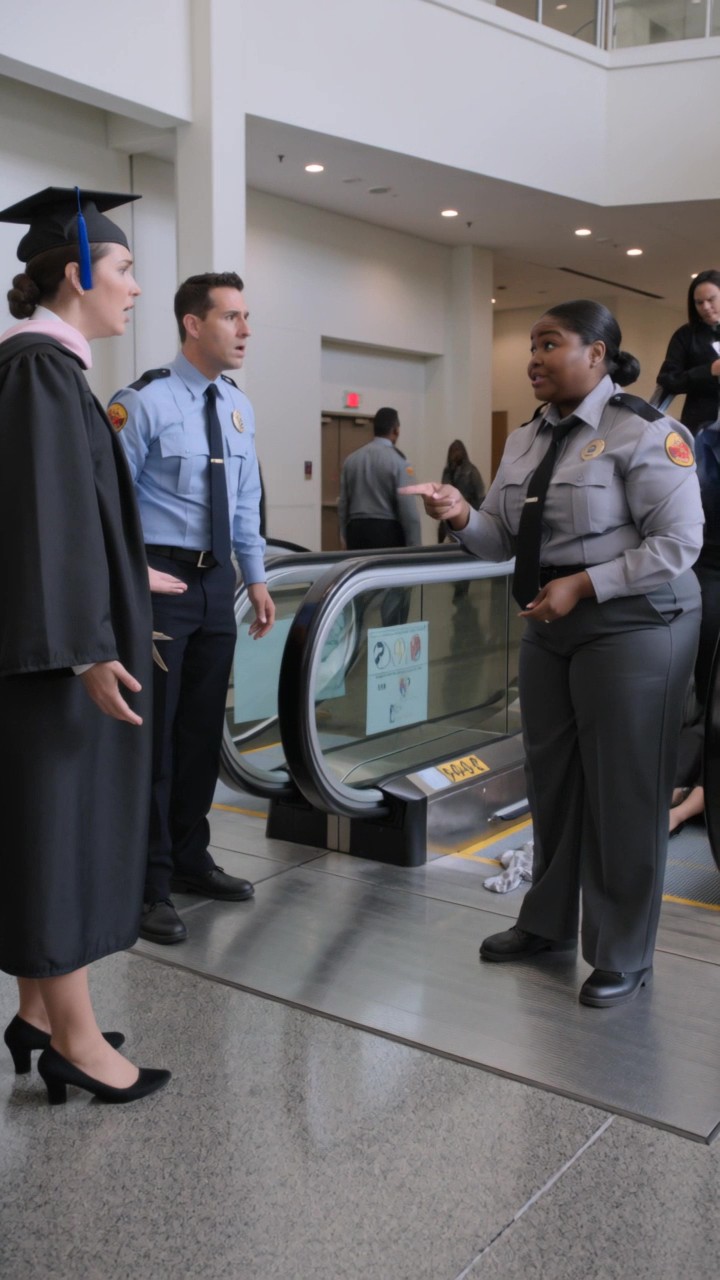
Maya Cole suffered a bruised hip and a scraped elbow.
Her graduation gown lost almost three feet of silver fabric.
The escalator stopped before anyone else reached the upper landing.
No person became trapped.
Those facts made the incident easier to repair than the outcome Rosa Bell believed she had prevented.
The Westbridge Convention Center hosted six high-school graduations in one weekend.
Thousands of families moved through the building.
Temporary signs directed students from dressing rooms to the main hall using two escalators and one elevator.
Maya’s school scheduled a formal processional.
Students wore standard black graduation robes.
Maya also wore a silver dress beneath hers.
The dress had belonged to her grandmother Elena.
Elena had sewn it for a community choir performance forty years earlier.
Maya’s mother, Rachel, altered the shoulders and added a narrow decorative train for graduation photographs.
The train was not part of the official robe.
It extended behind Maya when she walked.
At home and on flat floors, it moved safely.
On an escalator, loose fabric created a different risk.
Event instructions told graduates to lift long clothing.
The announcement played once before students entered.
Maya did not hear it over the crowd.
She stepped onto the escalator holding her cap in one hand and phone in the other.
Rachel followed several steps behind.
Rosa Bell worked overnight custodial operations at the convention center.
She cleaned floors, emptied bins, reset rooms, and reported damaged fixtures.
Before taking the job, Rosa spent eight years maintaining moving walkways at a regional airport.
She was not a licensed escalator mechanic.
Her airport work focused on cleaning access areas, checking warning brushes, identifying panel movement, and shutting equipment down when something changed.
She knew what a loose skirt panel sounded like.
A normal escalator produced steady mechanical noise.
A panel beginning to separate created a light repetitive click as the steps passed.
Three nights before graduation weekend, Rosa heard that click near the upper landing.
She found a side panel flexing slightly under hand pressure.
She submitted a maintenance ticket:
Right-side upper skirt panel loose. Edge lifts approximately quarter inch. Remove unit from public use pending mechanic check.
The facilities supervisor changed the priority from urgent to cosmetic.
A mechanic scheduled for the following week reviewed photographs and said the panel did not appear structurally displaced.
Staff applied clear protective tape across the edge as a temporary measure.
The escalator remained open.
The tape held during light traffic.
By graduation morning, repeated bags, shoes, and cleaning equipment had lifted one end.
Rosa noticed it during a pre-event floor check.
She radioed facilities.
Preston Hale, the event director, said the mechanic had already approved operation.
Rosa answered:
“He approved the photo. The tape is open now.”
Preston told her to place a cone near the side and keep people centered.
The first student group arrived before additional barriers could be found.
Rosa stood near the upper landing.
She saw Maya’s silver train resting against the right side.
At first, the fabric moved freely.
Then one corner stopped.
The remaining train continued forward with Maya.
The fabric tightened.
Maya did not feel it immediately because the black robe covered the attachment point and the escalator carried her upward.
Rosa shouted:
“Stop. Lift your dress.”
Maya turned.
The train pulled harder.
Rosa pressed the emergency stop.
Nothing happened immediately.
Later testing found the button worked, but the machine required a brief braking interval.
Rosa did not know whether the fabric would hold for that interval.
She carried rounded safety scissors used for opening supply packaging.
She stepped onto the landing.
Wrapped one arm around Maya’s waist.
Pulled her backward.
And cut the silver train near the dress seam.
The action looked violent.
Maya lost balance.
Rachel saw a custodian grabbing her daughter and cutting a family garment seconds before the ceremony.
She reacted before understanding the machine.
Security responded to the scream.
Preston removed the scissors.
The escalator continued moving just long enough to pull the detached fabric into the open side seam.
Then the brake engaged.
The silver train disappeared beneath the landing panel.
That visible proof changed the scene.
It did not answer every question.
The convention center opened an investigation.
Did Rosa need to pull Maya so hard?
Could she have stopped the machine sooner?
Why did she use scissors rather than wait for the brake?
Was the gown actually capable of pulling a person into the mechanism, or would the fabric have torn naturally?
Experts examined the garment, panel, and escalator.
The train had been reinforced at the waist during alteration.
The silver fabric itself was light.
The attachment stitching was stronger than expected.
The loose panel had created an opening large enough to capture folded material.
The escalator’s internal movement pulled the train beneath the landing plate.
Investigators could not state with certainty how far Maya would have been pulled before the dress tore.
They concluded the situation presented an immediate entanglement hazard and Rosa’s removal of the person was reasonable.
The force she used caused minor injury.
The likely alternatives carried greater uncertainty.
Rosa did not hide behind the finding.
She met Maya and Rachel with a student advocate present.
“I am sorry you fell,” she said.
Rachel folded her arms.
“You grabbed her without warning.”
“I shouted. She turned toward me.”
Maya remembered hearing something but not the words.
Rosa continued:
“I saw the cloth tighten. I chose to move you before I knew whether the stop would finish.”
Maya looked at the cut edge of the silver dress.
“It was my grandmother’s.”
“I know now.”
“You didn’t know then.”
“No.”
The answer mattered.
Rosa had not weighed sentimental value and rejected it.
She saw fabric connected to a person and a moving machine.
Emergency decisions often reduce a treasured object to material because the danger does not pause for biography.
That does not make the loss emotionally small.
Rachel had spent weeks altering the gown.
Elena had died the previous year.
The dress was supposed to let Maya carry her grandmother into graduation.
Now the back was cut unevenly.
Part of the original fabric remained inside the escalator until mechanics disassembled the landing.
The convention center recovered the train.
It was stained and stretched.
Rachel initially wanted to throw it away.
Maya stopped her.
“She saved the part still attached to me.”
That sentence did not erase anger.
It changed where the meaning lived.
A textile conservator volunteered to help after hearing about the incident.
Maya refused a dramatic restoration that would hide every cut.
The conservator shortened the dress and used a narrow section of the recovered fabric to create a removable silver sash.
The remaining damaged strip stayed unaltered inside an archival box.
At the rescheduled family photograph, Maya wore the shorter dress and sash.
The graduation ceremony itself continued after a delay.
Maya missed the original processional while receiving medical evaluation.
The school allowed her to cross the stage later with another small group.
She did not receive the exact moment she had rehearsed.
Safety does not rewind schedules.
The convention center paid medical costs, garment conservation, and event expenses.
It also faced a more serious facilities review.
Rosa’s urgent maintenance ticket had been downgraded without an in-person mechanic inspection.
The temporary tape had no documented recheck interval.
Event management kept the escalator open after Rosa reported the tape lifting.
The emergency-stop test occurred before the weekend but did not include response timing under full passenger load.
Preston did not create the loose panel.
He had accepted a photograph-based judgment over new physical evidence from the worker standing beside the equipment.
The center removed him from facilities authority while he remained in event programming after discipline.
Some families wanted him dismissed.
Rosa focused on procedures.
“Do not tell the next worker to center the crowd around a defect you already know exists.”
The escalator remained closed until a certified mechanic replaced the panel assembly and inspected the full unit.
The center changed its policy.
Any moving-equipment report involving a loose panel, unusual gap, repetitive click, lifted tape, or captured material triggered immediate shutdown.
Temporary coverings could not substitute for mechanical clearance.
Custodians and event staff received direct stop authority.
Formal events with gowns, costumes, mobility aids, or children required additional attendants at escalators and visible elevator alternatives.
Safety announcements appeared repeatedly, not once.
And workers reporting changing conditions could not be overruled solely by a prior photograph or inspection.
Rosa received a public commendation.
She accepted only after the wording changed.
The first draft called her a custodian who “instinctively prevented an accident.”
Rosa objected.
“It was not instinct. It was a reported defect and prior moving-walkway experience.”
The final statement named both.
That distinction protected the lesson.
Calling skill instinct often praises a person while hiding the training institutions failed to value.
The convention center offered Rosa a promotion to overnight facilities coordinator.
She accepted after the role included updated certification and actual authority to close equipment.
She remained involved in custodial planning.
Cleaners often saw machines at the hours when crowds were gone and subtle changes became audible.
Maya returned to the center six months later for a college fair.
She wore jeans.
At the escalator entrance, she paused.
Rosa was conducting a panel check with a mechanic.
Maya lifted the silver sash from her bag.
“I bring this when I have something important.”
Rosa smiled.
“You do not have to bring proof.”
“I know.”
Maya looked at the repaired side panel.
“Does it still click?”
“No.”
They listened together.
Only steady movement.
Maya stepped onto the center of the escalator and held the sash clear.
At the top, she turned.
“Thank you.”
Rosa answered:
“You can still be angry about the dress.”
“I was.”
“Past tense?”
Maya considered.
“Mostly.”
That was enough.
The silver train had vanished into the machine in front of everyone.
For several seconds, people believed Rosa was the person causing harm because she was the only one acting visibly.
The real danger had been quiet, mechanical, and already attached to Maya before anyone saw the scissors.





Leave a Reply