
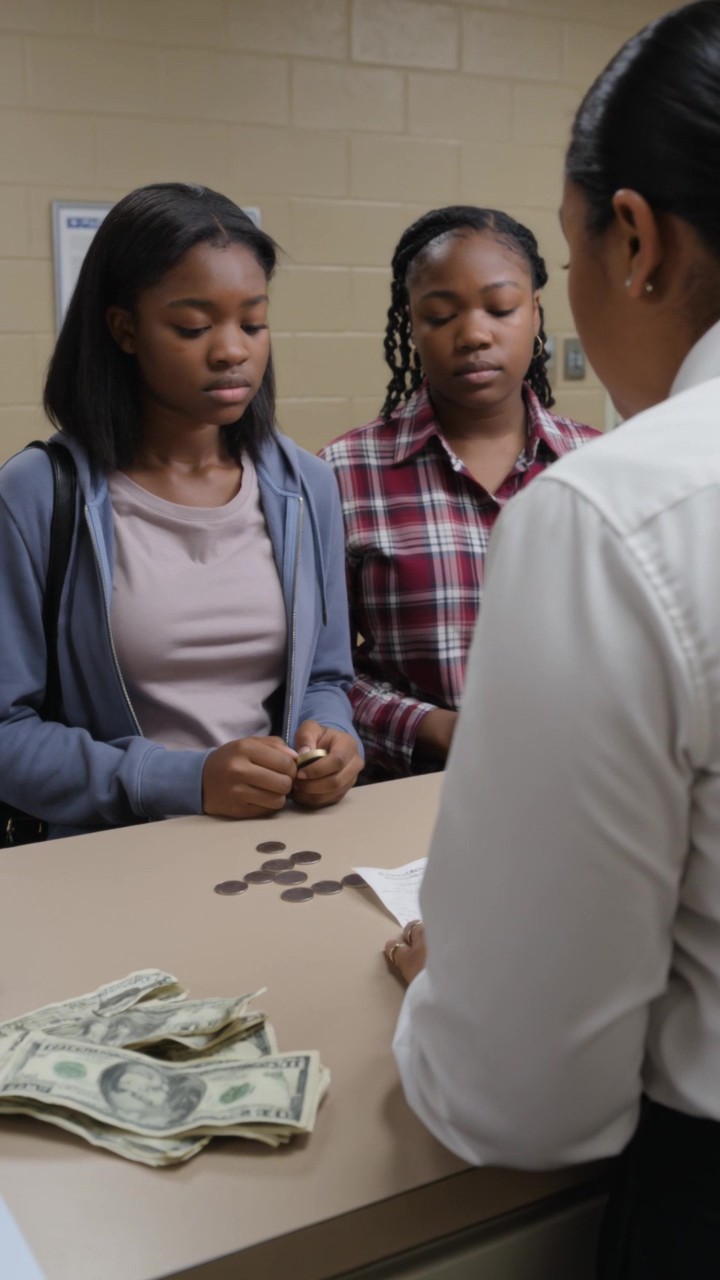
Maya Carter kept the second brass token in her fist until the metal warmed.
Her mother, Rachel, stood beside the college counter holding the tuition receipt.
Neither understood who the stranger was.
But Rachel recognized the sentence on the truck bumper.
Daniel Carter had painted those words above his workbench when Maya was a child.
He had been a mechanic for Westbridge Transit.
Not a driver.
Not a manager.
The person who inspected brake lines, replaced doors, and stayed late when buses returned with problems nobody wanted to carry into the next morning.
Daniel died three years earlier after a sudden illness.
He left no savings large enough to protect Maya from tuition deadlines.
He left tools.
Old uniforms.
A coffee thermos.
And one brass Route 9 token that should have become useless when the city changed to electronic fare cards.
The stranger had another.
Maya ran outside, but the painting truck had already turned onto the main road.
She photographed the company name on the door:
BELL & SONS CITY COATINGS.
There was no son listed on the website.
Only a business address in an industrial block near the old transit depot.
Rachel wanted to let the matter go.
“A person helped us. Maybe privacy is all he wants.”
Maya looked at the second token.
“He knew Dad.”
The next afternoon, she visited the address.
The man was painting a metal staircase behind a row of warehouses.
He saw Maya approaching and lowered his brush.
“I said no name.”
“You also left half a story.”
He sighed.
Then climbed down.
His name was Marcus Bell.
At sixteen, Marcus lived in a foster placement across town and worked nights washing dishes at a bus-station restaurant.
One winter evening, the restaurant manager accused him of stealing tips and fired him before the last Route 9 bus.
Marcus had no cash.
No coat thick enough for the freezing rain.
No safe place nearby.
Daniel Carter was repairing the rear door of the final bus.
Marcus asked the driver to let him ride and promised to pay the next day.
The driver refused.
Company policy required a fare.
Daniel heard the argument from beneath the bus.
He climbed out, wiped grease from his hands, and placed two brass tokens into Marcus’s palm.
“One for tonight,” he said.
Marcus asked why there were two.
Daniel answered:
“One for the day you see somebody else standing where you are.”
Marcus kept the second token.
He rode Route 9 to the home of a former teacher who helped him enter an apprenticeship program.
That apprenticeship became a painting job.
The job became a small company.
Marcus never forgot the mechanic beneath the bus.
But he lost Daniel’s last name.
For years, he carried the token, waiting for a person who needed a fare.
He paid for strangers’ groceries.
A motel room during a snowstorm.
A child’s inhaler.
None felt like the exact moment Daniel meant.
Then he stood behind Maya at the college counter.
Seventeen dollars short.
Holding the matching token.
Marcus knew.
Maya looked at him.
“You could have said all of that yesterday.”
“I could have.”
“Why didn’t you?”
Marcus dipped the brush into blue paint.
“Because your father helped me without making me perform gratitude in front of a line of people.”
The answer irritated her.
It also made sense.
Rachel arrived later that evening.
She brought Daniel’s old toolbox.
Inside the lid were faded marker lines recording repairs.
Near the bottom, one note read:
MARCUS — LAST ROUTE. TWO TOKENS.
Rachel touched the writing.
“He remembered your name.”
Marcus looked away.
“I wish I had found him sooner.”
“You found his daughter.”
That sentence almost turned the moment into a perfect repayment.
Maya refused to let it.
“Twenty dollars did not fix college.”
Marcus nodded.
“I know.”
The tuition balance was only the first problem.
Books cost hundreds.
Her work schedule conflicted with the required laboratory.
The family car failed twice during the semester.
Marcus did not become a secret millionaire.
He did not pay for everything.
He offered Maya weekend work maintaining records and painting small fixtures at his company.
She accepted only after negotiating hourly pay equal to the other assistants.
Marcus smiled.
“Your father would have asked that first.”
Maya completed the semester.
Not easily.
She failed one math exam and considered dropping out.
Marcus did not give a speech about Daniel.
He drove her to the tutoring center and waited outside with coffee.
Rachel began managing invoices for the painting company part-time.
The help moved in both directions.
Her bookkeeping exposed several unpaid city contracts Marcus had been too embarrassed to chase.
She helped him recover the money.
Years later, Maya became a transit-systems engineer.
Her first major project redesigned late-night bus access for students and low-wage workers.
The old Route 9 token sat on her desk.
The matching token remained with Marcus.
They did not join them in a display case.
Daniel had given two for a reason.
One to get home.
One to keep moving through the world.
Westbridge Transit eventually created an emergency fare program funded by unused card balances and community donations.
No rider was removed from the final bus solely for being short on fare.
At the program launch, officials invited Maya and Marcus to tell the story.
Marcus declined the stage.
Maya accepted, but she did not call him an anonymous angel.
She said:
“A stranger paid seventeen dollars because a mechanic once paid one bus fare. The important part is not that kindness came back to my family. The important part is that it stopped belonging only to us.”
Afterward, a student approached Maya.
His transit card had failed.
He needed to reach a night shift across town.
Maya opened her wallet.
The brass token could no longer pay the modern fare.
She kept it inside.
Then used her own card to purchase his ride.
Marcus watched from the back of the terminal.
He did not give his name.
He did not need to.
The second fare was still traveling.




Leave a Reply