
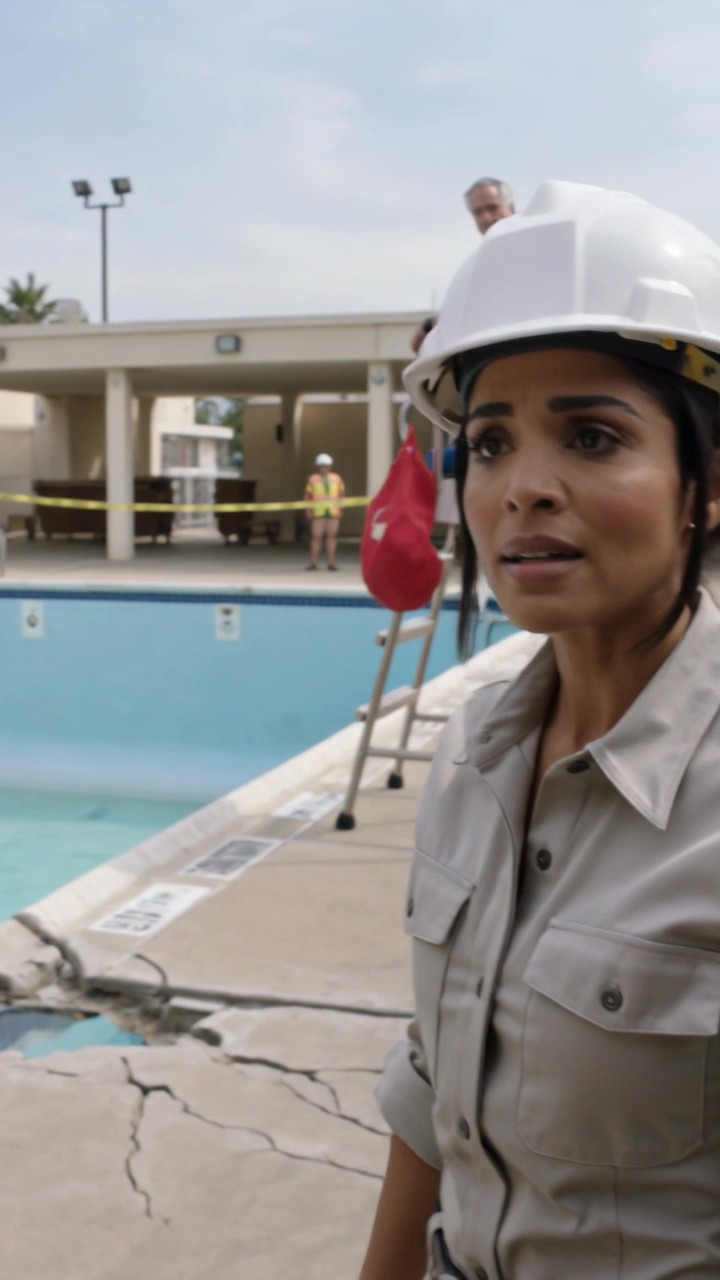
Lena Morales did not declare the pool safe because Henry Bell had once helped her.
She stopped the demolition because the first diagnosis did not explain the measurements.
That difference mattered.
A personal memory can make someone look again.
It cannot replace engineering evidence.
Riverside Community Pool opened in 1964.
The building was plain.
A rectangular indoor pool.
A smaller outdoor splash area.
Two locker rooms.
A multipurpose room where neighborhood children waited after school.
The facility needed work.
The roof had been patched repeatedly.
Several tiles were cracked.
The ventilation system struggled during winter.
Nobody honestly believed the pool could continue forever without investment.
The sudden deck failure looked like proof that the building had reached its end.
Three months earlier, a development company began excavating for a fourteen-story apartment building on the adjacent lot.
The foundation pit extended below the normal groundwater level.
To keep the excavation dry, contractors installed large dewatering pumps.
Those pumps removed water continuously and discharged it into the storm system.
Lowering groundwater around a construction site is common.
It also changes pressure in surrounding soil.
If fine soil particles move with the water, nearby ground can settle.
The pool’s shallow end sat on older fill close to the property line.
The city’s original site drawings were incomplete.
No settlement-monitoring points had been installed on the pool because the developer’s consultant classified it as a low-risk one-story structure.
The pool was not tall.
It was full of water.
Its shell depended on even support beneath a wide area.
The first crack appeared as a hairline near the shallow-end steps.
Staff reported it.
A city maintenance team filled it with sealant.
Two weeks later, the crack reopened.
Water loss increased.
The city hired a pool contractor.
The contractor saw the facility’s age, failed patches, and old shell.
He concluded the concrete had deteriorated and recommended closure.
The recreation department was already facing budget pressure.
Repair estimates appeared large.
Selling the site could fund a new regional recreation center several miles away.
The department accepted the failure diagnosis quickly.
Henry resisted.
He was not an engineer.
He had watched the pool for three decades.
He knew the seasonal water loss.
The usual deck movement.
The sound the gutter made when a filter valve stuck.
This crack behaved differently.
The shallow-end rail moved slightly away from the wall.
One lane line became uneven.
A locker-room door began sticking during the same month.
Henry submitted notes.
Management replied that old buildings often fail in clusters.
That answer sounded reasonable.
It was not evidence.
Lena arrived because a neighborhood organization hired her for an independent review.
The organization raised the fee through small donations.
Henry did not know she was the engineer until she walked through the gate.
At ten years old, Lena came to Riverside every afternoon because her mother, Rosa, cleaned offices in the municipal building across the street.
Rosa could not afford daily childcare.
Henry allowed Lena to sit in the lobby with homework as long as she remained away from the pool deck.
One afternoon, children from a swim team teased her for never entering the water.
Lena ran into the locker room.
Henry found her beside a bench, holding back tears.
She admitted she had fallen from a dock the previous summer.
An uncle pulled her out.
Since then, water covering her ears caused panic.
Henry did not promise to make her a swimmer.
He asked:
“Would you like to learn one thing that gives your body more time?”
She nodded.
For fifteen minutes after the pool closed, Henry taught her to float on her back in the shallow end.
He used a donated red swim cap with a black X above the right ear.
“Keep the X close to the water,” he said. “Do not fight to lift your whole head.”
The first day, Lena lasted two seconds.
Then five.
Then ten.
Henry did not touch her except when she asked for support beneath her shoulders.
He never charged Rosa.
He also did not turn the lessons into a public charity story.
Lena eventually joined beginner classes through a reduced-fee program.
She became a competent swimmer.
Not a champion.
The important change was that water became something she could study rather than only fear.
That interest led to civil engineering.
At university, she focused on groundwater, drainage, and infrastructure.
The red cap remained at Riverside because Lena forgot it after her family moved.
Henry kept it first in lost property.
Then on the lifeguard-chair hook because the black X reminded staff how a simple cue could make instruction understandable.
During the independent review, Lena placed settlement markers around the pool.
She compared elevation records from before construction.
The shallow end had dropped measurably toward the excavation.
She tested the crack flow.
Then asked the developer to pause dewatering briefly under controlled conditions.
When the pump stopped, groundwater pressure began stabilizing.
The pool’s abnormal drainage slowed.
That single test did not complete the case.
Further borings found loosened sandy fill beneath part of the deck.
Monitoring wells showed groundwater drawdown extending beyond the development’s predicted zone.
Fine particles had migrated toward the excavation system.
The pool shell had cracked because support beneath it changed.
The old concrete still needed repair.
Age made it more vulnerable.
The neighboring construction triggered the sudden failure.
Responsibility became disputed.
The developer argued the city’s neglected maintenance created the weakness.
The city argued the pumps caused the settlement.
Both were partly right.
If the pool had been newer, it might have tolerated more movement.
If the excavation had included better cutoff walls and monitoring, the movement likely would not have occurred.
A legal fight could last years.
The building could not reopen while waiting.
Lena proposed a temporary stabilization plan.
Reduce groundwater drawdown.
Install cutoff grouting between the sites.
Support the shallow-end deck.
Repair and test the shell.
Monitor movement continuously.
The cost was lower than demolition and replacement.
Still significant.
The developer’s insurer agreed to fund emergency stabilization without admitting full liability.
The city funded overdue roof and ventilation repairs rather than pretending every old problem belonged to the construction site.
The neighborhood accepted a six-month closure.
That decision disappointed families.
A saved building is not the same as an immediately usable building.
Children traveled to another pool.
Some stopped swimming because transportation was difficult.
Staff were reassigned.
Henry worried he would retire before reopening.
The city offered him a temporary desk role at a larger facility.
He accepted.
He did not volunteer for free to protect the pool’s identity.
Workers deserve wages during community campaigns.
The development company faced a formal review for inadequate neighboring-structure monitoring.
It installed additional groundwater controls.
Future excavations near pools, masonry schools, and other wide low-rise structures required settlement points even when the buildings were not tall.
The city changed too.
Independent review became mandatory before demolition when new construction occurred near a sudden structural failure.
A building’s age could no longer serve as the entire explanation.
Riverside reopened seven months later.
The shallow end had a visible new joint.
Lena asked the architect not to disguise it completely.
“People should know repair happened.”
Henry agreed.
The city wanted a plaque honoring Lena as the child saved by the pool who returned to save it.
She rejected the wording.
“The pool did not become structurally sound because I learned to float here.”
The final plaque read:
RIVERSIDE POOL REPAIRED AFTER INDEPENDENT GROUNDWATER REVIEW.
COMMUNITY REPORTS AND ENGINEERING TESTS KEPT A REPAIRABLE FACILITY FROM BEING DEMOLISHED.
Henry’s name did not appear.
He did not request it.
Lena placed the red swim cap inside a small display case near the beginner-class entrance.
Under the black X, she added one line:
ONE SMALL SKILL CAN GIVE YOU TIME FOR THE NEXT SAFE STEP.
On reopening day, a boy refused to enter the water.
His father became impatient.
Henry, now seventy-one and working his final summer, sat beside the pool edge.
He did not tell the child about Lena.
He held up a new red cap.
“Would you like to learn one thing?”
The boy shook his head.
Henry nodded.
“Then we sit today.”
The lesson had never been forcing courage.
It was creating enough safety that a person could choose the next step.
Lena watched from the observation window.
Years earlier, Henry gave her fifteen quiet minutes after closing.
She returned with measurements, testing, and a professional conclusion.
The small help did not purchase her future loyalty.
It gave her one early experience of fear becoming something understandable.
When the city was ready to bury the pool under an easy explanation, she knew to look beneath the surface.







Leave a Reply