
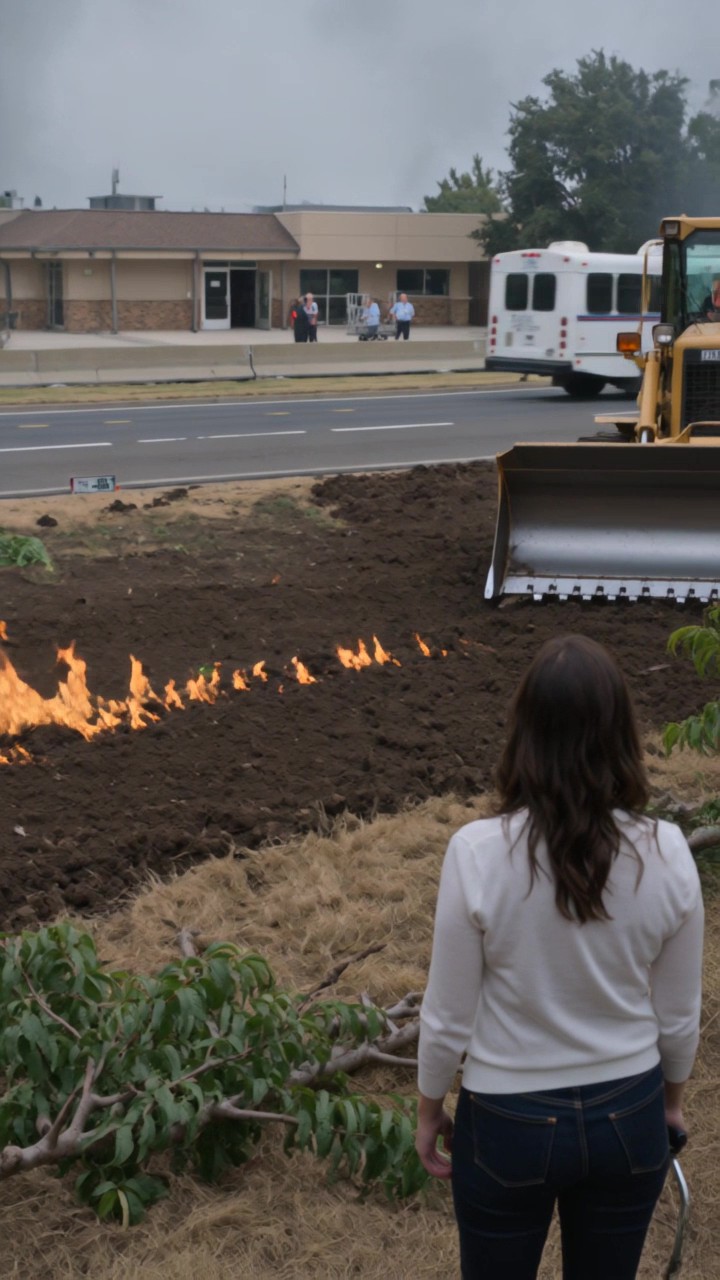
Every resident left Bellview Senior Center alive.
Every family in the mobile-home park reached the evacuation shelter.
The wildfire crossed part of the county road.
It did not reach the occupied buildings.
News reports called Ethan Cole’s decision a heroic sacrifice.
Margaret hated the word heroic.
Sacrifice sounded voluntary when spoken by people who lost nothing.
The Cole orchard contained fourteen acres of peach trees.
Not a vast commercial operation.
A family farm surviving through roadside sales, local markets, and seasonal contracts with two grocery stores.
Daniel Cole planted the first trees after leaving the military.
He used borrowed equipment.
Worked nights maintaining school buses.
Expanded one row at a time.
The orchard paid imperfectly.
Some winters the family borrowed against the next harvest.
Some summers heat damaged the fruit.
Still, it gave the family identity and income.
After Daniel died, Margaret managed sales and crop planning.
Ethan helped during pruning and harvest while working full-time for the county public-works department.
The silver pruning hook belonged to their father.
Its wooden handle had been replaced twice.
Daniel carried it through every winter row.
On the wildfire day, the county had already been warned about the gap.
A community wildfire plan identified the strip between Pine Ridge and the highway as a necessary secondary firebreak.
Most of the proposed line crossed public scrubland.
The final three hundred yards crossed private property:
The Cole orchard.
The county began negotiations.
It offered an easement payment and planned to thin vegetation along an existing service lane rather than remove productive trees.
Margaret agreed in principle.
Then funding shifted after storm damage required emergency road repairs.
The project stopped three hundred yards short.
The county treated the unfinished line as a next-season problem.
The fire arrived first.
It began twenty miles away during dry winds.
By afternoon, crews contained one flank.
The eastern edge moved through unmanaged grass and abandoned pasture.
Preston Hale, the incident commander, ordered evacuation of Bellview and the mobile-home park.
The plan assumed buses could clear residents before the fire reached the highway.
One senior-center bus developed a wheelchair-lift fault.
A second bus became delayed behind livestock trailers on the detour route.
Six residents remained inside.
The dozer team moved along the completed firebreak.
Ethan operated the lead machine.
When he reached the orchard boundary, the mapped line ended.
He radioed:
“Request authorization to continue through Cole property.”
Preston knew the orchard belonged to Ethan’s family.
He requested emergency property approval through county command.
Legal staff asked whether an alternate line could follow the creek.
The creek route contained soft ground and a wooden utility bridge unable to support the dozer.
A line along the highway would place crews directly in the path of windblown embers.
Minutes passed.
Fire does not understand administrative review.
Ethan saw burning leaves crossing the uncut grass.
The orchard itself was irrigated.
The ground beneath the trees remained partly clear.
But rows of dry prunings had been stacked for chipping after harvest.
If those ignited, fire could carry through the orchard canopy and throw embers toward Bellview.
A proper firebreak required removing trees, prunings, and surface fuel across a wide strip.
Ethan had enough time to cut one.
Not enough time to save both the center and the orchard rows nearest the highway.
Margaret arrived in a farm truck after hearing the county radio through a volunteer fire channel.
She believed firefighters would defend the orchard from its outer edge.
She did not know the senior center still had residents inside.
When Ethan lowered the blade, she saw only the machine destroying their father’s trees before flames had touched them.
Her anger was reasonable.
Ethan stopped rather than risk striking her.
He explained the trapped residents.
Then placed the pruning hook in her hand.
The gesture did not ask permission.
Emergency authority allowed him to act to protect immediate life.
It acknowledged who would carry the loss.
Ethan cut a firebreak approximately eighty feet wide.
He removed three mature rows and part of a younger block.
Another dozer cleared the stacked prunings.
Engine crews wet the road edge.
When the fire reached the bare strip, flame height dropped.
Crews held the line long enough for the buses to leave.
The orchard did not disappear entirely.
Thirty-eight percent of productive trees were destroyed by the dozers, direct fire, or heat damage.
The irrigation main broke beneath one track.
Smoke affected the remaining crop.
The grocery contracts were canceled for that season because the farm could not guarantee volume.
The family lost income immediately.
County officials arrived at the evacuation shelter that evening.
One suggested an award for Ethan.
Margaret answered:
“Bring a water crew to the broken irrigation line before you bring a plaque.”
The county did.
Emergency crews repaired the main overnight.
That saved some surviving trees.
The public investigation began after the fire.
It found Ethan’s decision consistent with emergency life-safety authority.
It also found the county’s unfinished firebreak and evacuation assumptions had created the final choice.
The project was delayed without a temporary mitigation plan.
Dry prunings near the proposed line had not been removed because the county and family disagreed about who would pay.
The senior center’s evacuation contract relied on two buses without a same-day lift check.
The mobile-home park had only one primary exit.
Preston had requested authorization rather than ordering Ethan forward immediately.
Some people blamed him for delay.
The review found his caution understandable because dozer lines on private agricultural property could cause major irreversible damage.
It also found emergency command lacked a clear threshold for acting when life evacuation and property preservation conflicted.
Preston remained incident commander but lost responsibility for pre-season mitigation planning.
He later testified publicly:
“Mr. Cole made the decision command should never have left to an operator whose own family owned the ground.”
That admission mattered.
Ethan refused the county bravery medal.
He asked that the money budgeted for the ceremony support orchard restoration and mobility-evacuation equipment.
The county said public funds could not simply be redirected.
Margaret laughed bitterly.
“Then find the form that can.”
They did, partly.
Insurance covered fire damage but disputed losses caused directly by county machinery.
The county’s emergency-damage process covered some trees and irrigation.
It did not cover the full future harvest value.
A disaster fund provided low-interest credit.
The senior-center foundation raised money.
Margaret initially refused donations tied to photographs of grateful residents.
“Our farm is not the price tag on their lives.”
A resident named Thomas Bell wrote to her:
“We are not paying for being alive. We are helping restore the place that made our road safer when the county had not finished its work.”
Margaret accepted the fund after it was placed under an independent agricultural-recovery trust.
The trust paid for soil testing, irrigation repair, new trees, and temporary income support for seasonal workers.
It did not rebuild mature trees instantly.
Peach trees need years before full production.
The family faced several reduced seasons.
That was the part television stories ignored.
A firebreak takes minutes to cut.
An orchard takes years to return.
The county completed the permanent wildfire line before the next dry season.
It did not pass through productive rows.
Engineers purchased a wider easement along the edge, installed an all-weather access lane, buried the irrigation crossing, and created a maintained fuel-reduction strip.
The mobile-home park received a second exit.
Bellview purchased a third evacuation vehicle with a manually deployable backup ramp.
Lift checks became mandatory before high-risk weather days.
Agricultural families joined mitigation planning before routes were finalized.
Ethan remained with public works.
For months, some farmers treated him as the operator who proved the county could bulldoze private land.
Others saw him as a hero.
Both versions made him uncomfortable.
He had not established a general rule that property never mattered.
He had made one decision with fire moving and people still inside.
Margaret’s relationship with him changed.
They had argued before.
Never about something irreversible.
During the first winter after the fire, they stood beside the cut rows.
Small replacement trees had been planted in protective tubes.
Margaret handed Ethan the silver pruning hook.
“You keep it.”
He shook his head.
“You run the orchard.”
“You carried the last decision Dad never had to make.”
Ethan took it.
Not as forgiveness.
As shared responsibility.
Margaret remained angry that he had not called her sooner during the developing fire.
Ethan remained angry that she stood in front of the machine.
They attended counseling through the agricultural recovery program.
That detail never appeared in news stories.
Families do not automatically become closer because one member saves strangers at shared cost.
The first replacement harvest arrived three years later.
Small.
Uneven.
Margaret delivered one crate to Bellview Senior Center.
No ceremony.
Residents ate peaches in the courtyard.
Thomas asked Ethan:
“Would you cut it again?”
Ethan looked toward the orchard.
“If those were the only choices, yes.”
Margaret stood beside him.
Then added:
“And the county’s job is to make sure they are never the only choices again.”
That became the real lesson.
The saving act was necessary.
The failure was allowing necessity to reach the operator’s blade.
A wooden sign now stands beside the permanent fire lane.
It does not call the orchard heroic.
It reads:
FIREBREAK COMPLETED AFTER THE PINE RIDGE FIRE.
MAINTAINED SO NO FAMILY, FARM, OR CREW MUST MAKE THAT CHOICE AGAIN.
The silver pruning hook hangs in Ethan’s dozer cab during fire season.
Not for cutting trees.
As a reminder.
Every emergency line crosses somebody’s life before it appears as a clean mark on a map.





Leave a Reply