
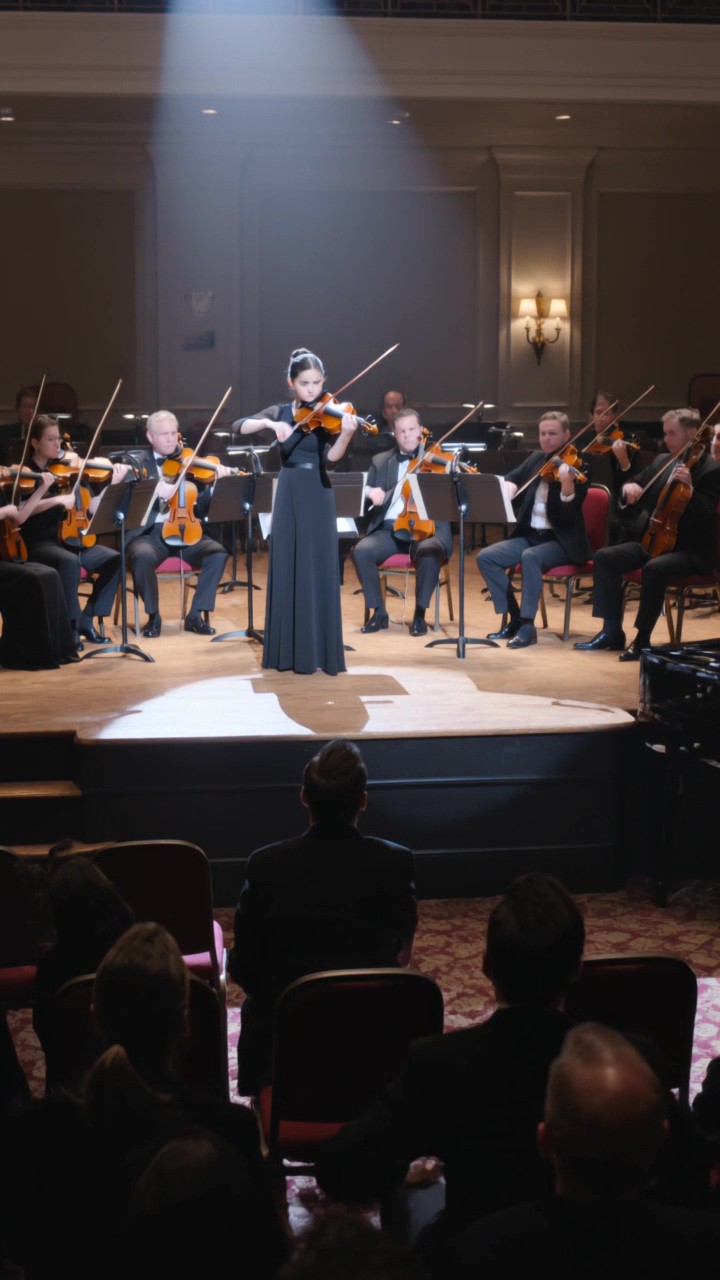
The silence lasted longer than the final note.
Then the scholarship judges stood.
Not because Nora Bell had played with theatrical force.
Because every musician in the room understood what had happened.
Grace Whitmore’s audition piece was technically difficult, but the real challenge lay in the partnership.
The violin carried the visible melody.
The piano had to breathe beneath it.
Support without dragging.
Lead without covering.
Anticipate when the young soloist would need half a second more.
The accompanist who walked out had played every rehearsal at the printed tempo.
Nora had played at Grace’s tempo.
That difference saved the performance.
Celeste Hart hurried toward the piano.
“Nora, return to the service area.”
The conductor turned.
“Not yet.”
His name was Adrian Vale, director of the Westbridge Conservatory Foundation.
He looked at the cracked metronome key on the stand.
“Show me the arrangement.”
Nora shook her head.
“I do not have it.”
“You said you wrote it.”
“I did.”
“From memory?”
“Yes.”
Grace lowered her violin.
“She has been helping me.”
Celeste looked sharply at the girl.
Grace explained.
During rehearsals at the hotel, the official accompanist repeatedly rushed the lyrical passages and blamed Grace for falling behind.
After each session, Grace practiced alone near the service corridor.
Nora heard her from the dish room.
One night, she tapped the correct pulse against a metal tray.
Grace stopped playing.
Nora tapped again.
Slow.
Steady.
Grace followed.
Over the next several weeks, they rehearsed without calling it rehearsal.
Grace played near the kitchen door.
Nora counted rests while stacking plates.
She marked breath points on scrap order paper.
She never entered the ballroom.
She never touched the grand piano until the accompanist left.
Adrian looked at Nora’s hands.
“You are not self-taught.”
“No.”
The answer opened a past the hotel knew nothing about.
Nora studied collaborative piano at Westbridge Conservatory twenty-three years earlier.
She was not the star soloist.
She was the student teachers requested when singers lost confidence or violinists struggled with tempo.
Nora could hear where another musician was going before they arrived.
She earned a graduate assistantship and expected to build a career accompanying students.
Then her younger brother Marcus suffered a serious illness.
Their parents had died years earlier.
Nora left school to care for him.
At first, the leave was temporary.
One semester.
Then another.
Medical bills grew.
Marcus recovered slowly but needed long-term support.
Nora worked hotel kitchens because evening shifts allowed her to attend appointments during the day.
Years passed.
Returning to conservatory became financially impossible.
Nora kept playing on an old keyboard in her apartment until several keys failed.
Eventually, even that stopped.
The cracked metronome key came from her student days.
Her instructor had broken the winding handle during a lesson and told her:
“Timing is not inside the box. The box only reminds you to listen.”
Nora carried the key in her apron pocket.
Not as a secret identity.
As proof that the part of her life everyone assumed had ended still existed somewhere.
Adrian remembered her name now.
“Nora Bell.”
She looked at him.
“You accompanied the vocal department.”
“Yes.”
“You disappeared before your final recital.”
“I left.”
“The faculty said you could not handle performance pressure.”
Nora’s face remained still.
“That was easier than saying the school had no emergency leave structure for caregivers.”
Several conservatory donors shifted in their seats.
Old institutions often turn structural abandonment into a personal weakness on the transcript.
Nora had not failed the program.
The program had no path for the life she was living.
Celeste whispered:
“This is a scholarship gala, not an employment hearing.”
Grace answered:
“It became both when you tried to remove the person playing for me.”
The judges asked Grace to repeat the final section.
This time Nora played again with the full orchestra prepared.
The performance was not identical.
Grace missed one high entrance.
Nora caught the change and reshaped the piano line beneath her.
That was what Adrian noticed most.
Not perfection.
Listening.
Grace completed the audition.
She received the scholarship.
The award did not belong to Nora, and Nora refused every attempt to make the girl’s achievement into a story about being rescued by a hidden genius.
“Grace practiced,” she said. “I made room for the work to be heard.”
After the gala, the hotel offered Nora a promotion to entertainment coordinator.
She declined.
The job was mostly schedules, contracts, and guest relations.
She wanted music.
The conservatory offered to restore her old enrollment and let her complete the degree.
Nora was fifty-one.
She did not need permission to pretend she was twenty-eight again.
She negotiated something different.
A paid position as an accompanist in the youth-access program.
Professional evaluation based on skill.
Training for updated technology.
And credit toward completing the credential only if it supported the work rather than delaying it.
Adrian agreed.
The conservatory also created an emergency re-entry policy for students who left to provide family care.
Tuition did not disappear.
Life did not become simple.
But leaving for someone’s survival no longer had to be recorded as an unexplained failure.
Celeste received disciplinary action after hotel staff described a pattern of preventing service employees from entering guest spaces even when their work was relevant.
She was not fired.
The hotel revised its performance-event emergency rules and paid Nora for the hours she had spent unofficially coaching Grace after management learned about the rehearsals.
Nora returned to the dish room for three more weeks while her conservatory contract was finalized.
Coworkers expected her to speak more now that everyone knew about the piano.
She did not.
Quiet had never meant empty.
She simply preferred words that completed a task.
On her final hotel shift, Grace entered the kitchen carrying the cracked wooden metronome.
A repair shop had restored the spring but left the damaged key visible.
“It works,” Grace said.
Nora wound it once.
Tick.
Tick.
Tick.
Too rigid.
She stopped it.
“Play without it.”
Grace smiled.
At the conservatory, Nora became known as the accompanist who never looked irritated when students stopped mid-phrase.
She asked:
“Where did you lose the music?”
Sometimes the answer was a measure number.
Sometimes fear.
Sometimes hunger.
Sometimes a parent waiting outside.
Nora listened before playing.
Students improved around her because she did not use skill to make their mistakes look smaller than her talent.
Years later, Adrian invited Nora to perform a solo recital.
She declined twice.
Then accepted one condition:
Half the program would feature young musicians she had accompanied.
During the final piece, Nora played alone.
No dramatic reveal.
No announcement that a dishwasher had become the best musician in the room.
She did not need the comparison.
The audience heard hands that had spent years beneath hot water and still remembered how to make a piano breathe.
Behind the stage, the cracked metronome key sat on the music stand.
A reminder:
The loudest person in the room does not set the truest tempo.
The person listening might.




Leave a Reply