
Nina Alvarez did not become important because a museum placed her hands on a wall.
The paintings mattered because the gallery had almost repeated the same mistake the work was trying to expose.
It admired labor once labor became art.
It tried to hide the worker when she arrived in uniform.
Daniel Alvarez grew up in a one-bedroom apartment above a laundromat.
His father left when he was seven and remained inconsistent afterward.
Some years he called.
Some years he did not.
Nina worked mornings at the Harbor Crown Hotel and evenings cleaning a legal office three nights a week.
She did not tell Daniel that hardship automatically made people stronger.
She told him work paid for specific things.
Rent.
Food.
School supplies.
Heat.
And sometimes twenty dollars for paint instead of a new pair of shoes.
Daniel drew constantly.
On grocery bags.
Hotel notepads Nina brought home after managers approved discarding them.
Cardboard inserts from new shirt packages.
He drew faces first.
Then buildings.
Then hands.
Hands interested him because they revealed what people were doing before the camera asked them to smile.
At twelve, he drew Nina folding fitted sheets.
At fourteen, he drew her repairing the zipper on his winter coat.
At sixteen, he drew her asleep at the kitchen table with one hand still holding a bus transfer.
Nina disliked that drawing.
“It makes me look exhausted.”
“You were exhausted.”
“That does not mean every truth needs an audience.”
Daniel kept it private.
The boundary shaped his later work.
He did not want to turn his mother’s labor into a sentimental product without consent.
When he entered art school on scholarship, instructors praised his observation.
They also encouraged him to make the work “more universal.”
One professor suggested removing hotel logos and domestic details so viewers would not read the paintings as family biography.
Daniel tried.
The paintings became technically polished and emotionally empty.
He returned to the specific details.
The blue housekeeping cart.
The red knuckles after a winter shift.
The thumb bent slightly from an old laundry-machine injury.
The neat way Nina folded cash into separate envelopes for rent, electricity, and groceries.
The work became a series called:
HANDS IN EVERY ROOM.
Not all the paintings depicted Nina.
One showed a dishwasher’s hands beneath steam.
Another showed a mechanic holding a child’s hair ribbon while repairing a bus seat.
Another showed a nursing aide rubbing lotion into an elderly patient’s forearm.
Daniel interviewed every subject.
Paid small modeling fees when grants allowed.
Asked what could be shown publicly.
No names appeared without permission.
Nina agreed to six sittings.
Then kept appearing in the work because her hands had shaped Daniel’s earliest visual memory.
She set conditions.
No photographs of her sleeping.
No hotel guest names.
No suggestion that she loved every sacrifice.
“I worked because we needed money,” she said. “Do not make poverty sound like a beautiful decision I made for your career.”
Daniel wrote that sentence in his studio.
The first major gallery rejected the series.
Its director said labor-themed work was difficult to sell unless it contained either anger or nostalgia.
Daniel’s paintings contained both, but not in simple forms.
A second gallery accepted three pieces.
They sold slowly.
Then museum curator Leah Brooks saw the series during a regional artist review.
She proposed a full exhibition.
The museum needed private sponsorship.
Celeste Hart, owner of a luxury hospitality group, funded the opening.
Her company operated hotels, restaurants, and event spaces.
She liked the series.
It matched a public campaign celebrating “the people behind service.”
Celeste purchased the final painting before the exhibition opened.
THE HANDS THAT KEPT THE LIGHT ON would later hang in her company headquarters.
Daniel was uneasy.
He needed the funding.
He also knew corporate admiration for workers often ended before wages, schedules, or authority changed.
The museum contract allowed the sponsor to host a private buyer preview.
Celeste’s team planned the opening photographs.
Daniel with curators.
Daniel with collectors.
Daniel with his “family inspiration.”
The team requested a photograph of Nina in formal black clothing.
Nina owned a black church dress.
She planned to change after work.
Then a hotel guest became ill and the room required additional cleaning before reassignment.
A coworker left early for childcare.
Nina finished both sections.
She reached the museum with eighteen minutes remaining and no time to go home.
The uniform was clean.
Her hands showed the day.
Celeste saw risk.
Not to safety.
To image.
She believed buyers would focus on the contrast between the artist’s success and his mother’s job.
That contrast was already the center of the exhibition.
Celeste wanted it controlled through paintings, captions, and elegant lighting.
Nina’s arrival made the labor present, not aesthetic.
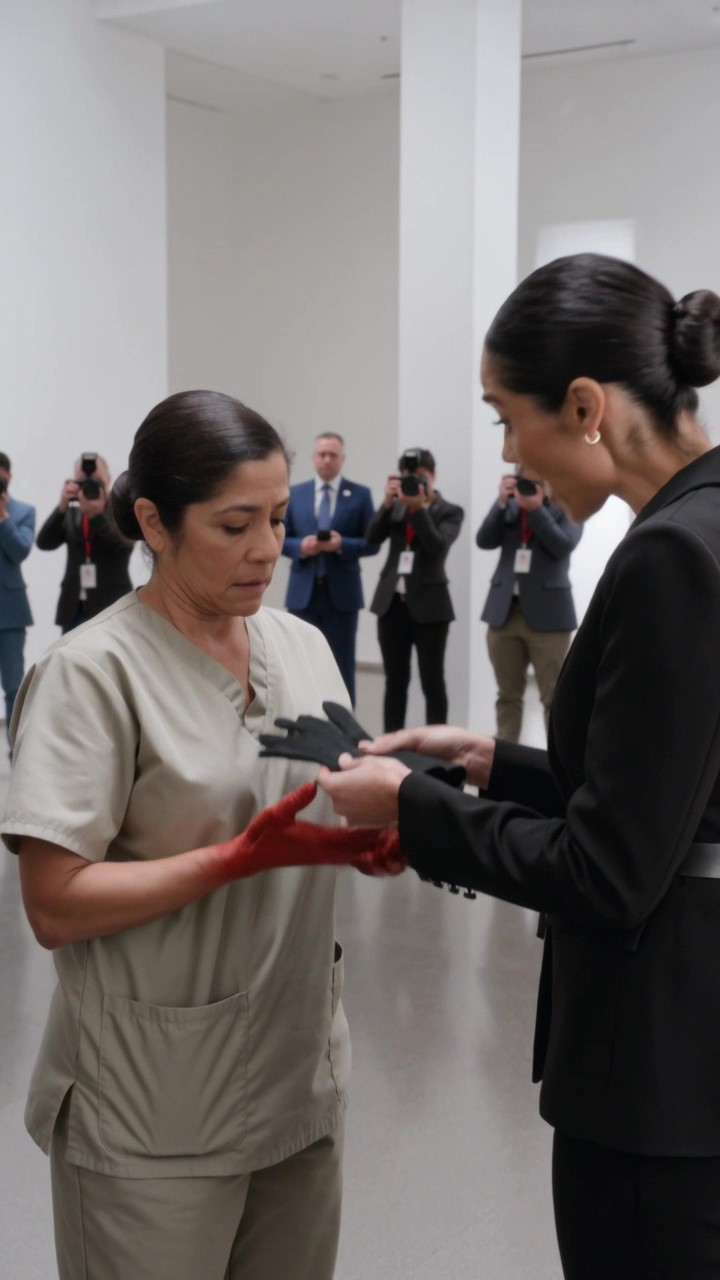
The black silk gloves came from a styling kit used for jewelry photography.
Celeste said they would “soften the hands.”
Nina understood immediately.
Her hands were acceptable thirty feet tall in oil paint.
Not beside expensive dresses holding a plastic museum cup.
Nina did not shout.
She placed the gloves down and sat behind the column.
Some viewers might interpret that as weakness.
Nina later described it differently.
“I did not want the first thing my son saw after five years of work to be me fighting with the person holding the sponsor microphone.”
She planned to tell him after the reveal.
The curtain dropped first.
The paintings made Celeste’s decision impossible to defend.
The curator brought Nina forward because she knew the artist’s subject list.
Daniel asked who had offered the gloves.
Celeste answered honestly.
The sponsor team expected Daniel to create a dramatic scene.
He did not destroy the photographs or throw anyone out.
He asked the museum to pause the private preview.
Then he took the microphone.
“My mother came from work,” he said.
“She was offered gloves because her hands did not match the buyer photographs.”
He pointed toward the paintings.
“This exhibition asks what happens when society wants the product of labor but not the visible worker.”
He looked at Celeste.
“We just received an answer.”
The room became quiet.
Nina did not want a public speech made over her.
She asked for the microphone.
“I do not need anyone to call my hands beautiful.”
That sentence surprised people.
Beauty was the gallery’s language.
Nina continued:
“They hurt. They need rest. They have done work I am proud of and work I would have left sooner if I had more choices.”
She lifted the bandaged knuckle.
“Respect is not pretending damage is decoration.”
Then she returned the microphone.
The opening continued.
Nina stood where she wanted.
Beside Daniel for one photograph.
Beside two hotel coworkers for another.
Alone beside the final painting for none.
She declined.
“The painting already has my hands.”
The incident spread online because a guest recorded Daniel’s explanation.
Some viewers praised him for honoring his mother.
Others accused the museum of turning working-class pain into luxury entertainment.
That criticism deserved attention.
The museum held a worker-panel discussion several weeks later.
Hotel housekeepers, maintenance workers, dishwashers, home-care aides, and museum cleaners participated.
They received honoraria.
The conversation moved beyond whether Celeste had been rude.
Workers discussed scheduling, repetitive injury, invisible emotional labor, tip theft, staffing ratios, and the expectation that service employees remain pleasant while exhausted.
Nina spoke once.
She did not become the permanent representative of every housekeeper.
Celeste attended.
Her first apology focused on intention.
“I believed gloves would make the photographs feel more formal.”
Nina answered:
“You offered them only to me.”
Celeste rewrote the apology.
She admitted she treated Nina’s work-worn hands as an image problem and used the language of presentation to disguise class discomfort.
She asked whether Nina wanted the painting purchase canceled.
Nina looked at Daniel.
The sale belonged to his career.
Daniel said the painting could remain sold only if the company accepted a condition.
The headquarters display would include a full label written with Nina’s approval:
This painting depicts hotel housekeeper Nina Alvarez. During its museum opening, the corporate sponsor attempted to hide her work-worn hands from photographs while displaying their image as art.
Celeste agreed.
Her communications team advised against it.
She signed anyway.
That action did not settle the larger issue.
Hale Hospitality reviewed its housekeeping practices after employees used the publicity to raise concerns.
Several properties relied on room quotas workers said were unrealistic.
Protective gloves existed but were often stocked in limited sizes.
Workers lost paid time traveling between distant floors.
The company commissioned an outside review with employee representatives.
Room assignments changed at three properties.
Travel time became part of workload calculation.
Supply sizes expanded.
A worker committee gained authority to challenge unsafe daily quotas.
Wages did not suddenly double.
Every problem did not disappear.
Public embarrassment created an opening.
Workers had to organize and use it.
Nina remained at Harbor Crown for another eighteen months.
Daniel hoped the exhibition income would allow her to retire immediately.
Nina refused.
One successful show was not a pension.
She also did not want to become financially dependent on her son at the moment his career remained uncertain.
They met with an advisor.
Daniel contributed to paying off Nina’s remaining debt.
Nina increased retirement contributions.
She reduced one office-cleaning shift after chronic hand pain worsened.
The museum’s occupational-health partner connected workers with an ergonomics clinic.
Nina received treatment and learned different gripping techniques.
She did not need her hands preserved as symbols while the actual joints deteriorated.
Daniel’s career advanced.
The exhibition traveled to two cities.
At the second museum, staff requested Nina appear in promotional photographs.
She declined.
“I am not touring as the painting’s proof.”
Daniel supported the choice.
The work had to stand without repeatedly extracting his mother’s story.
He expanded the series to include rest.
Hands not moving.
A closed cleaning cart.
A mechanic’s gloves drying.
A nurse asleep with hands open rather than folded around a task.
Critics said the new paintings were quieter.
Daniel considered that success.
One year later, Celeste invited Nina to the headquarters unveiling.
Nina attended in her church dress.
Not because the dress was more respectable.
Because she was not coming from work.
The label remained beside the painting exactly as agreed.
Several executives found it uncomfortable.
One asked why the company displayed an admission of error.
Celeste answered:
“Because buying the painting without the label would repeat it.”
Nina heard the sentence.
She did not congratulate Celeste.
Accurate behavior did not require a reward from the person harmed.
At home, Daniel framed no photograph from opening night.
He kept the black silk gloves inside a studio drawer.
Years later, a young curator asked to display them beside the painting as an artifact.
Nina refused.
“The insult is already explained. You do not need to make the gloves valuable too.”
The gloves remained ordinary.
That decision protected the point.
The gallery had tried to turn Nina’s hands into an embarrassment while selling their image.
The answer was not to turn every object connected to the humiliation into another collectible.
Nina eventually retired at sixty-seven.
Her coworkers held a small lunch in the hotel break room.
Daniel brought no cameras.
He gave her a tube of unscented hand cream recommended by the clinic and a pair of practical work gloves for gardening.
Nina laughed.
“These hands finally stop earning money and you give them another job.”
They planted tomatoes on the apartment balcony.
The bandage scar still appeared in the painting.
The redness faded after retirement.
Her hands changed.
Art froze one period.
Life continued.
At the museum, visitors still stood before THE HANDS THAT KEPT THE LIGHT ON.
Some called the hands beautiful.
Some called them strong.
The label asked for something more exact.
They belonged to a woman whose labor deserved pay, safety, rest, and public presence before anyone decided it was worthy of a frame.




Leave a Reply