
Rosa Alvarez did not go to the ceremony to replace one hero with another.
She went because the ferry company had received eighteen witness statements, three crew reports, and a time-stamped maintenance log—and still printed a program that erased the lower deck.
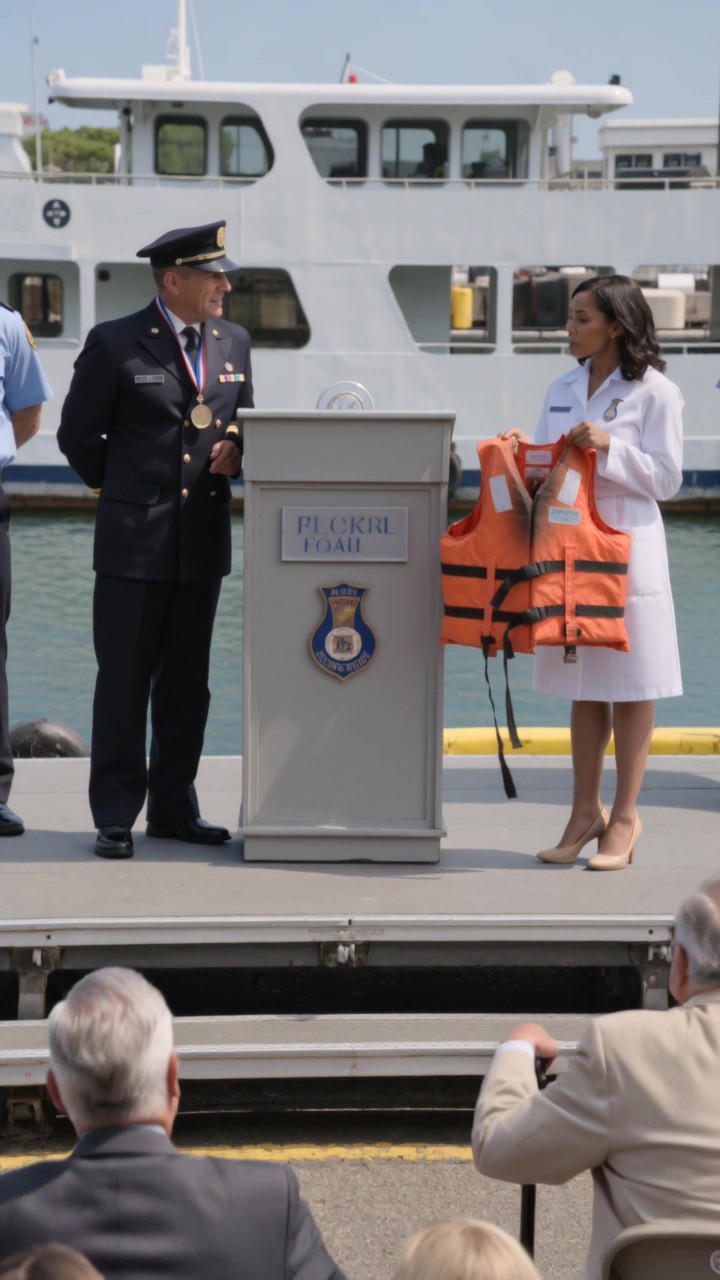
The orange life jacket made the missing part visible.
Two years earlier, the passenger ferry Harbor Queen left Westbridge at 4:20 p.m.
It carried sixty-three passengers and twelve crew members.
The crossing usually took thirty-five minutes.
Halfway through the channel, an electrical fault ignited insulation near an engine-room cable tray.
The automatic suppression system contained most of the fire.
Smoke entered the ventilation ducts before dampers fully closed.
An alarm sounded.
Captain Preston Hale ordered passengers to move to the upper deck and directed the ferry toward the nearest emergency dock.
Those decisions mattered.
The ferry remained stable.
The crew avoided panic on the main deck.
The vessel reached shore.
The problem developed below.
The lower lounge had been added during an older renovation.
Families used it because it was quieter and close to the restrooms.
A smoke door separated the lounge from the main central stairwell.
When the alarm activated, the magnetic hold released.
The door closed.
Its lower hinge had been damaged by a food-delivery cart earlier that week.
Under pressure from the warped frame, the latch jammed.
Passengers pulled.
The door did not open.
The emergency intercom in the lower lounge had a loose connection.
The button lit.
No voice reached the bridge.
Rosa worked in the ferry galley across the service corridor.
She was preparing coffee when she smelled electrical smoke and heard pounding behind the lounge wall.
She opened the galley door.
Smoke already covered the ceiling.
The central passenger route was blocked by the jammed door.
Rosa knew another route existed.
The ferry’s original design included a narrow freight hatch used decades earlier to move food crates from the lower deck to a mid-level service landing.
The powered lift had been removed.
The hatch remained.
A manual crank was stored behind a bolted galley panel for emergency maintenance.
Rosa knew about it because she had watched a technician use it during a plumbing repair.
Most passenger crew had never opened it.
She removed the crank.
The panel latch stuck.
She used the handle of a stock pot to knock it free.
Then she turned the mechanism.
The freight hatch opened only halfway.
The guide rail had not been lubricated.
Rosa crawled through first and reached the lower lounge from the side service corridor.
Eighteen passengers were inside.
Six were children.
One older man used a cane.
A woman had left her portable oxygen bag on the other side of the jammed smoke door.
Rosa did not tell everyone to run.
There was nowhere clear to run yet.
She took orange life jackets from the storage bench and created a route.
One jacket tied to the freight hatch.
One on the mid-level landing.
One at the rear stairwell door.
The color remained visible beneath emergency lighting.
She wrote the six children’s names on one jacket collar so she could count them without depending on frightened adults answering over each other.
Child first.
Then the older passengers.
Then the remaining adults.
The freight opening was narrow.
People moved one at a time.
Rosa and a deckhand named Marcus Bell lifted the older man through while another passenger held the cane.
A mother refused to move without the oxygen bag.
Rosa told her:
“The bag is replaceable. You are not.”
The sentence later appeared in a newspaper article attributed to Preston.
It had been Rosa’s.
On the bridge, Preston received reports that the main passenger areas were clearing.
He did not know the lower lounge door had jammed until a deckhand radioed from the mid-level service landing.
By the time Preston reached the stairwell, Rosa had moved fifteen of the eighteen passengers.
He helped the last three climb, ordered the deck sealed, and confirmed the passenger count.
Then he returned to the bridge.
Again, his role was real.
The false story grew afterward.
The ferry company faced regulatory questions.
Why had the smoke door remained in service after hinge damage?
Why did the intercom fail?
Why was the emergency freight route absent from passenger evacuation training?
And why did a galley worker know the alternate route better than officers assigned to safety?
The first company statement said:
“Captain Hale and the Harbor Queen crew evacuated all passengers through primary and secondary routes.”
Accurate.
Then a television interview introduced Preston as:
“The captain who personally entered the smoke-filled lower lounge and led families to safety.”
He did not correct it.
During a maritime-industry conference, Preston described tying life jackets along the corridor.
That was false.
Rosa watched the clip in the galley break room.
Marcus, the deckhand, told her to file a correction.
She did.
The company thanked her for “supporting the captain’s evacuation.”
The phrasing absorbed her action back into his.
Rosa needed the job.
She did not pursue the fight publicly.
The passengers did.
Thomas Bell, the elderly man with the cane, kept the orange jacket Rosa had placed around his shoulders.
The company allowed passengers to leave with emergency jackets because several were transported for medical evaluation and replacement inventory was already ordered.
Thomas noticed the children’s names on the collar.
He found the families through a reunion group.
They compared memories.
All eighteen signed statements.
The harbor board acknowledged receipt.
Then scheduled a medal for Preston alone.
Its reason was administrative.
The captain held ultimate responsibility for the vessel.
Awards traditionally went to the commanding officer.
Tradition made it easy to turn responsibility for the whole operation into ownership of every necessary act.
At the ceremony, Thomas raised the jacket.
The six children—now older—stood with their parents.
One girl pointed toward Rosa.
“She told us not to follow the loudest voice. Follow the orange jackets.”
The board chair turned to Preston.
“Did you open the galley freight hatch?”
“No.”
“Did you write the children’s names?”
“No.”
“Did you enter the lower lounge before Ms. Alvarez?”
Preston looked at the floor.
“No.”
“Then why did you tell the conference that you marked the route?”
Preston remained silent for several seconds.
“Because by then, it was the story everyone expected.”
Rosa answered:
“No. It was the story you were rewarded for.”
The ceremony stopped.
An independent maritime review reopened the public record.
Bridge logs showed Preston remained in command during the first minutes.
Galley maintenance records confirmed Rosa accessed the crank panel.
Service-camera footage showed passengers emerging through the freight hatch before Preston reached the landing.
Crew radio logs recorded Marcus saying:
“Rosa has the lower lounge moving through galley access.”
The evidence had never been hidden.
It had been summarized upward until only the captain remained.
The harbor board withdrew the individual medal.
Rosa refused to accept it alone.
“The captain kept the ferry moving toward shore,” she said. “Marcus helped people through the hatch. Passengers carried children. The engine crew contained the fire.”
The final recognition named the complete emergency team and described roles.
Preston received formal discipline for repeating actions he had not performed and was removed from company public-relations work.
He remained a licensed captain after retraining and regulatory review.
Some crew members wanted him dismissed.
Others believed his actual bridge decisions and later admission justified a narrower consequence.
Rosa did not decide his career.
She asked the company to fix the conditions that made the story possible.
Smoke doors received documented post-impact inspections.
Lower-lounge intercoms were tested before every departure.
All crew—including galley, cleaning, ticketing, and catering staff—trained on alternate routes.
Emergency maps showed service passages.
And no public incident account could be finalized before frontline reports were reviewed verbatim.
The freight hatch was rebuilt with an accessible manual release.
A bright orange plate marked it.
The six children helped choose the wording:
SECONDARY EXIT. OPEN WHEN THE MAIN WAY IS NOT SAFE.
Rosa accepted a paid role as passenger-emergency trainer while keeping two galley shifts each week.
She did not want to become an office figure who forgot what equipment looked like behind stacked food boxes.
Marcus became a deck-safety lead.
Thomas returned for the first drill after the changes.
He brought the scorched jacket.
Rosa asked him to donate it to the ferry archive.
He refused.
“You already let one institution hold the record.”
He kept it until his death, then left it to the six children together.
They placed it in the terminal training room with their names still visible.
Preston attended one training quietly.
Afterward, he approached Rosa beside the crank panel.
“I thought the public needed one person to trust.”
Rosa tightened the panel latch.
“They needed one ferry to trust.”
He nodded.
The distinction was larger than it sounded.
A captain can carry responsibility without absorbing every hand beneath the title.
The next engine alarm occurred during a docked maintenance test.
No smoke reached passengers.
Still, the crew opened primary and secondary routes.
A galley trainee turned the manual crank under supervision.
The hatch moved smoothly.
Nobody received an award.
The route worked before anyone needed a story.




Leave a Reply