
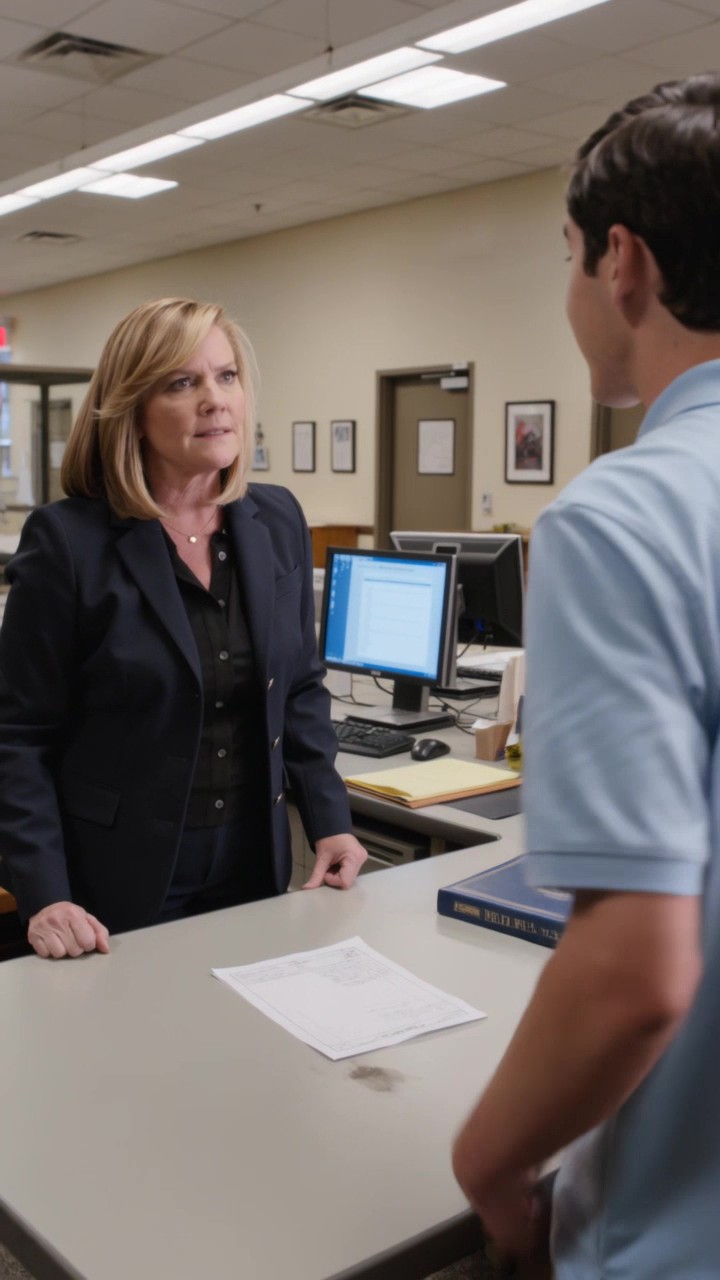
Eli Brooks had made mistakes at work.
That was part of why the accusation stuck so quickly.
He was nineteen, in his first semester at Westbridge Community College, and working twelve hours a week as a library page. He shelved books, moved carts, scanned returns, packed interlibrary loan envelopes, and carried archive boxes between offices.
The job was small in title and large in consequence.
It paid part of his tuition.
It also allowed him to study on campus between shifts rather than spending bus fare traveling home and back.
Eli wanted to become a social-work assistant. His academic record from high school was uneven, but he was improving. The library job gave him routine and references.
Two weeks before the scholarship-box incident, Eli made a shelving error. He placed a nineteenth-century history volume in the local government aisle. The book was found the next day. No patron lost access permanently. Still, Director Celeste Hart noted the mistake in his probation file.
She wrote:
Needs closer supervision with materials requiring accurate routing.
The note was fair as far as it went.
The danger came when that note became the explanation for a different problem before evidence was checked.
The missing blue archive box contained forty-two scholarship applications from students seeking emergency completion grants. The grants helped students facing eviction, car failure, childcare loss, medical bills, or other barriers that could force them to leave school before finishing a semester.
The foundation required paper originals because several documents included signed hardship statements and financial forms. The library served as the collection site. At noon, the applications would be reviewed in a donor luncheon room, then delivered to the foundation office by five.
Eli received the sealed box from the financial-aid desk at 10:15. He logged it on Cart B, signed the transfer, and rolled it to the processing office. The processing assistant was away from the desk. Eli left the box on the incoming table according to routine.
He did not know that the donor events team was also preparing a display. The display used blue archive boxes for historical photographs of past grant recipients. A senior administrator entered processing at 10:22 looking for display materials. She saw the blue box, stamped a routing slip, and moved it to the donor exhibit room.
She did not read the side label carefully.
Her calendar was full, the luncheon was behind schedule, and the blue box looked like the others.
That was a mistake.
But by 11:05, when the applications could not be found, the administrator had already left to greet donors. Celeste checked the transfer log and saw Eli’s signature. She remembered his shelving error. She concluded the problem likely began with him.
Eli searched processing, circulation, and two storage closets. Panic made him clumsy. He knocked over a stack of periodicals. Celeste interpreted that as more evidence of carelessness.
She prepared a termination form stating that Eli had failed to route time-sensitive scholarship materials and compromised donor review.
Had he signed it, the record could have followed him beyond the library. Even if the box was found later, personnel documents often travel farther than corrections.
Samuel Ortiz understood that because he had spent thirty-two years in circulation before retirement. He volunteered two mornings a week repairing worn book jackets and training students on old equipment. He knew the library’s routes the way drivers know streets.
He also knew the date stamps.
Processing used black ink.
Financial aid used red.
The donor exhibit room used blue because the event staff wanted blue date marks on temporary accession slips.
Samuel noticed the smudge on Eli’s cart log. It was blue. That meant someone had stamped the box or log after it left Eli’s assigned route. The mark was not proof of innocence by itself, but it pointed away from the simple story.
When Celeste told him to stay out of personnel matters, Samuel did not argue job titles. He showed the ink.
They found the box beneath a cloth banner in the exhibit room. The senior administrator had placed it there, intending to arrange the display later. Every application remained sealed. The deadline was still reachable.
The foundation reviewed the applications on time.
Three students in that box received grants the following week.
One used the funds to keep an apartment.
One repaired a car needed for clinical placement.
One paid a licensing test fee.
Eli kept his job.
But he did not return to work the next morning as if nothing had happened.
He had stood in front of a director, a donor representative, and coworkers while being asked to accept blame for losing other students’ futures. His hands shook for days whenever he signed a cart log.
Samuel found him in the stacks.
“You are checking the same label four times,” he said.
Eli answered:
“Four is safer than one.”
“Four is fear. Two with attention is a system.”
That became the beginning of the repair.
The library reviewed material routing. It found the problem was not one student worker or one administrator. Multiple departments used similar blue boxes. Event staff could enter processing without a check-out requirement. Time-sensitive financial materials traveled through ordinary carts. Probation notes about one type of error could influence discipline for unrelated incidents.
Celeste apologized to Eli.
Her first attempt focused on the outcome:
“The box was found, and your termination was not processed.”
Eli said:
“You wrote it.”
Celeste paused.
Then corrected herself.
“I wrote a termination before confirming the route. I let a previous mistake decide what I believed about this one.”
That apology mattered because it named the act.
The senior administrator also apologized. She remained employed but lost unsupervised access to processing during financial-aid collection periods and received disciplinary documentation for mishandling restricted materials.
The library changed policies.
Scholarship boxes became bright green with large labels on every side.
Only financial-aid staff or trained processors could move them after receipt.
Time-sensitive boxes used two-person transfer logs.
Event materials could not be stored in processing during scholarship weeks.
Cart logs included ink-color checks because Samuel’s observation proved useful.
And probation notes had to describe specific skills without becoming a general character label.
Eli received paid time to retrain rather than being treated as lucky to keep the job.
He learned improved routing.
He also gained the right to ask for a second staff check on restricted items without being mocked for anxiety.
Samuel declined formal recognition at the donor luncheon.
He said:
“If you want to thank me, put the ink chart where student workers can see it.”
The library did.
A laminated card appeared near the cart station:
BLACK — PROCESSING.
RED — FINANCIAL AID.
BLUE — EXHIBIT.
GREEN — SCHOLARSHIP LOCKBOX.
If color and route disagree, stop the cart.
Months later, Eli made another mistake. He placed a stack of returned DVDs on the wrong media shelf. He reported it himself. The supervisor corrected it without turning it into a character judgment.
Progress did not mean perfection.
It meant mistakes were handled at the right size.
At the end of the year, Eli applied for one of the same completion grants after his bus pass funding ran out. He worried the library incident would bias the application. The process was blind. He received a small transportation grant.
On the award notice, he recognized the green lockbox tracking number.
He laughed for the first time about the whole thing.
Samuel told him:
“See? Systems can protect you from people’s memories.”
Eli later trained new pages.
On their first day, he showed them the cart routes and ink chart.
Then he said:
“If something goes missing, do not sign a story just because someone important writes it quickly.”
That sentence became unofficial library wisdom.
The scholarship box was saved.
Eli’s job was saved.
But the deeper rescue was his right to be more than the worst small mistake in his probation file.







Leave a Reply