
Nobody touched the recorder.
The voice inside it was weak, interrupted by radio static and the roar of something burning nearby.
Ben had no clear memory of his father’s face.
But the voice entered him like something remembered by the body before the mind.
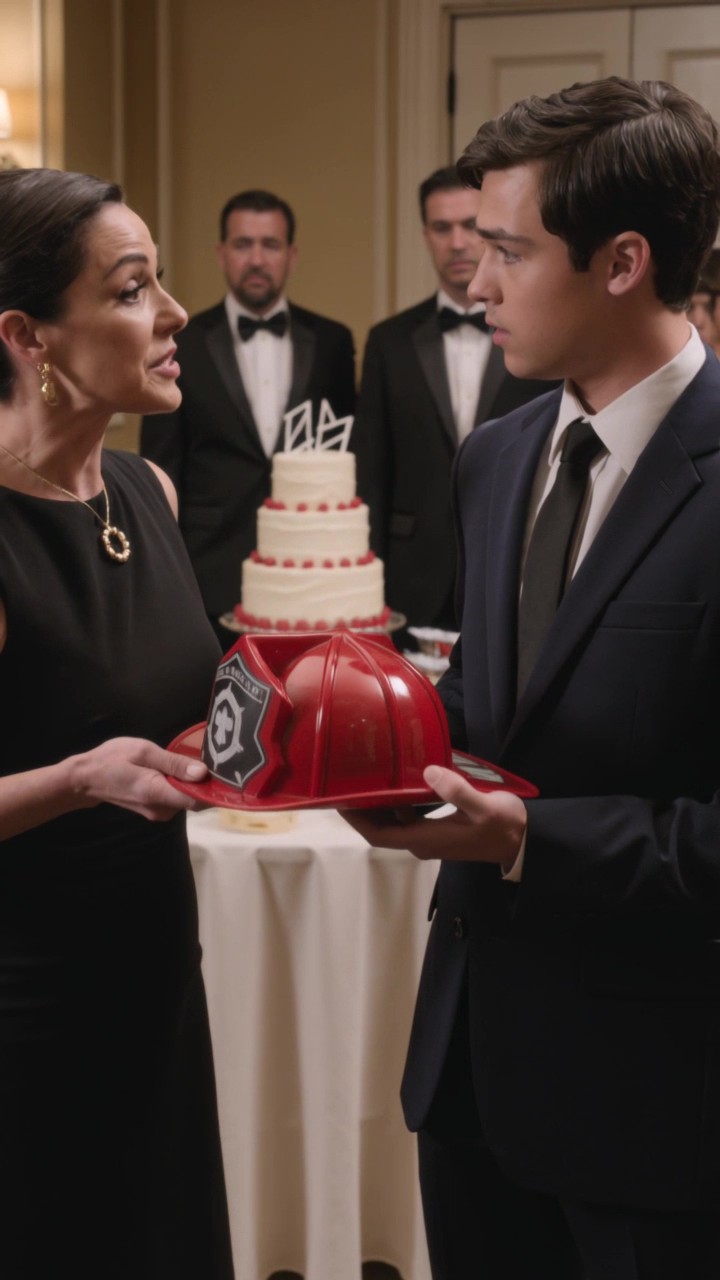
Nora Bell picked up the red helmet carefully.
“The recorder was sealed beneath the lining after the fire investigation,” she said.
Charles stared at her.
“Why was it never given to the family?”
Nora looked at him.
“It was.”
The ballroom shifted.
Ben turned toward his uncle.
Charles’s face changed.
Not guilt alone.
Fear.
Seventeen years earlier, Daniel Carter worked as a night security guard at the River Street warehouse complex.
He was not a firefighter.
Not trained for rescues.
The warehouse included a community childcare room used by night-shift employees.
When an electrical fire started in the loading area, alarms failed in the rear corridor.
Daniel saw smoke beneath the childcare door.
He entered before the fire crew arrived.
Three children were inside.
One hid beneath a table.
Two were trapped behind a fallen storage rack.
Daniel carried the first child out.
Returned for the second.
Then used a maintenance cart to move the rack enough for the third child to crawl free.
Witnesses saw him leave the building afterward.
That was the moment the public story went wrong.
Daniel did not leave to escape.
He ran toward a secondary fire entrance to guide crews to a maintenance passage where two cleaning workers were still missing.
The roof collapsed before he returned.
His body was found two days later near the service stairwell.
The first news report called him “unaccounted for after leaving the scene.”
By the time authorities corrected the wording, people had already decided what it meant.
The cleaning workers survived in a sealed utility room.
The three children were too young to identify the man who carried them out.
Daniel became a question.
Then a rumor.
Then, inside the Carter family, an embarrassment.
Nora had been the dispatcher receiving broken radio transmissions from the warehouse.
Daniel carried a small voice recorder because the security radios often failed inside concrete structures.
During the rescue, he recorded short location notes for incoming crews.
The final recording contained the children’s status and one sentence about Ben.
Investigators logged the recorder as damaged property.
Months later, Nora requested it be returned to the family.
She delivered it to Charles because Ben’s mother was hospitalized and Charles handled Daniel’s estate.
Charles told her he would protect Ben from “confusing hero stories” until the investigation was complete.
It was complete within weeks.
Charles never returned the recorder.
Ben stared at him.
“Why?”
Charles looked toward the guests as if privacy still existed in the room.
“Your mother was dying.”
“She lived three more years.”
“She was fragile.”
“Why?”
Charles’s voice broke.
“Because Daniel had always been the brave one.”
The confession did not arrive nobly.
It came in pieces.
Charles and Daniel grew up in the same small town.
Daniel became the son who fixed neighbors’ roofs, stopped at accidents, and remembered birthdays.
Charles became successful.
Built a property company.
Paid family bills.
Still felt invisible whenever Daniel entered a room.
After the warehouse fire, Charles saw what the heroic story would do.
Daniel would become even larger in death.
Charles would raise the child beneath the shadow of a brother everyone praised.
So he let the rumor remain.
Not by inventing the fire.
By withholding the one object that corrected it.
He told himself Ben needed stability more than truth.
Over time, that excuse hardened into family history.
Ben picked up the recorder.
The next section played.
Daniel’s voice was quieter:
“Ben turns one next week.”
A cough.
“If I miss it, give him the red helmet. He thinks I am a fireman when I wear it.”
The helmet had been Ben’s toy.
Daniel used it during bedtime games.
That was why it sat in the warehouse security office.
He wore it for a photograph on Ben’s first birthday invitation, making the baby laugh.
The fire melted one side.
Daniel still placed the recorder beneath its lining because it was the only object he knew would reach his son.
Nora had kept the helmet after Charles refused it.
She waited.
At first because Ben was a child.
Later because the family moved and cut contact.
Every year, she checked public records.
On Ben’s eighteenth birthday, she decided adulthood was old enough for the truth Charles had kept deciding he could not handle.
Ben asked to hear the recording again.
Nora warned that the final minutes contained fire noise and emergency confusion.
He listened only to his father’s message.
Not the rest.
He did not need the sound of death to prove love.
The ballroom guests began leaving quietly.
The birthday celebration could not continue as planned.
Charles asked to speak with Ben alone.
Ben refused.
Not forever.
That night.
“I have spent my whole life trying not to become a man who runs,” he said. “You built that fear out of my father’s grave.”
Charles lowered his eyes.
He had raised Ben.
Paid for school.
Sat beside hospital beds.
Helped with homework.
His betrayal did not erase every act of care.
His care did not excuse the betrayal.
Both truths made forgiveness harder.
Ben left the country club with Nora and the burned helmet.
Over the next months, the warehouse fire record was formally corrected in the local memorial archive.
The three rescued children, now adults, were located.
One remembered a red plastic helmet.
Another remembered a man saying:
“Close your eyes and hold my jacket.”
The third remembered being carried beneath a wet blanket.
They could not give Ben his father back.
They gave him fragments of the person Charles had hidden.
The city added Daniel Carter’s name to the warehouse memorial.
Ben refused a large ceremony.
He wanted one sentence engraved:
HE RETURNED AFTER THE CHILDREN WERE SAFE.
Charles attended from the edge of the crowd.
Ben did not invite him to stand with the family.
Not yet.
Nora gave Ben the recorder in a protective case.
The red helmet remained burned and uneven.
A restoration specialist offered to repair it.
Ben declined.
“The damage is part of why the message stayed hidden.”
He placed the helmet on a shelf beside one photograph of Daniel holding him as a baby.
No dramatic altar.
No perfect hero story.
Daniel entered a burning building without formal training.
That decision could have created another victim.
It also saved three children.
Ben learned to love a father without turning every choice into legend.
He studied emergency management, not firefighting.
He became interested in how early errors in public information harden into permanent stories.
His first research project examined the phrase “left the scene” and how context changes its meaning.
Years later, Charles asked if he could hear Daniel’s message.
Ben considered refusing.
Then pressed play once.
When the voice said, “Tell my son I did not run away,” Charles covered his face.
Ben did not comfort him.
He let the truth do what it should have done seventeen years earlier.
Remain in the room long enough that nobody could replace it with something easier.






Leave a Reply