
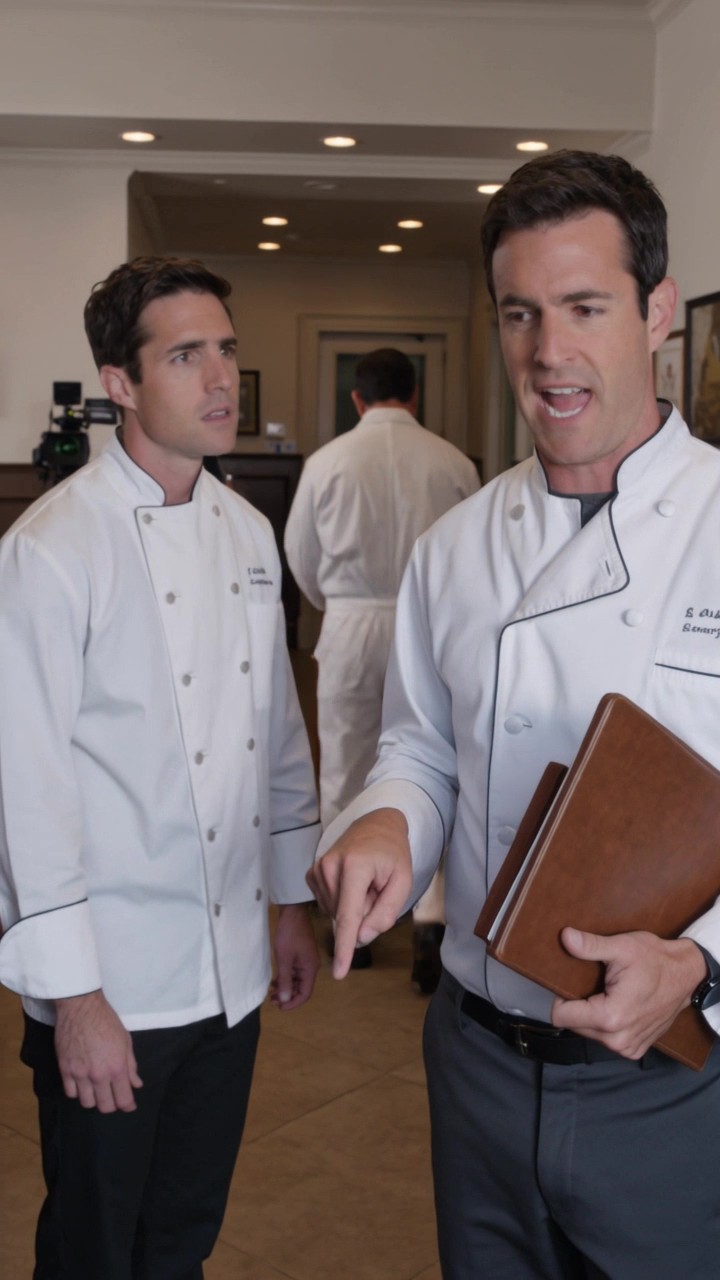
Henry Bell did not return to the ribbon.
He stood beside the service corridor while investors, guests, and restaurant staff looked toward him.
Ethan walked across the lobby.
“You guaranteed the lease?”
Henry nodded.
“Why didn’t you tell me?”
“You said you wanted to build it yourself.”
Charles Whitmore stepped closer.
“This is impossible. I introduced the investors.”
“You introduced people,” the landlord said. “None of them guaranteed the first three years.”
The restaurant project had nearly collapsed eleven months earlier.
Ethan had a strong menu, excellent training, and years of kitchen experience.
He also had student debt, limited collateral, and no previous ownership record.
The bank approved equipment financing only if he secured a lease guarantee.
Charles promised one.
Then withdrew after the final budget showed the restaurant would not become profitable as quickly as he expected.
He told Ethan the bank had changed its terms.
That was partly true.
He did not mention his own withdrawal.
Henry learned about the problem when Ethan asked whether the old bicycle repair shop had space to store restaurant chairs.
He did not have enough money to guarantee the lease personally.
He did have the shop building, owned jointly through a neighborhood small-business cooperative.
The cooperative operated a guarantee pool.
Members could pledge a portion of property equity to support new local businesses, but the decision required a risk review and monthly contribution.
Henry presented Ethan’s plan without naming their relationship at first.
The committee liked the projected lunch service, apprenticeship positions, and use of local suppliers.
Henry then disclosed that Ethan was his adopted son and removed himself from the vote.
The cooperative approved the guarantee.
Henry pledged his shop’s share.
If the restaurant failed badly, the fund could claim part of his building equity.
The landlord agreed to the lease.
Ethan believed Charles’s network had opened the final door.
Henry let him believe it.
Not because he wanted a future dramatic reveal.
Because Ethan had spent years saying he did not want to be treated like a rescued child.
At nine, he entered Henry’s home carrying one plastic bag and a recipe card from his mother.
Adults praised Henry for “saving” him.
Ethan hated the word.
It made every meal, school fee, and family disagreement feel like debt.
Henry stopped using it.
He adopted Ethan because he wanted a son, not an audience.
When the restaurant guarantee became necessary, Henry helped quietly for the same reason.
The mistake was not the help.
The mistake was silence after Charles began claiming the project as proof of biological family returning.
Charles filled the gap.
He introduced suppliers.
Secured local press.
Paid for the launch event.
Then gradually reframed the story.
Ethan’s talent came from “the Whitmore side.”
His business ambition emerged only after reconnecting with his real father.
Henry became the mechanic who had provided a stable childhood but could not understand the next level.
Ethan accepted more of that story than he wanted to admit.
At the opening, he saw Henry’s coveralls and imagined the investors’ judgment before hearing a single word.
He sent the man who raised him toward the door used for boxes.
Henry looked at the final lease certificate.
The landlord needed his signature because the restaurant had passed inspection and the guarantee was entering its active term.
He could sign.
The doors would open.
Or he could refuse and end the launch.
Charles looked at him.
“You should not risk a repair shop for a restaurant with these margins.”
Henry answered:
“That is what the cooperative review was for.”
“Then sign and stop turning this into a family scene.”
Henry looked at Ethan.
“I did not turn it into one.”
Ethan lowered his eyes.
The staff waited.
Food was prepared.
Hourly workers expected their first full shift.
Canceling the opening would not punish only Ethan or Charles.
Henry signed.
The restaurant opened forty minutes late.
He did not join the family photograph.
He sat near the kitchen entrance using the wooden recipe stand to hold Ethan’s mother’s old card.
The first dish served was her chicken stew.
Ethan carried it personally.
He placed the bowl before Henry.
“I am sorry.”
Henry looked at the steam.
“For which part?”
The question prevented a cheap apology.
Ethan answered carefully.
“For letting him call you less because you were the one who stayed.”
Henry nodded.
“And?”
“For sending you to the delivery door because I was ashamed of your clothes.”
Henry picked up the spoon.
“Those clothes paid for culinary school.”
“I know.”
“You knew before today.”
Ethan accepted that.
Knowing facts does not prevent people from betraying them under social pressure.
Henry did not forgive him in one sentence.
He ate the stew.
Said it needed salt.
That ordinary criticism gave Ethan more hope than a speech would have.
The restaurant’s first year was difficult.
Two investors left after Charles disagreed with Ethan over expansion.
Food costs rose.
A winter pipe failure closed the kitchen for ten days.
Henry did not cover every loss.
The cooperative guarantee was not free money.
Ethan made monthly contributions.
He attended financial reviews.
When sales fell, he cut his own salary before staff hours.
Charles wanted to convert the dining room into a more expensive concept.
Ethan refused.
Their relationship deteriorated.
The biological reunion did not end in total rejection either.
Charles helped negotiate one supplier contract and introduced a hotel client that stabilized catering revenue.
He had real skills.
His failure was believing those skills entitled him to rewrite fatherhood.
Henry’s contribution also received boundaries.
The cooperative board required him to step out of restaurant decisions.
He could not use the guarantee to control Ethan’s menu, hiring, or hours.
Support did not become ownership.
That protected both men.
Eighteen months later, the restaurant qualified to replace the community guarantee with its own operating history.
Henry’s shop equity was released.
At the meeting, Ethan returned the opening key.
Henry shook his head.
“That belongs to the restaurant.”
Ethan placed it into the wooden recipe stand instead.
“Then it stays where Mom’s recipe stays.”
The restaurant established a paid apprenticeship for teenagers leaving foster care.
Ethan refused promotional language about saving disadvantaged youth.
Applications asked about interest, availability, and goals.
Not gratitude.
Henry taught one monthly session on bicycle delivery maintenance because the restaurant used local couriers.
He arrived in the same coveralls.
Nobody sent him around back.
At the second anniversary, the photographer requested a family picture.
Charles stood on one side of Ethan.
Henry on the other.
The image was not proof all wounds had healed.
Charles and Henry remained cautious around each other.
Ethan still carried shame about the opening day.
Henry still remembered the side door.
But family no longer meant choosing which father’s contribution erased the other.
When a reporter asked who made the restaurant possible, Ethan answered:
“My mother left the recipe. My father Henry built the life that let me learn it. Charles brought connections I later learned to use without surrendering control. The staff made it work.”
No single benefactor.
No miraculous rescue.
Still, beneath the recipe card, the opening key remained.
A reminder that the man treated like an embarrassing delivery worker had quietly placed his own livelihood behind the son who almost forgot where home had begun.






Leave a Reply