
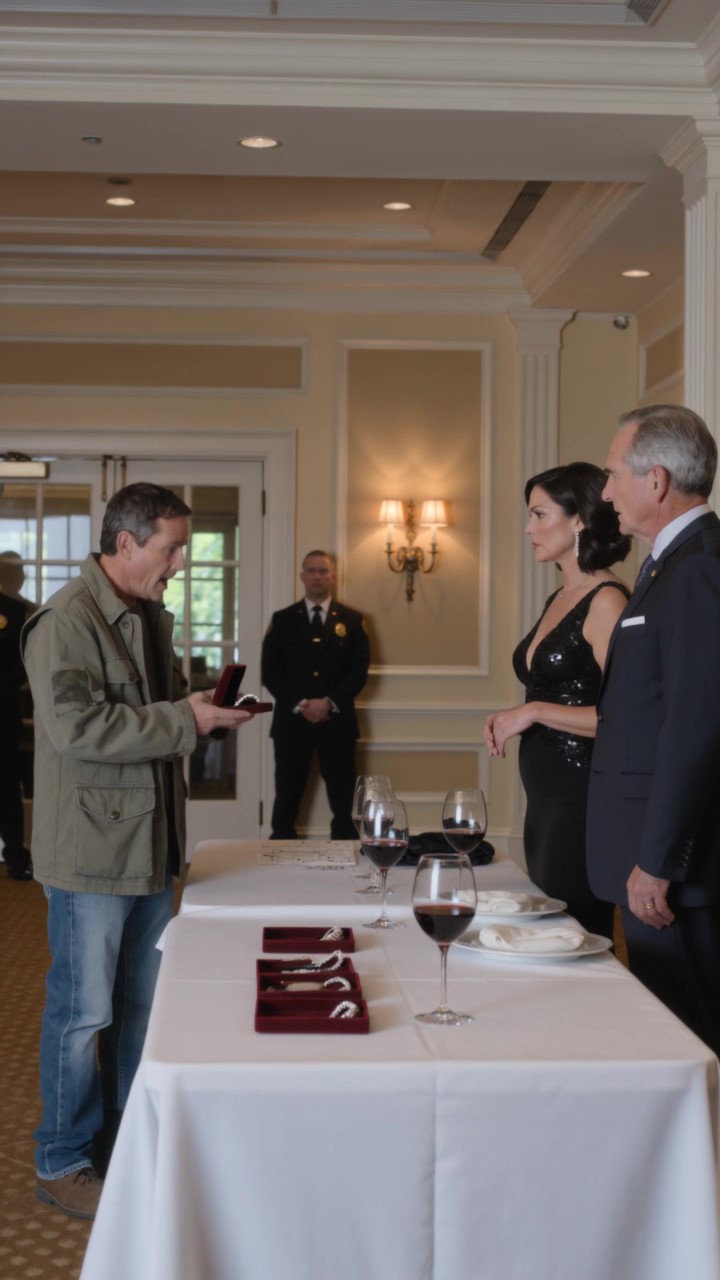
Marcus Reed did not walk into the gala looking like the person donors expected to thank.
That was why the room believed the planted story quickly.
He was forty-nine, a Gulf War veteran, and had spent four months moving between temporary shelter beds, a church basement, and the covered loading area behind the Westbridge Community Center. His right knee stiffened in cold weather. His disability claim had been delayed after a paperwork dispute. He was not a saintly symbol of poverty. He was tired, proud, sometimes angry, and still careful about other people’s property.
On the night of the gala, Marcus waited near the alley because a volunteer told him leftover meals might be distributed after cleanup. He heard a side door open. Two men argued near the service entrance. One voice belonged to a young aide he had seen in campaign photographs beside Mayor Charles Whitmore.
The aide said:
“If the auction bracelet is traced, it leads back to the foundation account.”
The other man told him to keep walking.
A velvet box dropped beside the trash bins when the aide’s coat caught on the door handle. The two men left in a hurry and did not notice. Marcus picked up the box. Inside, he found the bracelet and an auction card with the gala address.
He also saw something odd. The visible donor label had been pasted over another tag. The lower tag showed the Whitmore family name.
Marcus could have sold the bracelet. He knew that. He also knew a pawn shop would ask questions and likely call police. More importantly, the box had not fallen from some careless rich guest. It had fallen from people trying to hide it.
He carried it to the front entrance because the service door had locked behind the men. The moment security saw him, the story became simple.
A homeless man.
A diamond bracelet.
A rich room ready to believe theft before return.
The pawn ticket appeared during the search. Marcus knew immediately someone had slipped it into his backpack. But denial sounded weak when the paper described the exact item.
The kitchen worker, Nina Alvarez, had filmed because she had seen the aide’s hand move toward Marcus’s bag. Nina worked private catering events and knew how quickly blame traveled downward. She had once been accused of taking a guest’s phone after finding it under a chair. The phone was later found in the guest’s own coat, but the apology never reached the staffing agency.
Since then, Nina recorded when situations turned dangerous for low-wage workers.
Her video forced the gala to stop.
Police reviewed the clip, the bracelet tags, the pawn ticket, and the auction records. The bracelet had been donated months earlier through a shell foundation connected to a city redevelopment charity. Its listed donor was a corporate sponsor, but the original insurance documents showed it had belonged to the mayor’s late wife.
The problem was not the donation itself.
The problem was where the bracelet had been before the donation.
Investigators later found that the bracelet had been pledged quietly as collateral for a private loan connected to the mayor’s campaign consultant. When repayment became difficult, the item was moved through the charity auction to make its transfer appear philanthropic and clean.
The pawn ticket in Marcus’s backpack was not a real completed pawn record. It was a staged document meant to make him look like he had tried to sell the bracelet earlier.
The mayor’s aide claimed he acted alone to protect the campaign from embarrassment. Messages on his phone showed the mayor knew the bracelet’s history and approved a plan to discredit anyone who returned it.
Marcus was released after questioning. He did not become rich. The bracelet stayed in evidence. The gala committee issued a statement thanking “a concerned citizen.”
Nina objected.
Marcus did too.
“My name was clear enough when they called me a thief,” he said. “Use it when you correct it.”
The revised statement named him:
Marcus Reed returned the missing bracelet and was wrongly suspected after false evidence was planted on him.
That correction mattered, but it did not repair everything.
Several guests had filmed him being searched. Those videos spread faster than the correction. Shelter staff heard whispers. One volunteer asked Marcus whether he “really had nothing to do with it.” Marcus stopped eating at that program for two weeks.
Nina helped him contact a veterans’ legal clinic. The clinic did not turn him into a miracle case. It corrected his benefits paperwork, helped replace a missing ID, and connected him with transitional housing. Marcus accepted because he wanted a door that locked, not because people suddenly called him heroic.
The gala committee faced its own review. Staff had been trained to watch service workers and outsiders more closely than donors, board members, or political guests. Lost valuables procedures allowed security to search a person’s bag based on suspicion without first preserving video from all angles. Event workers had no safe way to report misconduct by powerful guests.
New rules required immediate video preservation, two-person evidence handling, and staff access to an independent reporting line. Security could still intervene when valuables were missing. But suspicion had to be treated as a question, not a conclusion.
Mayor Whitmore resigned during the investigation. Criminal and ethics proceedings continued. The charity auction was canceled and the items returned or re-verified through independent documentation.
Marcus was asked to attend a later community event. He declined the stage but agreed to speak privately to volunteers.
He said:
“Do not make honesty sound surprising when it comes from someone poor. If you are shocked I returned it, ask what story you already believed about me.”
Nina kept the video but never posted the full version online. She gave it to investigators and to Marcus’s attorney. She did not want his humiliation becoming another piece of public entertainment.
Months later, Marcus moved into a small veterans’ apartment. On the first night, he placed his army jacket on the chair, locked the door, and slept for ten hours.
The bracelet had never belonged to him.
Neither had the lie.
The only thing he carried into the gala was the truth, and the room nearly threw him out for looking like the wrong person to hold it.






Leave a Reply