
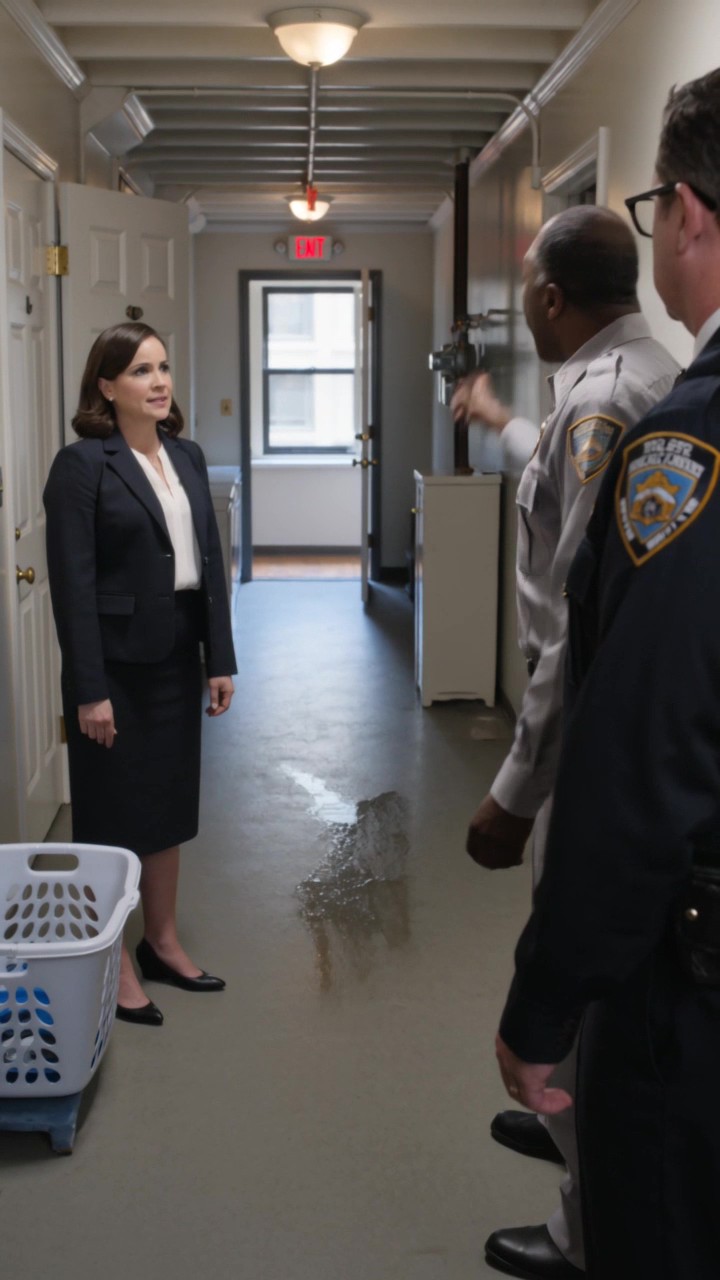
The eviction paused.
Not canceled.
Not yet.
The officer could not remove Rachel Cole while the debt supporting the order was being disputed with new physical evidence in front of him.
Samuel Bell kept the apartment valve closed.
The red submeter continued turning.
One full rotation.
Then another.
Water was moving somewhere beyond Rachel’s fixtures.
The property manager called an emergency plumber.
Samuel already knew where to look.
Three years earlier, the building owner renovated the ground-floor laundry room and added individual water submeters to several apartments.
The work was done in stages.
Old pipes remained inside the walls.
New pipes crossed them.
One hot-water recirculation line serving the laundry room and two upper units had been connected downstream of Rachel’s submeter.
That meant every time the shared system circulated or the building washers filled, part of the volume appeared on her bill.
At first, the error was small.
Then a cracked coupling began leaking inside the service chase.
The water never entered Rachel’s apartment directly.
It drained beneath the slab into an old floor channel.
Her meter recorded it day and night.
Rachel received the bills.
The building received the water.
When she complained, management looked at her life.
Single mother.
Two laundry baskets.
A washing machine that ran in the evenings.
A teenage son who wore restaurant uniforms.
A mother recovering from surgery who needed linens washed often.
The explanation formed itself:
Unauthorized laundry service.
Celeste issued warnings.
Then lease penalties.
Then an eviction notice for unpaid utility charges and prohibited business activity.
Rachel denied running a business.
She brought receipts showing only household detergent.
Letters from her mother and neighbor.
Photographs of the machine’s normal size.
None seemed as persuasive as the meter.
Numbers looked objective.
The system producing them was not.
Samuel worked as the building porter.
He handled trash rooms, light repairs, deliveries, and after-hours leaks.
Before that, he spent twelve years in municipal water maintenance.
He knew how flow sounded through copper.
He knew a moving meter with a closed isolation valve meant one of three things:
The valve failed.
The meter was connected incorrectly.
Or water crossed the line downstream.
He reported the rushing sound twice.
The first work order said:
Tenant states high bill; inspect washing machine.
A handyman checked the hoses and closed the ticket.
Samuel submitted another:
Continuous flow audible in common chase after unit shutoff.
Celeste returned it with a note:
Do not conduct unauthorized diagnostics inside occupied units.
Samuel did not enter Rachel’s apartment.
He listened from the basement and hallway.
He asked management to schedule a full submeter test.
The owner delayed because opening the wall would disrupt the profitable laundry room during a busy month.
The eviction moved faster than the repair.
On the morning the officer arrived, Samuel decided the argument needed a visible test.
Rachel opened every tap to prove the water stopped.
Samuel closed the unit valve.
The fixtures went silent.
The meter kept spinning.
That was the moment the debt stopped looking inevitable.
The emergency plumber opened the service panel.
Behind it, the recirculation line crossed Rachel’s meter branch before splitting toward common systems.
The coupling sprayed steadily into the drain channel.
Celeste stared at the pipe map.
“This is not how the renovation drawing shows it.”
Samuel answered:
“Walls do not read drawings.”
The plumber traced the actual line.
The submeter had billed Rachel for common water for at least two years.
The building’s utility software also applied sewer charges and late fees to that volume.
By the time management filed eviction, the false balance exceeded four months of rent.
The building’s attorney withdrew the immediate action.
An independent audit began.
Rachel remained in the apartment.
That did not restore her reputation automatically.
Neighbors had seen notices taped to her door.
Some believed she had used water secretly and found a technical excuse.
Her son stopped inviting classmates home because he was tired of hearing jokes about “the laundry apartment.”
Rachel asked the owner for a written correction.
The first draft said:
A plumbing irregularity affected certain calculations.
She rejected it.
“The notice called me dishonest by name.”
The final letter stated that Rachel had not operated an unauthorized business, that her water charges were caused by a building plumbing and metering error, and that all related penalties were void.
Copies went to the housing court, tenant-screening company, and every resident who had received the original building notice.
That mattered.
A private credit would have fixed the account.
A public correction repaired part of the damage.
The audit found two other units had smaller billing errors from the same renovation.
Management reimbursed the tenants.
The building owner faced city penalties for inaccurate submetering and delayed leak repair.
Celeste was removed from property operations after investigators found she repeatedly closed maintenance concerns once a tenant-behavior explanation seemed available.
She was not accused of installing the pipe incorrectly.
Her failure was allowing a convenient story about Rachel to replace testing.
Samuel was fired the day of the shutoff for insubordination.
The owner offered reinstatement after the plumber confirmed the cross-connection.
Samuel refused the first offer.
It described him as having “used an unconventional method that fortunately revealed a defect.”
He wanted the record to say he had submitted two prior warnings.
The owner revised it.
Samuel returned under a new maintenance-escalation policy.
Porters could request independent review of continuous-flow, gas, electrical, or structural concerns if a manager closed the same issue twice without investigation.
They also received training and pay recognition for prior trade experience.
Samuel became senior building systems technician.
He did not become a public hero.
He still changed hallway bulbs and cleared blocked trash chutes.
Professional knowledge and ordinary maintenance work existed in the same job.
Rachel did not become his best friend.
She was grateful.
She was also angry that he waited until eviction day to force the test.
“You heard it for months.”
“I reported it.”
“You could have shown me the valve sooner.”
Samuel considered that.
“Yes.”
He had respected management boundaries until the consequences became extreme.
Procedure had protected his job longer than it protected her home.
He apologized.
That conversation improved the new policy.
Tenants gained the right to witness a shutoff-and-meter test after two unexplained high bills.
They did not have to depend on a worker deciding when rules had failed enough.
The building replaced the submeter system and repaired the chase.
Rachel used part of the reimbursement to replace her old washing machine, even though it had never caused the debt.
She wanted a model with a visible usage display.
Not because she accepted blame.
Because after months of numbers being used against her, she wanted to see what her own appliance actually consumed.
Her teenage son helped create a simple spreadsheet comparing household use with building statements.
A local tenant organization adopted the template.
The laundry baskets remained in Rachel’s hallway.
She still washed her mother’s sheets.
Still helped the elderly neighbor when arthritis made carrying clothes difficult.
She did not stop acts of care simply because management had once renamed them an illegal business.
Months later, a new tenant reported a meter moving while every tap was closed.
The office scheduled a same-day test.
Samuel closed the unit valve.
The meter stopped.
No leak.
No accusation.
The tenant had a running toilet that was repaired within an hour.
That ordinary outcome was the point.
Not every high bill proved landlord failure.
Not every high bill proved tenant misuse.
The job was to test before deciding whose character explained the number.
Rachel kept the eviction notice in a folder beside the correction letter.
She did not frame either one.
One represented how quickly a home could be threatened.
The other represented how difficult it was to make an institution say clearly:
We were wrong about you.
The meter had kept spinning after her water stopped.
That small red wheel saved more than an apartment.
It separated evidence from suspicion long enough for Rachel’s dignity to enter the room.







Leave a Reply