
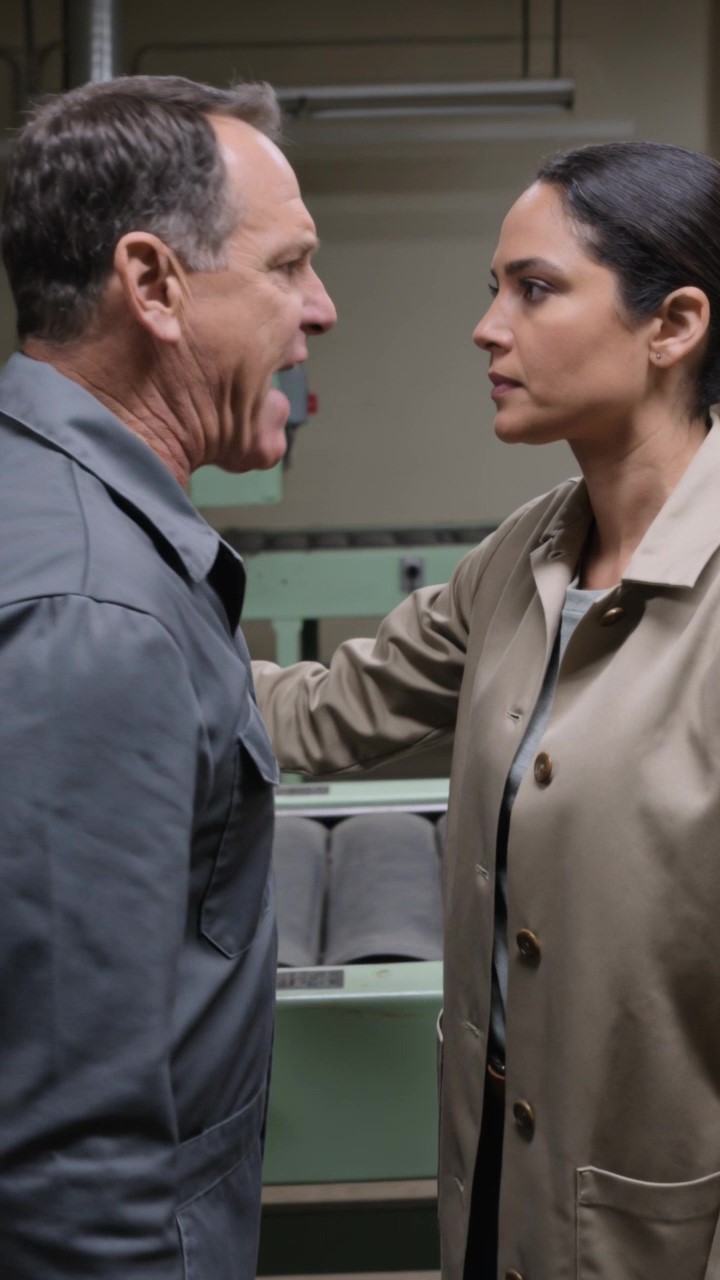
Leah Whitmore did not save the factory without hurting anyone.
The varnish line remained closed for nineteen days.
The holiday order shipped late.
The largest retail customer reduced payment under the delay clause.
Workers lost planned overtime.
Several families had already budgeted that money.
One employee postponed a tuition payment.
Another canceled a trip to visit her mother.
The plant survived.
The interruption still had a human cost.
That was why calling Leah either traitor or hero simplified what happened.
Whitmore Furniture had operated for forty-eight years.
Charles inherited it from his father and expanded from custom cabinets into commercial dining furniture.
The factory employed ninety-three people.
The work was physically demanding but relatively stable.
Charles knew many families by name.
He had advanced wages during illness, funded trade certifications, and resisted moving production overseas.
He also carried debt from a major equipment upgrade.
The holiday chair contract would determine whether the company entered the new year with enough cash to avoid layoffs.
The varnish booth was essential.
Finished chair frames moved through a controlled enclosure where coatings were applied and vapors drawn into an exhaust system.
Workers wore required protective equipment.
The booth also depended on airflow.
The front monitor measured pressure near the main intake.
The rear duct had a separate filter housing added during an older expansion.
Its pressure sensor had failed months earlier.
A replacement was on order.
Until then, maintenance relied on manual checks.
During a scheduled filter change, Noah Brooks assisted the night maintenance supervisor.
Noah was nineteen.
He entered the factory apprenticeship through a county vocational program.
The position combined paid work with logged training hours.
Losing the placement could delay his certification by a year.
Noah carried the new rear filter to the housing.
The filter arrived sealed in clear protective wrap.
He removed the outer bag.
A second band of film remained tightly wrapped around half the intake side.
The overhead light was weak.
The supervisor slid the filter into the frame.
When Noah questioned the shiny surface, the supervisor said it was a protective mesh designed to remain.
That answer was wrong.
After startup, airflow at the front monitor appeared normal because the main intake still pulled.
The blocked rear section created stagnant air near the back of the booth.
Odor accumulated during longer production runs.
Workers began reporting symptoms.
The first report went to a line leader:
Strong sweet smell near Booth 3 rear exit.
The leader opened a side door during break and told workers to keep lids on solvent containers.
The second report mentioned eye irritation.
Management checked the front monitor.
Green.
The third involved two workers requesting reassignment for the remainder of a shift.
Charles authorized additional portable fans outside the booth and scheduled a full ventilation review after the holiday order.
He did not believe the line posed immediate danger.
That belief protected the production schedule.
It also rested on incomplete information.
Leah served as quality and safety coordinator.
She was Charles’s daughter.
Employees often assumed her title existed because of family.
Some of that suspicion was fair.
She began in the office, not on the factory floor.
She later completed occupational-safety coursework and spent seven years learning the operation.
She still had more access to the owner than other workers.
That access created responsibility.
When Noah called her, his voice was shaking.
He said the supervisor wanted him to sign the maintenance sheet stating:
Rear filter installed and airflow visually confirmed.
Noah had not performed an airflow test.
He had only watched installation.
He feared refusing would end the apprenticeship.
Leah met him after the shift.
They opened the filter housing under the facility’s inspection procedure.
The clear film remained.
Leah photographed it.
She did not remove the filter herself because doing so would alter the evidence and leave the booth without any rear filtration.
She placed a temporary tag on the housing and told Noah not to sign.
The maintenance supervisor removed the tag before morning production.
He said Leah lacked authority to lock a system that still met the primary monitor threshold without an industrial-hygiene result.
Leah contacted an independent ventilation technician.
The earliest appointment was the next afternoon.
The holiday shift was scheduled to run through the night.
Leah believed waiting placed workers inside a booth with compromised exhaust.
She also knew shutting the line without proof could threaten the contract.
She asked Charles to pause production.
He refused.
“We have odor complaints, not evidence of exposure beyond limits.”
Leah answered:
“We have a blocked filter.”
“We have a photograph of material you have not identified.”
“Then open the housing.”
“After the run.”
That was the point where disagreement became action.
Leah contacted the state workplace-safety consultation line.
She described the filter, missing rear sensor, worker reports, and pressure-monitor location.
The consultant advised an immediate stop pending assessment.
Leah submitted the photographs through the company’s emergency reporting channel and placed her personal lock on the varnish-line energy control.
Her lock carried her name.
LEAH WHITMORE.
Noah’s name appeared nowhere in the external report.
She documented him as a confidential employee witness.
She sent him home and contacted the vocational program so his logged hours and placement could not be terminated before review without notice.
Workers saw only the shutdown.
The owner’s daughter had stopped the line days before the shipping deadline.
Rumors spread.
Some believed she wanted to force her father to sell.
Others believed she was building a public safety career by sacrificing the factory.
The maintenance supervisor told workers:
“She trusted one nervous apprentice over everyone whose paycheck comes from this line.”
Leah refused to identify Noah publicly.
That silence made the accusation stronger.
She accepted it because revealing him before independent investigators arrived would allow the factory hierarchy to isolate him.
At the lockout confrontation, Charles took her badge.
He did not strike her.
He did not threaten her physically.
He said the words that hurt most:
“You chose strangers over your own family.”
Leah answered:
“The people breathing in this booth are not strangers to the factory.”
Then she waited.
The state inspector arrived through an expedited response because production was active and the rear sensor remained inoperative.
The independent technician opened the housing.
The protective film covered approximately half the filter face.
Airflow measurements near the rear work zone fell well below the system’s design range.
Vapor testing showed elevated concentrations during simulated production.
Investigators did not conclude workers had suffered permanent injury.
They did conclude continued operation under those conditions was unsafe.
The maintenance supervisor admitted telling Noah to sign.
He said he believed the film was part of the filter and wanted the paperwork complete before shift change.
The supplier’s instruction sheet clearly said:
REMOVE ALL PACKAGING BEFORE INSTALLATION.
The sheet had remained inside the shipping box.
The supervisor had not read it.
Charles’s decision received closer review.
He did not know about the packaging film until Leah showed him the photograph.
He believed portable fans and a green front monitor provided enough protection until full inspection.
The investigator found that reasoning inadequate.
A missing sensor, repeated worker symptoms, visible obstruction, and a safety coordinator’s stop request required shutdown.
The company could not use production urgency to turn uncertainty into permission.
The filter was replaced.
The rear sensor was repaired.
Ducts were cleaned.
Airflow was balanced and independently tested.
Production restarted on day twenty.
The factory negotiated a partial delivery rather than losing the entire contract.
The customer accepted the first completed shipment and moved the remaining order to another supplier.
Whitmore Furniture lost profit.
It did not collapse.
Charles created an emergency wage fund using executive bonuses, insurance coverage for interrupted operations, and a short-term line of credit.
It replaced part—not all—of the workers’ lost overtime.
Leah insisted the fund include contract cleaners and temporary finishers.
Their households had lost income too.
The maintenance supervisor was dismissed for directing a false sign-off and removing the temporary tag.
Noah remained in the apprenticeship.
The vocational program transferred his direct supervision to a certified mechanic from another department.
He repeated the filter-change module.
Not as punishment.
To ensure the confusing installation became actual training.
Noah later told Leah:
“I thought protecting me meant nobody would know I was involved.”
Leah answered:
“Protecting you meant you got to tell the truth after the people who controlled your hours could no longer punish you for it.”
That distinction mattered.
Confidentiality should not erase the witness forever.
It should allow the witness to speak under safer conditions.
The factory held a formal review with union representatives, employee-elected safety members, and outside specialists.
Workers remained angry about lost money.
One forklift driver told Leah:
“My daughter’s school did not accept safety as tuition.”
Leah did not respond with a speech.
She asked what the emergency wage fund had failed to cover and brought the numbers to the board.
The company could not repay every projected overtime hour.
It created no miracle.
It did reimburse documented late fees caused by delayed checks and offered no-interest payroll advances.
The workers’ anger did not make the shutdown wrong.
The shutdown’s correctness did not make their anger wrong.
Charles apologized publicly.
He admitted the company relied on one monitor after another sensor failed, delayed full inspection, and treated the contract deadline as evidence that the risk could wait.
He also apologized to Noah for the apprenticeship pressure.
His apology to Leah remained private.
“I believed you wanted to prove you could overrule me.”
Leah looked at him.
“I wanted you to be right. Restarting would have been easier if you were.”
Charles lowered his eyes.
“I called it betrayal because you used the authority I gave you against the decision I wanted.”
“Yes.”
“That is what the authority was for.”
“Yes.”
The relationship did not repair immediately.
Leah remained safety coordinator, but no longer reported directly to Charles.
The board created an independent safety committee with stop authority.
Any worker could request confidential review through the vocational program, union, or third-party hotline.
Apprentices could not sign maintenance verification alone.
Missing sensors required documented interim controls and fixed deadlines.
Production could not continue after repeated symptom reports without qualified assessment.
And all safety holds triggered wage-continuity review so workers did not experience protection as punishment without support.
The factory also changed its bonus structure.
Supervisors no longer received full production bonuses if overdue safety repairs remained unresolved.
The cost of stopping became visible.
So did the cost of failing to repair.
Noah completed the apprenticeship two years later.
At his certification ceremony, Charles attended.
Leah stood in the back.
Noah carried the blue filter frame—not the contaminated filter itself, which had been disposed of under safety procedures.
He placed the supplier instruction sheet inside the empty frame.
REMOVE ALL PACKAGING BEFORE INSTALLATION.
Then he said:
“The most dangerous part was not that I did not know.”
He looked toward the maintenance instructors.
“It was that I thought being new meant I had to sign like I did.”
The vocational program added a module on refusal rights and accurate verification.
Leah eventually left Whitmore Furniture for a regional safety role.
Workers assumed the shutdown had destroyed her place in the family business.
In one sense, it had.
She no longer expected to inherit operational leadership.
Charles hired an outside plant director.
That choice reduced family conflict and professionalized management.
Leah retained a small ownership share but no daily control.
She and Charles continued meeting for Sunday breakfast.
Some weeks they discussed the factory.
Some weeks they did not.
A betrayal is often defined by whose side a person chooses.
Leah had been accused of choosing regulators, an apprentice, and frightened workers over her father.
The truth was less clean.
She chose the purpose of the authority her father had given her, even when using it cost both of them.
The red lock stayed in the factory safety office.
Leah’s name remained engraved on it.
A plaque beneath it read:
THE LOCK DID NOT CLOSE THE FACTORY.
IT KEPT ONE DEADLINE FROM BECOMING PERMISSION.
Workers passed it every day.
Some still remembered the overtime they lost.
No reform required them to forget.
The apprentice remembered something else.
When everyone demanded a name to blame, one person placed her own name on the lock and gave him enough time to tell the truth without losing his future first.







Leave a Reply