
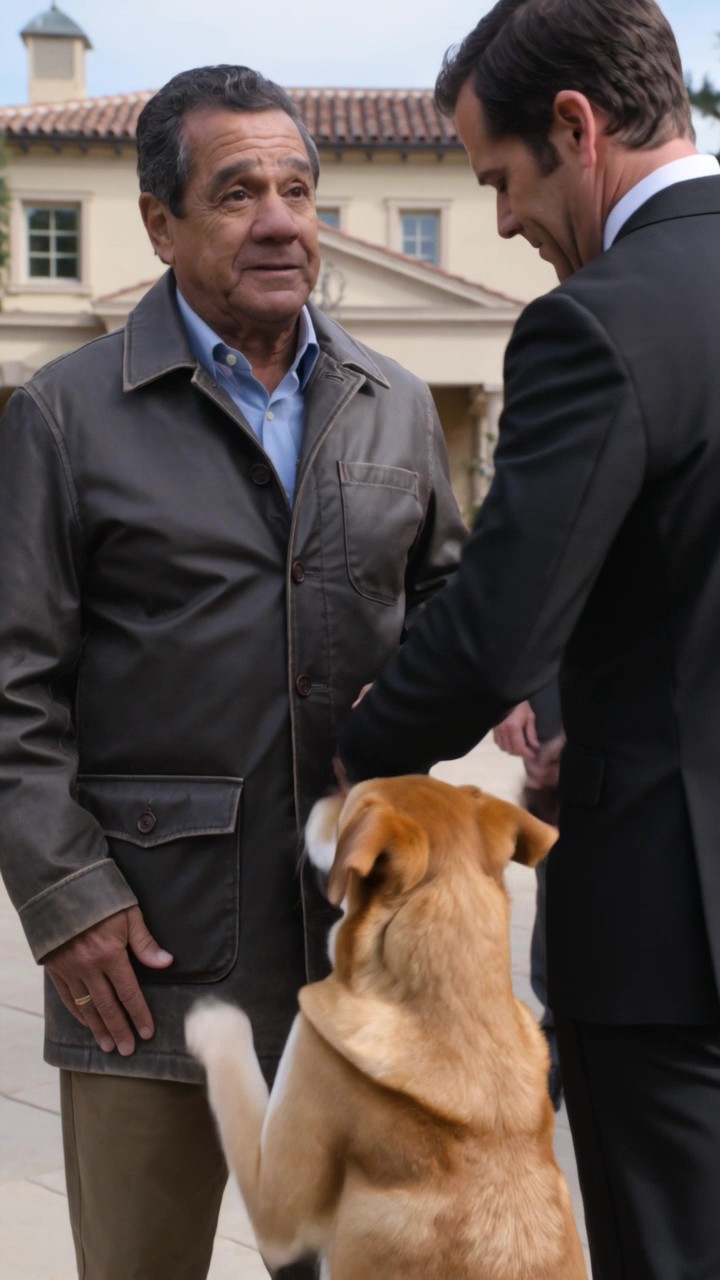
The estate lawn emptied slowly.
Guests who had come to watch a polished adoption announcement now stood in small groups, uncertain whether they had witnessed a reunion or a family accusation.
Maple remained beside the gate.
The green leash hung between her and Samuel Ortiz.
The dog was thirteen years old.
Her hips were stiff.
Her hearing had weakened.
But the two taps on the handle still meant the same thing:
Wait.
Look at me.
We move together.
Samuel had taught that signal when Maple was a young rescue dog afraid of traffic.
He worked long-haul truck maintenance then.
His shifts began before dawn.
Maple rode with him only on local calls, sleeping beneath the workbench in the repair shop.
The old metal tag listed Samuel’s name and a telephone number disconnected years earlier.
Six years before the estate ceremony, Samuel was struck by a vehicle while walking home from work.
He survived.
Recovery took months.
One leg required repeated surgery.
His apartment had stairs.
The hospital social worker arranged temporary rehabilitation housing where animals were not permitted.
Samuel asked his older sister Margaret Whitmore to care for Maple.
Margaret lived alone in the large estate house.
She agreed.
At first, she sent photographs.
Maple sleeping near the fireplace.
Maple watching birds through the kitchen window.
Maple wearing a green raincoat Samuel had bought.
Then Margaret’s messages became less frequent.
She said the dog was struggling with separation.
She said moving Maple back after months might be cruel.
Samuel disagreed.
He completed rehabilitation.
Moved into an accessible apartment.
Asked for his dog.
Margaret delayed.
Then she called and said Maple had become ill suddenly and died at an emergency veterinary clinic.
Samuel asked where she was buried.
Margaret said the clinic handled cremation.
He asked for the ashes.
She said there had been a paperwork problem.
Samuel was grieving, exhausted, and ashamed that he had needed help.
He stopped pushing.
The lie remained.
Margaret kept Maple.
Why?
The answer was not money.
Not cruelty in the simple sense.
Margaret had become deeply lonely after her husband died.
Her adult children lived elsewhere.
Maple slept beside her bed.
Waited outside the bathroom.
Forced her to walk through the garden every morning.
Margaret convinced herself that the dog had chosen a stable home over Samuel’s uncertain recovery.
She changed the microchip contact at a veterinary visit by presenting the temporary care letter and saying Samuel had surrendered ownership.
The clinic should have verified the transfer directly.
It did not.
Margaret told her children Maple had been abandoned by a man unable to care for her.
Over time, the dog became “Mother’s rescue.”
The story allowed Margaret to keep what she loved without naming the person she had taken it from.
Samuel learned Maple was alive three weeks after Margaret died.
A former repair-shop customer saw a newspaper photograph of the Whitmore estate announcement.
The dog wore a velvet collar.
Her face was older.
The white patch on the chest remained.
Samuel drove to the public estate viewing with the green leash and old records.
The family refused him at the gate because he appeared without an appointment and claimed ownership of a dog listed in the estate inventory.
That caution was not unreasonable.
The immediate dismissal was.
Charles saw an oil-stained coat, an old leash, and a man with no current microchip registration.
He decided the claim was opportunistic.
The family proceeded with the ceremony.
Maple corrected the social hierarchy before the paperwork did.
She did not understand legal ownership.
She recognized Samuel’s smell.
Voice.
Tapping signal.
And the leash used during the first years of her life.
The old tag beneath the velvet collar remained because a groomer had been unable to remove its rusted ring without cutting it.
Margaret covered it instead.
After the ceremony stopped, the estate attorney reviewed Samuel’s documents.
Original shelter adoption record.
Early veterinary invoices.
Municipal dog license.
Photographs showing the chest marking and green leash.
A rehabilitation letter naming Margaret as temporary caregiver.
No signed surrender.
The microchip clinic opened its archived transfer form.
The signature line for Samuel was blank.
The change had been processed from Margaret’s statement alone.
Legally, the situation required review.
Emotionally, Maple had already chosen where to stand.
Charles looked at Samuel.
“Why did you not come sooner?”
Samuel’s face tightened.
“Your mother told me the dog was dead.”
Vivian sat down.
She remembered her mother refusing to discuss the cremation when the children asked why there was no urn.
At the time, they assumed grief.
Now they understood secrecy.
The family could have fought.
The estate had resources.
Samuel had modest income and no lawyer.
Instead, Vivian asked for an independent animal-welfare assessment.
Not to challenge Samuel’s dignity.
To make sure his current home and Maple’s medical needs were suitable after six years apart.
Samuel agreed.
His accessible apartment permitted dogs.
He had arranged a ground-floor unit partly because he once hoped to adopt again.
His pension covered ordinary care.
Maple’s age meant medication and possible mobility support.
The estate offered to fund lifelong veterinary expenses.
Samuel hesitated.
He did not want the money used as continuing ownership.
The attorney created a medical trust controlled by an independent veterinary nonprofit.
The support belonged to Maple, not to either human household.
That solution mattered.
Restitution should not turn into another leash.
Maple moved home gradually.
For one week, Samuel visited the estate every day.
Then Maple spent afternoons at his apartment.
Then one night.
The dog struggled at first.
She searched for Margaret near bedtime.
Waited beside doors that did not exist in Samuel’s smaller home.
Samuel did not interpret grief for Margaret as rejection of him.
A dog can remember more than one person.
Love does not prove the past arrangement was honest.
Vivian visited with Maple’s bed and favorite blanket.
She apologized.
“We believed the story we were given.”
Samuel nodded.
“You also tried to remove me before reading what I brought.”
“Yes.”
That was the part she could own.
Charles found apology harder.
He had built the estate ceremony around his mother’s image as a compassionate rescuer.
Samuel’s return complicated the memorial.
It required the family to accept that a person could care deeply for an animal and still wrong its owner.
Margaret was not rewritten as a monster.
The estate tribute was corrected.
The public program no longer said she rescued Maple after abandonment.
It said:
Margaret cared for Maple during Samuel Ortiz’s recovery and then wrongfully kept the dog after temporary care should have ended.
Charles resisted the wording.
Vivian insisted.
“A memorial that removes the harm is another velvet collar over the tag.”
The sentence stayed.
The veterinary clinic also changed its transfer policy.
Temporary caregivers could not alter ownership without direct signed confirmation, legal documentation, or a verified abandonment process.
Microchip records gained a separate emergency-care contact field so temporary responsibility did not become permanent ownership by convenience.
Maple lived with Samuel for two more years.
She walked slowly.
Slept beneath a new workbench in the apartment’s small hobby room.
Every morning, Samuel clipped the old green leash to her collar.
He tapped twice.
She raised one paw when she felt like it.
Some days she did not.
Age had changed the precision of the signal.
It had not erased recognition.
Vivian visited once a month.
Charles came twice.
The meetings were awkward.
That was all right.
Maple accepted treats from everyone.
Animals do not owe humans the clean emotional boundaries our stories demand.
When Maple died peacefully after a period of declining health, Samuel kept the old tag.
The veterinary trust paid the final bills as promised.
He invited Vivian to the small memorial walk.
Charles attended without cameras.
They walked the route around Samuel’s accessible housing complex.
At the last corner, Samuel tapped the empty leash handle twice.
No paw lifted.
He did not need one.
Maple had already answered at the estate gate when the people around her were still deciding which story looked more respectable.


Leave a Reply