
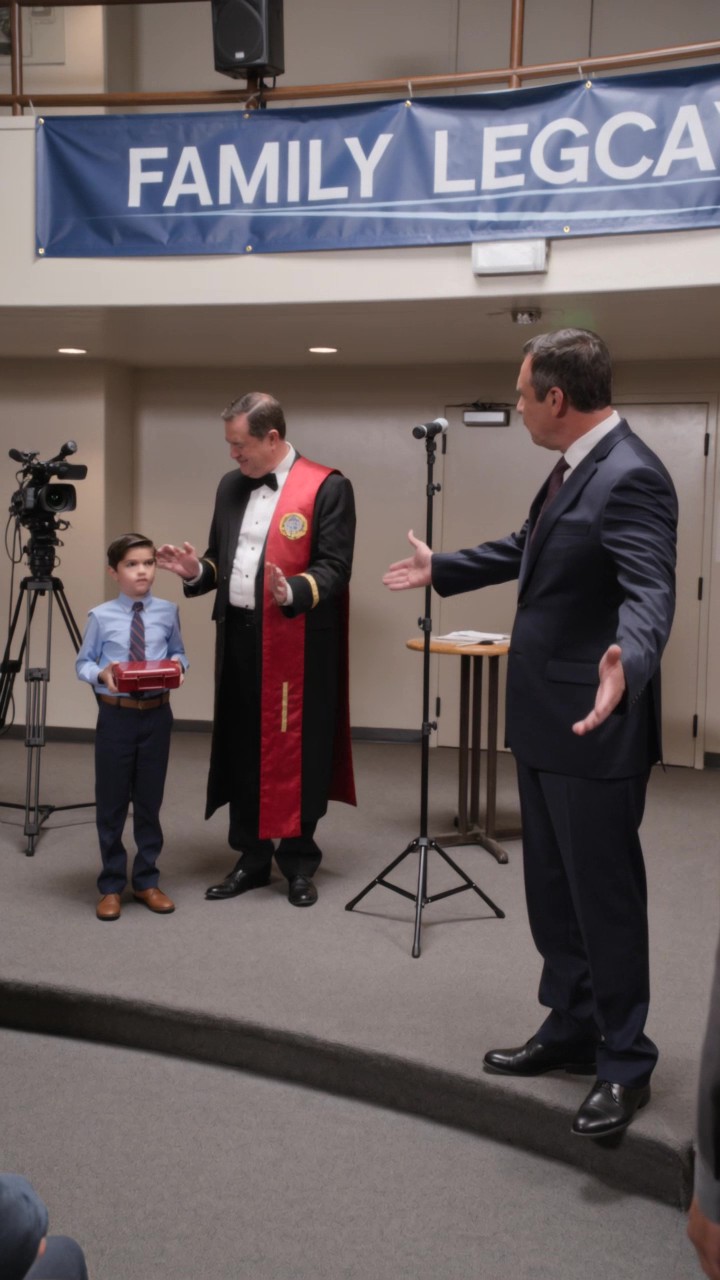
Charles Whitmore did not leave the auditorium.
For several seconds, he remained beneath the school banner with his arms lowered at his sides.
The cameras had been arranged for a public reunion.
A successful father.
A scholarship child.
A prestigious school welcoming a family back together.
Eli’s red lunchbox changed the picture.
The lunchbox came from a discount store.
Samuel Ortiz bought it the week before Eli started kindergarten.
The boy wanted one shaped like a rocket.
The rocket version cost more.
Samuel found a plain red box and painted three white stars on the side.
Two washed away during the first year.
One remained beneath the scratches.
At first, Samuel placed notes inside because Eli cried at school drop-off.
The boy’s mother, Rachel Brooks, worked early shifts at a rehabilitation laundry facility.
Samuel’s bus-maintenance shift began at ten.
He handled mornings.
The first note said:
MOM COMES HOME AFTER DINNER. I’LL BE AT THE GATE.
Eli could not read all the words.
His teacher read them to him privately.
The next day, Samuel drew a small gate.
Then a bus.
Then a cloud with the hallway light beneath it.
As Eli learned to read, the notes changed.
SPELLING TODAY. SLOW IS STILL FORWARD.
DON’T TRADE THE APPLE. YOUR MOTHER BOUGHT THE GOOD ONES.
I’M PROUD OF THE TRUTH, EVEN WHEN THE ANSWER IS WRONG.
The notes were not always wise.
One promised pancakes after a dentist appointment, then Samuel forgot the pancake mix.
Another incorrectly explained that the moon followed the school bus because “it liked public transportation.”
Eli kept those too.
The lunchbox recorded ordinary presence.
Charles had not always been absent.
He and Rachel were young when Eli was born.
Charles worked for his father’s real-estate company and wanted to build a separate career.
He loved his son.
He also treated love as something that could wait until his life became stable.
When Eli was three, Charles accepted an overseas development position.
He and Rachel separated.
At first, he called every week.
Then every month.
Then mostly on birthdays.
He sent money inconsistently because he disputed expenses and believed Rachel should move closer to his parents.
Rachel filed for formal support.
The relationship became legal, tense, and distant.
Charles told himself the distance protected Eli from arguments.
Rachel told herself not speaking about Charles protected the child from disappointment.
Eli built his own explanation:
His father existed somewhere important.
Samuel existed at the gate.
Samuel never asked Eli to call him Dad.
He introduced himself to teachers as Samuel.
When other children asked whether he was Eli’s father, he answered:
“I’m the adult who is picking him up.”
At home, he repaired city buses.
The work was dirty, technical, and steady.
He taught Eli how a brake line carried pressure and why stripped bolts became dangerous when people forced them.
He attended school events in whatever uniform the shift allowed.
Sometimes Rachel asked him to change first.
Not because she was ashamed.
Because she knew Westbridge Academy’s families noticed occupations before names.
Samuel usually changed.
On Family Legacy Day, he could not.
A bus carrying elderly passengers developed a wheelchair-ramp fault during morning service.
Samuel remained until the repair passed its safety cycle.
He arrived at the academy eleven minutes before Eli’s presentation.
Charles’s return began six months earlier.
His overseas company had been acquired.
He came home wealthy, confident, and determined to correct the years he had missed.
He paid all overdue support.
Opened an education account.
Bought Eli a laptop.
And applied to place him at Westbridge Academy after learning the boy’s public school had cut advanced science activities.
Rachel agreed to the application because Eli wanted the robotics program.
Charles funded the tuition gap.
His involvement helped.
That truth mattered.
He was not a stranger appearing only for a photograph.
He began attending weekend visits.
He learned Eli liked astronomy.
Took him to a planetarium.
Paid for tutoring when reading difficulties appeared in longer assignments.
Charles wanted to become a present father.
The problem was how he understood the role.
He believed money and opportunity could compress time.
He described Samuel as a good man who had “helped while I was away.”
He told Rachel:
“Eli should know who his father is now.”
Rachel answered:
“He always knew. You are the one deciding the word means only you.”
The school amplified the conflict.
Charles’s company donated equipment to the robotics wing.
The development office created a Family Legacy Day presentation around donors who supported student opportunity.
Eli was selected to speak.
The coordinator asked him to bring an object representing family guidance.
He chose the lunchbox.
The school assumed the object connected to Charles.
When staff learned the notes came from Samuel, the development office revised the script.
The headmaster planned to introduce Charles as the father who “returned to secure his son’s future.”
Samuel’s role became:
Family supporter.
Then Charles’s assistant emailed the school.
The message said the stage image should avoid confusing the public about paternity and legal guardianship.
Samuel received a new seat assignment behind the side camera.
Rachel objected.
The coordinator said donor photographs had limited space.
Samuel told her not to fight before Eli’s event.
“I am not coming for the photograph.”
That sentence sounded generous.
It also allowed the system to continue.
Eli noticed the empty family chair.
A counselor told him Samuel had been moved because of camera organization.
The boy understood more than adults expected.
He had heard Charles refer to Samuel as temporary.
He had watched his mother become quiet.
He knew the school’s beautiful program contained only one father’s name.
Onstage, the headmaster told him to bring the keepsake to his father.
Eli chose the person the object already belonged to.
That choice did not settle custody, legal rights, or the future of his relationship with Charles.
A nine-year-old should not carry those decisions.
It exposed one false claim:
That the adult who paid for opportunity automatically owned the story of who prepared the child to receive it.
After the presentation, Charles requested a private room.
Rachel, Samuel, Eli, the counselor, and Headmaster Preston Hale joined him.
Charles looked at the notes.
“Did you tell him to do that?”
Samuel answered:
“No.”
“You let him embarrass me.”
“I was standing where your office asked me to stand.”
Charles turned toward Rachel.
“You allowed our son to make a public choice between fathers.”
Rachel looked at Eli.
“The school placed two men under a banner and told him only one counted.”
Preston interrupted.
“Our intent was to honor family leadership.”
Rachel held up the printed program.
“Then why did you remove one family member’s name after the largest donor complained?”
The headmaster had no useful answer.
Eli sat with the red lunchbox in his lap.
Charles lowered himself into the chair across from him.
“Do you think I am not your father?”
Eli looked frightened.
Samuel stepped forward.
The counselor raised one hand.
“Do not make him answer a question built to hurt someone.”
Charles closed his eyes.
He had spent years imagining the moment his son recognized him again.
He had not imagined recognition could include another man.
Eli finally spoke.
“You are my father.”
Charles opened his eyes.
“But you keep talking like he was only waiting until you came back.”
The sentence was not polished.
It was precise.
Charles looked at Samuel.
For the first time, he asked:
“How many notes?”
“Two hundred seventeen.”
“You counted?”
“Eli did.”
The boy had numbered them the previous week for the assignment.
Charles picked up one written on a bus-repair tag.
SCHOOL PLAY. FRONT ROW IF THE 42 BUS PASSES TEST.
A faint grease mark crossed the corner.
“Did you make it?”
Samuel nodded.
“The bus passed.”
“What if it had not?”
“I would have arrived late.”
The ordinary answer defeated the fantasy of perfect parenting.
Samuel showed up often.
Not always effortlessly.
Charles asked for a copy of the notes.
Eli refused.
“They’re mine.”
Charles nodded.
That was the first good response he gave that afternoon.
The academy issued a correction.
The event photographs identified:
Eli Brooks with his mother Rachel Brooks, stepfather Samuel Ortiz, and father Charles Whitmore.
The school removed the phrase “temporary parental figure” from internal correspondence and apologized publicly for allowing donor preferences to determine family recognition.
Future family events used the adult relationships students and guardians provided.
Schools still verified legal pickup and decision-making authority privately.
Public captions did not need to erase stepfamilies, foster caregivers, grandparents, or chosen guardians to preserve legal accuracy.
Charles withdrew his threat to reduce the robotics donation.
That choice mattered.
An apology supported by punishment of other students would have been another form of control.
He remained part of Eli’s life.
The path was uneven.
Charles had resources Samuel did not.
He could take Eli traveling.
Pay for camps.
Introduce him to engineers.
Samuel occasionally felt replaced.
He disliked admitting it.
Rachel occasionally defended Samuel so quickly that Charles believed no effort would ever count.
Family counseling gave the adults rules.
Do not ask Eli who the better father is.
Do not use money as proof of love.
Do not use years of presence as permission to block new effort.
Do not call a caregiver temporary while the child is still depending on him.
Charles started small.
He attended a weekday reading meeting without photographers.
He learned to pack lunch.
His first note said:
SCIENCE QUIZ. I DON’T KNOW THE ANSWERS EITHER.
Eli kept it.
Not in the red lunchbox.
In a separate blue envelope.
The distinction was his.
Samuel did not ask the notes to be combined.
A child can build more than one relationship without pretending every relationship began at the same time or carried the same weight.
At the end of the school year, Eli’s robotics team presented a bus-door alert.
Samuel helped them understand the mechanical latch.
Charles paid for approved sensors.
The students wrote the code.
On the project board, Eli listed contributors:
MAYA — PROGRAMMING.
JORDAN — WIRING.
SAMUEL — BUS HARDWARE QUESTIONS.
CHARLES — SENSOR FUNDING AND ENGINEER CONTACT.
No single adult became the hidden genius.
Both men saw their names.
Both stayed quiet.
The red lunchbox eventually became too small for Eli’s meals.
Rachel wanted to store it safely.
Eli placed it on his desk instead.
The 217 notes remained inside.
New notes stopped.
Not because Samuel stopped showing up.
Because presence no longer needed daily proof.
On Eli’s tenth birthday, Charles gave him a telescope.
Samuel built a simple wooden stand for it from leftover bus-seat material.
The three of them watched the moon from the apartment courtyard.
Charles asked whether it still followed public transportation.
Eli laughed.
“Samuel made that up.”
Samuel folded his arms.
“There is no evidence it doesn’t.”
Charles laughed too.
It was not a perfect family ending.
It was a room where nobody had to disappear for another person to become a father.
The child had walked past the man with the stronger title.
Not to reject him forever.
To return the word family to the person who had been living it while everyone else argued over who had the right to say it.







Leave a Reply