
Teresa Alvarez did not design Maya’s entire project.
Maya did.
The idea began after a school bus stalled during a small engine fire in the maintenance yard.
No children were inside.
Teresa helped inspect the vehicle afterward.
The emergency windows opened correctly when an adult mechanic pulled the handles.
One handle required more force than Teresa expected.
She asked:
“What happens when the strongest person on the bus is eleven?”
That question stayed with Maya.
She attended Westbridge Academy on a partial scholarship.
The school’s robotics program had advanced printers, sensors, and software.
Maya knew how to build digital controls.
She did not know how frightened children pulled objects while crouching, coughing, or standing at the wrong angle.
Teresa knew school buses.
For thirteen years, she had repaired brakes, seats, door mechanisms, wheelchair lifts, and emergency exits for the city transit contractor.
Her title was mechanic.
Her specific specialty was interior safety hardware.
She had seen release straps installed too high.
Plastic handles become brittle.
Seat coverings block access.
And well-designed parts fail because nobody tested them with wet gloves or small hands.
Maya asked her mother to help test the first prototype.
Teresa refused to build it for her.
“This has to be your work.”
She did agree to answer questions.
Maya constructed a low-mounted lever extension that could attach to several bus-window handles without permanently modifying the vehicle.
The user pulled a fabric loop.
The loop redirected force through a small pulley and opened the latch.
Her first version used a thin nylon cord.
It cut into the test glove.
Teresa brought home scrap seat-belt webbing approved for disposal.
She showed Maya how load-bearing stitches differed from decorative stitches.
A straight line could peel under force.
A boxed pattern with crossing stitches distributed stress.
Maya sewed the yellow loop herself on Teresa’s old industrial machine.
The stitches were uneven.
They held.
At the district science fair, the device opened the test window with less hand force than the original handle.
Maya qualified for the academy’s national robotics final.
That was when Helix Mobility became involved.
The company sponsored Westbridge’s engineering wing.
Its mentors helped Maya replace a rough wooden pulley housing with a printed component and improve the mounting bracket.
Their technical contribution was real.
The public-relations department wanted a polished demonstration.
The yellow strap looked homemade.
The stitches were visible.
Helix replaced it with a white loop produced by a promotional supplier.
The supplier used softer woven tape and a narrow bar tack meant for bag handles, not repeated emergency pulling.
The new loop looked better beneath stage lights.
It had never been tested at the final load.
Maya objected during rehearsal.
The program coordinator told her:
“The sponsor improved the appearance without changing the function.”
Maya asked to keep the yellow strap as backup.
She left it in the lab.
On competition morning, a staff member placed all non-branded parts in storage.
Maya called Teresa.
Teresa found the strap in a labeled return bin after speaking with the robotics teacher.
She drove directly from an emergency bus repair.
She had no time to change.
The academy’s invitation did not require formal clothing.
The event email recommended it.
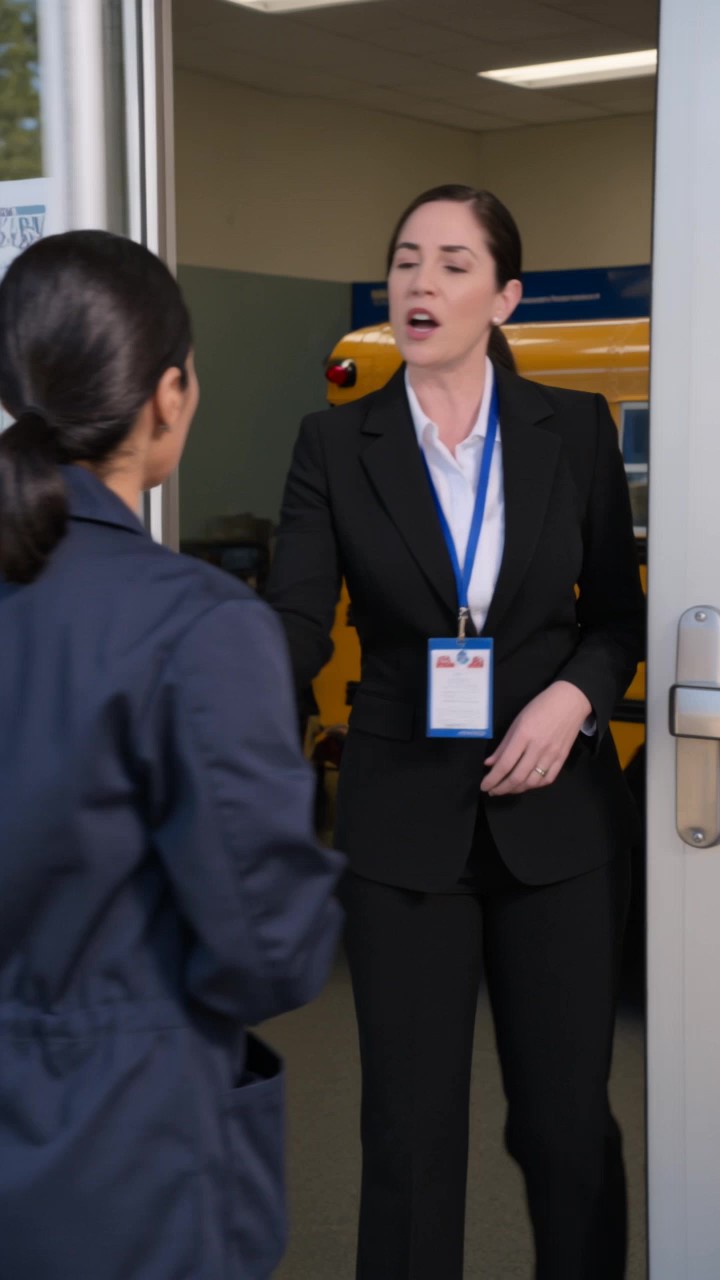
Celeste turned a recommendation into a barrier after seeing the uniform.
She believed the stained parent would disrupt donor photographs and raise questions about how much adult assistance Maya received.
That concern could have been handled through judging rules.
Instead, she treated Teresa as a contractor trying to enter the wrong door.
The sponsor’s white loop failed during the live demonstration.
The yellow loop worked because Maya had tested it eighty-seven times under different angles and because Teresa taught her how to examine the stitch after every pull.
The judges paused the competition.
They needed to determine whether the parent’s involvement violated student-work rules.
Teresa did not demand credit for the invention.
She described exactly what she had done.
Answered questions about bus hardware.
Demonstrated the sewing machine once.
Refused to repair Maya’s early failures.
Maya supplied design sketches, test data, and dated videos showing her own work.
Helix engineers supplied records of their later changes.
The review concluded the project remained Maya’s.
Family consultation was permitted.
The real violation involved replacing a tested safety component after final verification without the student’s approval.
Maya was allowed to repeat the demonstration.
She did not win first place overall.
Another team’s emergency-communication system earned the top score.
Maya received the practical safety-design award and a full summer engineering scholarship.
That outcome mattered.
The story was not that a working-class parent proved wealthy students and professional engineers were useless.
The engineers improved parts of the device.
The parent contributed field knowledge the polished lab had missed.
The student integrated both.
After the awards, Celeste apologized to Teresa in the lobby.
“I believed the judges might see your presence as improper assistance.”
Teresa looked at the locked glass door.
“You did not ask me what I assisted with.”
“No.”
“You decided the uniform answered.”
Celeste nodded.
The school issued a public correction because the exclusion had occurred in front of staff and families.
Teresa was identified as an invited parent and industry-skilled contributor—not an unregistered contractor.
The academy reviewed its event access policies.
Dress recommendations could not become admission requirements.
A parent arriving from work could not be redirected based on uniform.
Questions about project assistance had to follow the same documented process for every family.
Sponsors could not alter functional parts after final testing without student and faculty approval.
And technical mentor lists had to name skilled-trade contributors, not only people with corporate or university titles.
Maya’s own response was more complicated.
She had seen her mother outside the glass and understood immediately why.
She also remembered times she had asked Teresa not to wear the transit jacket into the school café because classmates stared.
One evening after the competition, Maya placed the yellow strap on the kitchen table.
“I did it too.”
Teresa looked up from a brake manual.
“Did what?”
“Acted like your uniform was something happening to me.”
Teresa did not rush to comfort her.
“You were trying to survive a place that makes certain work invisible until it needs the answer.”
“That doesn’t make it okay.”
“No.”
Maya sat down.
“I’m sorry.”
Teresa touched the uneven box stitches.
“Then learn the difference between wanting privacy and asking somebody else to disappear.”
The device entered a pilot program with the city bus contractor.
It required further testing.
Fire codes, durability standards, child safety, and manufacturer approval mattered.
A competition success did not make a homemade part ready for real buses.
Helix funded professional engineering review.
Teresa joined the advisory group as a paid transit-hardware specialist.
Maya participated as the student inventor.
The final product looked different.
A molded grip replaced the yellow fabric.
The force path remained the one Maya developed.
Inside the training case, they kept the original stitched loop.
A label read:
PROTOTYPE 4 — HAND-SEWN BY MAYA ALVAREZ AFTER FIELD GUIDANCE FROM TERESA ALVAREZ, TRANSIT MECHANIC.
Teresa insisted Maya’s name appear first.
Maya insisted both appear.
One year later, Westbridge Academy held another robotics final.
A father arrived wearing a grocery warehouse vest.
A mother came directly from a nursing-home kitchen.
A grandfather wore paint-marked work trousers.
No one was sent to the rear gate.
At the entrance, a small sign said:
PARENTS COMING FROM WORK ARE ALREADY DRESSED FOR THEIR ROLE.
Teresa considered the wording slightly dramatic.
She still photographed it.
Not because the school had become perfect.
Because a glass door that once treated her labor as an embarrassment now opened without asking her to hide the evidence of it.







Leave a Reply