
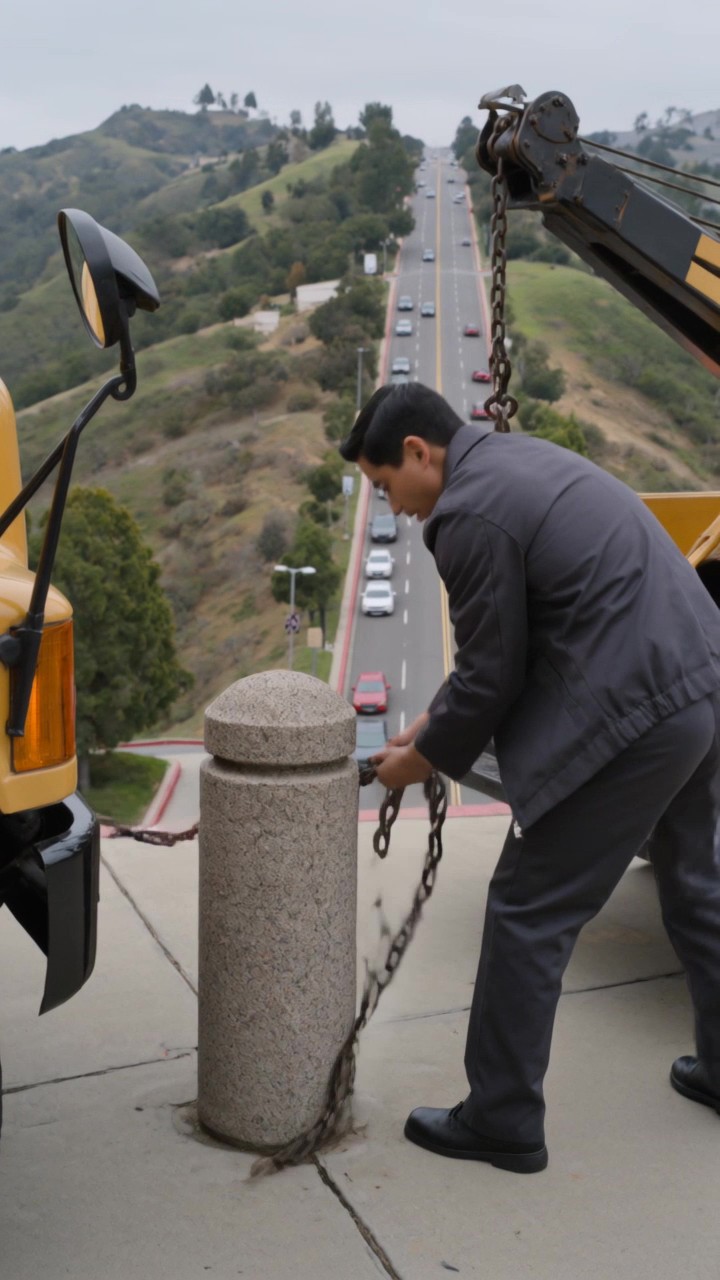
The police did arrive.
So did district officials.
But by then, the truth was no longer waiting for an important person to announce it.
Twenty-two children had watched Bus 18 push Daniel’s tow truck downhill.
Parents had seen the parking brake lever fall.
Museum cameras had recorded the yellow wheel chock splitting before the collision.
The physical evidence spoke clearly.
Daniel Ortiz had not lost control of his tow truck.
He had chosen a collision.
A small one.
Controlled.
Against a reinforced recovery frame.
Because the alternative was an unmanned school bus entering a four-lane road.
The investigators opened the brake housing.
The cable was heavily corroded near the rear assembly.
A temporary adjustment had increased tension enough to pass a stationary check but had not fixed the damaged section.
When the bus sat on the museum slope, the weakened cable began to slip.
Preston Hale, the driver, sat on the curb with his head in both hands.
“I set the brake.”
Daniel stood beside him.
“I know.”
“I checked the dashboard light.”
“I know.”
Preston looked up.
“Then this could have happened to anyone.”
Daniel nodded.
“That is why the mechanic’s signature matters.”
The driver had not caused the failure.
The children had not behaved recklessly.
Even Vivian’s first panic was understandable.
What followed was not.
Daniel had shouted clear instructions.
Adults had focused on the visible crash instead of the moving wheels.
The district transport contractor tried to describe the failure as an unexpected mechanical event.
Daniel placed the corroded cable section on the investigation table.
“I reported this exact failure.”
The company representative looked at it.
“You removed company property.”
“I removed a discarded sample from the scrap bin after documenting the inspection.”
“Do you have the report?”
Daniel shook his head.
“My system access was terminated.”
For one moment, it seemed the company might still turn the story into one mechanic’s accusation.
Then Preston, the driver, spoke.
“I heard the maintenance supervisor tell him to clear the bus for contract review.”
Everyone looked at him.
Preston continued.
“I told myself it was not my department.”
His voice broke.
“Today, twenty-two children were in my department.”
That confession changed the investigation.
Another mechanic came forward.
Then a dispatcher.
The company had delayed repairs on three buses to keep enough vehicles active during contract renewal.
Bus 18 was removed permanently.
The transport contractor lost the district agreement.
Daniel was offered his mechanic position back.
He declined.
Not dramatically.
Not to punish anyone.
He had opened a small roadside recovery business after being fired, and for the first time in years, nobody could order him to sign an inspection he did not trust.
Instead, he agreed to train the district’s new independent safety team.
His first lesson did not begin with a manual.
He placed the two broken halves of the yellow wheel chock on a table.
STOP FIRST.
EXPLAIN LATER.
“My father made this after I froze during my first shop accident,” Daniel told the new mechanics. “He said emergencies are not the time to protect your reputation.”
Vivian attended the training.
She had apologized privately after the museum incident.
Daniel asked her to repeat it publicly because the accusation had been public.
At the next school board meeting, she stood before parents.
“I saw a tow truck hit a bus and believed the most frightening explanation. When Daniel told us the bus was moving, I ordered people to restrain him instead of checking the wheels.”
She paused.
“Fear explains my reaction. It does not excuse refusing new information.”
Daniel accepted that apology.
He did not pretend it erased the moment a security guard held him while a bus pushed downhill.
The children from Bus 18 made him a new wheel chock in their school workshop.
Bright yellow.
Too large to carry in a pocket.
Every student signed it.
The small boy from the window wrote:
YOU PICKED THE SAFEST THING FOR US TO HIT.
Daniel kept the original broken chock in his tow truck.
The new one sat in his training room.
Bus safety procedures changed across the district.
Drivers loaded on slopes only with a second wheel restraint.
Mechanics could place a bus out of service without management approval.
No inspection signature could be replaced after a mechanic refused clearance without an independent review.
Months later, Daniel drove past the science museum.
Children were boarding a new bus on the same circular driveway.
Two bright wheel chocks sat beneath the rear tires.
The driver saw Daniel’s tow truck and raised one hand.
Daniel waved back.
His headlight had been replaced.
The bumper still carried the dent from Bus 18.
He left it there.
Some damage is not failure.
Sometimes it is the exact shape of what stood between people and something worse.

Leave a Reply