
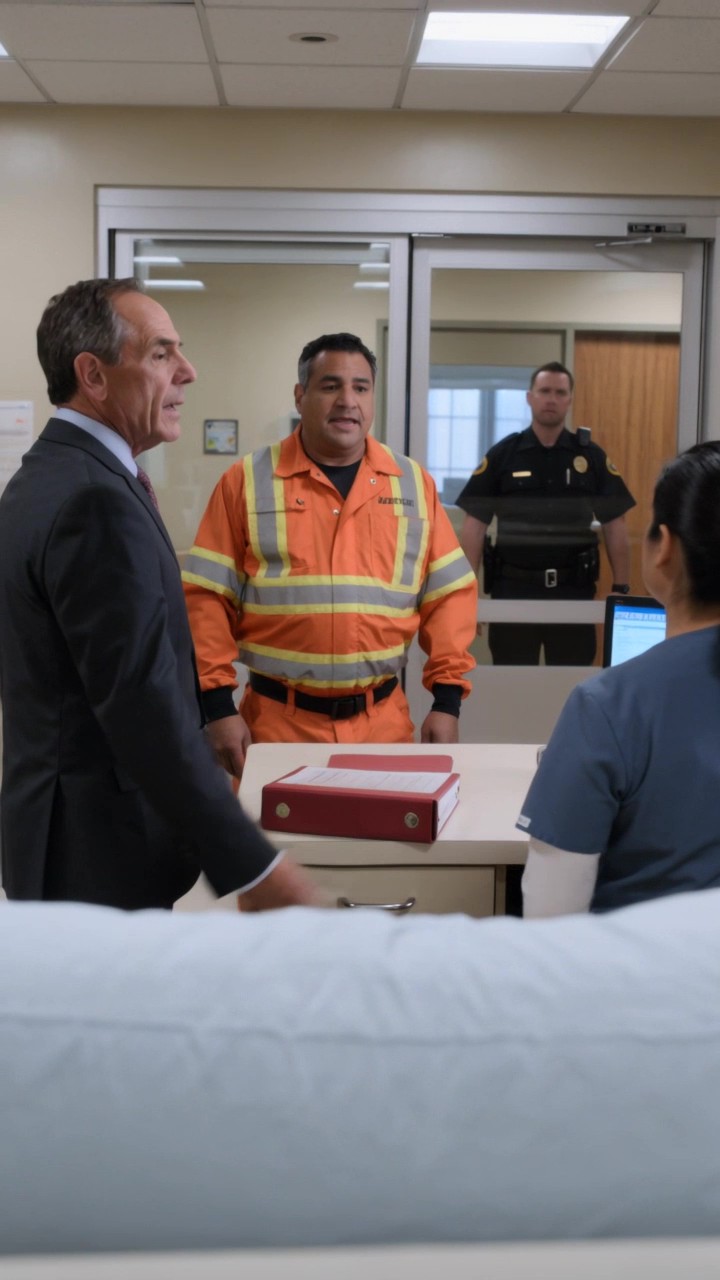
Samuel Ortiz did not enter the ICU as a stranger who had defeated the family.
He entered because Charles Whitmore had chosen him.
That difference mattered.
Charles’s son Preston remained beside the glass door.
His daughter Vivian joined by video call from another state.
Both were shocked.
Neither knew their father had changed his healthcare proxy eighteen months earlier.
The old hospital chart still listed Preston as emergency contact.
The red binder contained the newer directive.
Signed.
Witnessed.
Filed with Charles’s primary-care clinic.
Never imported into the hospital’s electronic record.
The ICU nurse verified the document with the clinic before giving Samuel proxy authority.
Until then, the team continued only necessary medical care and delayed non-urgent decisions.
The process frustrated everyone.
It also prevented one missing digital file from being replaced by another rushed assumption.
Charles had suffered a stroke affecting speech and movement.
He understood much of what happened around him, but forming words required time.
Doctors believed his condition could improve.
The conflict was not about whether to provide urgent treatment.
It was about who would speak if a complex decision arose before Charles could communicate reliably.
Preston believed that role belonged naturally to family.
Samuel believed it belonged to the person Charles named.
The hospital initially followed Preston because he looked like the expected answer.
Adult son.
Business clothes.
Same last name.
Samuel arrived in wet municipal gear smelling faintly of rain, leaves, and diesel.
The receptionist did not read the binder before telling him to leave.
That was the failure.
Samuel and Charles met seven years earlier on Alder Street.
Samuel operated a street sweeper before dawn.
Charles lived alone in a brick townhouse beneath a large oak tree that dropped leaves into the gutter faster than the machine could collect them.
Every autumn, Charles complained.
Every autumn, Samuel explained that parked cars blocked the curb line.
Their relationship began as an argument about leaves.
Then Charles started moving his car before the sweeper arrived.
Samuel began stopping for coffee from the thermos Charles placed on the front steps.
They spoke for five minutes at a time.
Weather.
Baseball.
Road repairs.
Charles’s late wife.
Samuel’s grandchildren.
Charles had spent his career as a corporate attorney.
He was precise, impatient, and accustomed to being obeyed.
Samuel was equally unwilling to be impressed.
When Charles criticized the city route, Samuel handed him a neighborhood map.
“Plan it better.”
Charles did.
His revised parking schedule reduced blocked curb sections on three streets.
The city adopted part of it.
Friendship grew from disagreement without flattery.
Two years before the ICU admission, Charles suffered a smaller stroke.
He temporarily lost clear speech.
Preston flew in, took control of appointments, and spoke over his father in every room.
He believed he was helping.
Charles felt erased.
Samuel visited during rehabilitation.
When Charles struggled to make a word, Samuel waited.
No guessing.
No finishing the sentence.
No pretending time pressure mattered more than the speaker.
They developed the three-tap signal.
Three taps.
Pause.
Three taps.
It meant:
I understand you. Stay long enough for me to answer.
After Charles recovered, he reviewed his planning documents.
He asked Preston to attend a meeting about future care.
Preston postponed twice because of work.
Vivian joined one call but became upset when Charles discussed disability and death.
Charles did not interpret their discomfort as lack of love.
He interpreted it as evidence they might struggle to separate his wishes from their fear.
He asked Samuel to serve as healthcare proxy.
Samuel refused at first.
“I am not family.”
Charles answered:
“That is why you wait for my answer instead of assuming yours is mine.”
Samuel agreed under one condition:
The children would remain informed unless Charles explicitly requested otherwise.
Charles accepted.
The red binder was created.
It contained the advance directive, medication list, insurance information, physician contacts, and plain-language notes about what Charles valued.
He wanted aggressive treatment when recovery was reasonably possible.
He did not want slow speech confused with lack of understanding.
He wanted hearing aids placed before serious discussions.
He wanted rehabilitation options explained directly to him, even if he could respond only by pointing or tapping.
The binder did not contain instructions to abandon treatment.
It contained instructions not to abandon the patient inside other people’s decisions.
In the ICU, the nurse brought Charles’s hearing aids.
Samuel sat where the patient could see him.
Preston stood on the other side.
A speech therapist established a simple communication board.
Yes.
No.
Pain.
Tired.
Family.
Samuel pointed to FAMILY.
Then toward Preston.
Charles tapped once for yes.
Preston’s eyes filled.
He had entered the hospital ready to protect his father from an outsider.
He had not realized his father wanted both men in the room.
The physician explained the next evaluation.
Samuel did not answer for Charles immediately.
He waited.
The patient pointed.
Tapped.
Rested.
Tried again.
When Charles could express a choice himself, the proxy had no reason to replace him.
That surprised Preston.
He believed Samuel wanted authority.
Samuel wanted Charles heard.
The first real conflict came the next day.
The care team recommended temporary nutritional support if Charles’s swallowing remained unsafe.
Preston wanted immediate action.
Samuel asked whether Charles could be reassessed after another therapy session because the directive emphasized direct participation whenever possible.
Preston accused him of delaying care.
The doctor clarified that waiting several hours was medically acceptable.
Charles used the communication board to choose reassessment.
Later that day, he passed part of the evaluation but still needed temporary support.
He agreed to it himself.
No miracle.
No family member proven entirely wrong.
A process that allowed the patient to remain present.
The hospital’s ethics office reviewed the lobby incident.
The receptionist said she believed Samuel was attempting to enter through a restricted visitor policy.
Security said Preston identified himself as the son and disputed the document.
Both concerns could justify verification.
Neither justified refusing to look at the binder.
The hospital changed its procedure.
Any person claiming healthcare-proxy or designated-support status could request immediate document review, regardless of relationship or appearance.
Staff would verify rather than dismiss.
Electronic records gained alerts when outside clinics reported updated directives.
Visitor training included chosen family, close friends, neighbors, and community caregivers—not only spouses and relatives.
Work uniforms could not be treated as evidence that someone belonged at a service entrance.
Preston apologized to Samuel in the cafeteria.
“I thought you were taking my place.”
Samuel stirred his coffee.
“You thought there was one place.”
“My father did not tell me.”
“He tried.”
Preston looked down.
That hurt because it was true.
Charles had asked for conversations.
His children postponed them because planning for illness felt like surrender.
Samuel had shown up because the route placed him outside Charles’s house every morning.
Presence had grown from repetition.
Not blood.
Not superiority.
Charles spent three weeks in the hospital and two months in rehabilitation.
His speech improved.
One side remained weaker.
He returned home with support.
Preston arranged longer visits and reduced work travel.
Vivian handled insurance calls from a distance.
Samuel still came by after the street route, but no longer carried the whole burden alone.
The red binder stayed on a shelf near the front door.
Charles added a new page.
It named Preston as alternate proxy after Samuel.
Not because Samuel had failed.
Because the family had begun learning how to wait.
At a follow-up appointment, a receptionist asked Samuel:
“Relationship to patient?”
Samuel looked at Charles.
Charles tapped the chair arm three times.
Pause.
Three.
Then managed one slow word.
“Friend.”
Samuel wrote it on the form.
Friend.
Healthcare proxy.
Street sweeper.
The person who knew the signal.
None of the titles canceled the others.
The hospital had almost turned him away because he did not look like family.
Charles’s recovery taught everyone a more accurate question:
Not who shares the patient’s name.
Who did the patient trust enough to hear the answer before speaking for him?







Leave a Reply