
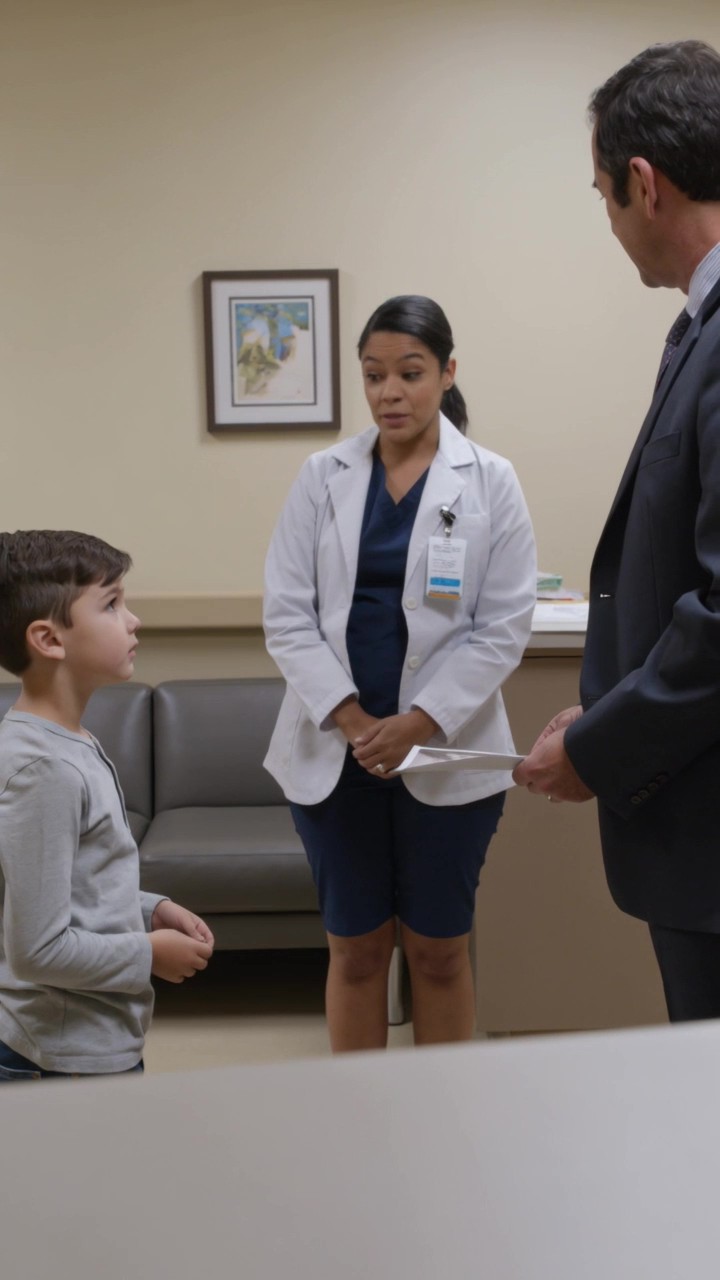
The hospital family room stayed silent.
Charles Whitmore looked at his son standing beside a laundromat owner in a wet apron.
The choice hurt.
Not because Noah had rejected luxury.
Because he had revealed a language his own father did not know.
Social worker Dana Brooks closed the temporary placement form.
“This is not a final custody decision,” she said. “It is an emergency overnight plan while Noah’s mother remains in surgery.”
Charles stood.
“I have legal parental rights.”
“You do.”
“Then he comes with me.”
Dana looked at Noah.
“He has had limited contact with you for more than two years.”
“That was his mother’s decision.”
Rosa spoke carefully.
“This room should not become a trial while he is waiting to hear if she wakes up.”
Charles turned toward her.
“You have already inserted yourself into my family.”
Rosa did not answer immediately.
She had heard versions of that accusation since Noah and his mother, Elena, moved into the small apartment above Spin & Fold Laundry.
Elena had been evicted after missing rent during an illness.
She took the room above the laundromat because Rosa offered weekly payments and did not require a deposit.
Rosa was not a saint.
She needed a tenant.
Elena needed time.
The relationship grew from ordinary things.
A key left beneath a flowerpot.
Soup on the stairs.
A child doing homework beside washing machines because the apartment was too hot.
When Elena worked evening warehouse shifts, Rosa kept Noah downstairs until she returned.
The dryers frightened him at first.
The spinning windows made him think clothes disappeared.
So Rosa gave him a green token.
“This goes in,” she said, “the machine turns, and what belongs to you comes back.”
After that, the token became a promise Noah could hold.
Charles looked at the grocery bag.
“You brought pajamas?”
Rosa nodded.
“Dinosaurs. No buttons.”
“Why no buttons?”
“They press against his stomach when he curls up.”
Charles looked at Noah as if seeing a stranger assembled from details.
He loved the boy.
That was not the same as knowing him.
Charles and Elena had separated after years of conflict. He moved to another state for work. Visits became phone calls. Phone calls became birthday transfers and occasional video messages.
He blamed Elena for limiting access.
Some of that blame was justified.
Some was easier than admitting he had accepted distance whenever work offered an excuse.
Dana asked Noah whether he understood the question.
He nodded.
“Do you want to sleep at Rosa’s home tonight?”
Noah tapped twice against Rosa’s palm.
“Yes.”
Charles’s lawyer objected.
Dana maintained the emergency plan.
Noah would stay in the hospital family accommodation with Rosa overnight, not leave the building. Charles could remain nearby. When Elena’s condition stabilized, the longer arrangement would be reviewed.
That compromise mattered.
The child’s choice was not treated as magical legal authority.
It was treated as evidence of safety.
Rosa opened the grocery bag.
Pajamas.
A toothbrush.
A folded blanket smelling faintly of laundry soap.
And a small plastic dinosaur missing its tail.
Noah climbed onto the family-room couch.
Charles sat across from him.
For twenty minutes, neither spoke.
Then Charles tapped the table twice.
Noah looked up.
The rhythm was wrong.
Too fast.
Charles tried again.
Tap.
Pause.
Tap.
Noah shook his head.
Rosa placed her hand over Charles’s wrist.
“Together.”
She tapped twice with the right spacing.
Noah’s shoulders lowered.
Charles swallowed.
“What does it mean exactly?”
Rosa looked at the green token.
“It means someone left because they had to. Not because they stopped loving him.”
The sentence was meant for Noah.
It reached Charles too.
Elena survived surgery.
Recovery took months.
During that time, Charles asked the family court for expanded parenting time. Rosa did not oppose him.
She asked only that Noah’s routine, school, therapy, and relationship with Elena remain stable.
Charles expected a battle.
Instead, he received a list.
Dry toast.
Dinosaur pajamas.
No buttons.
Hallway light on.
Two taps when plans changed.
The first overnight visit at Charles’s house failed.
Noah cried beside the washing machine because it had no coin slot.
Charles called Rosa.
He was embarrassed.
She did not use the moment to prove she was better.
She said:
“Put the green token in a small bowl. Let him hear the dryer stop. Then tap twice.”
It worked.
That frightened Charles more than failure.
A woman he had called a stranger knew how to reach his son through a machine sound.
He began attending therapy sessions.
Not to win custody.
To learn presence.
Elena returned home eventually, but could not immediately resume warehouse work. Charles paid support directly and consistently. He moved closer. He stopped treating money as the same thing as arrival.
Rosa remained part of Noah’s life.
Not mother.
Not replacement family.
Chosen safety.
At Spin & Fold, Dryer 8 finally broke beyond repair.
A technician removed the old coin plate.
Rosa gave it to Noah.
He placed the green token inside and mounted it in a small frame above his bed.
Under it, Charles helped him write:
SOMEONE CAN LEAVE THE ROOM AND STILL COME BACK.
Years later, Noah no longer needed the token during every separation.
He still carried it on difficult days.
At his mother’s recovery anniversary, the four of them ate dinner above the laundromat.
Elena.
Noah.
Charles.
Rosa.
No simple label fit the table.
That was all right.
Family had become less about who could claim the child and more about who learned the signals that let him feel safe enough to grow.



Leave a Reply