
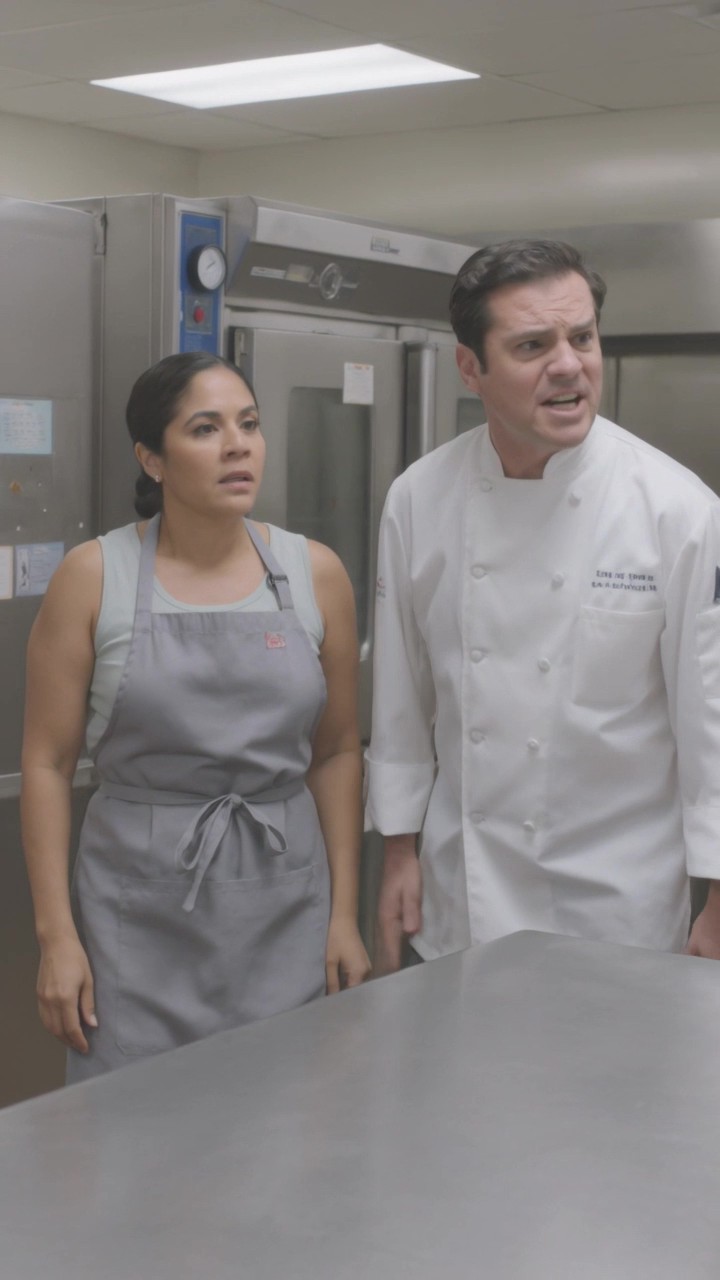
Nobody in the banquet kitchen was burned.
That fact mattered more than the ruined dinner schedule.
The split coupling released steam across three stainless-steel tables, overturned trays, and soaked the center aisle.
Forty servers had been moved to the service corridor only because Ana Morales refused to restore the line before the warning was checked.
The wedding meal began ninety minutes late.
Several dishes had to be replaced.
The hotel refunded part of the event bill.
The bride cried in a storage room because the dinner she had planned for a year no longer matched the printed schedule.
Safety did not make those losses imaginary.
It made them survivable.
The hotel facilities team isolated the boiler and opened the ceiling access.
Inside the steam line, a failed trap had allowed condensed water to collect.
When the boiler feed restarted, pressure pushed a slug of water through the pipe.
The impact—water hammer—struck the weakened coupling repeatedly.
Ana had heard the same sound in the garment factory where she once worked.
There, steam powered industrial presses.
A senior mechanic taught her:
“Steam hisses. Water trapped in steam hits like a hammer.”
Ana became skilled at identifying blocked traps, unstable gauges, and supports shifting under vibration.
She was never the factory engineer.
She was the maintenance lead on the pressing floor.
When the factory closed, her credentials did not transfer cleanly to the hotel industry.
The only immediate job she found was washing banquet dishes.
Her title changed.
The physics did not.
At the emergency review, Preston Hale insisted he believed Ana had overreacted.
“The gauge had not crossed the maximum mark.”
Ana answered:
“The line was hitting before the gauge stabilized.”
“The ovens had been inspected that morning.”
“The inspection did not include the trap above the plating room.”
“You had no authorization to shut down a central utility.”
“I had a red emergency switch beside my hand and forty people under the pipe.”
The investigator looked at the kitchen diagram.
“Why did you open the drain valve after Mr. Hale restarted the system?”
“To reduce pressure before the coupling opened.”
That action likely limited the release.
The coupling still split.
The steam plume lasted seconds rather than continuing under full boiler pressure.
Preston had seen Ana’s badge and apron.
He had not seen the years behind her hearing.
The review also found that Ana reported a smaller knocking sound two nights earlier.
Her supervisor wrote:
Dishwasher reports ceiling noise during cycle.
The maintenance ticket was categorized as “kitchen nuisance” rather than “steam system.”
No engineer inspected the line.
The hotel’s reporting software required employees to select a department.
Dish-room workers could choose plumbing, cleaning, equipment, or pest control.
There was no steam category.
Ana selected plumbing.
The request went to a general handyman queue.
A building can fail through a chain of reasonable-looking boxes.
Preston did not create the broken trap.
He did make the final dangerous choice.
The wedding schedule, guest complaints, and food timing felt certain.
Ana’s warning felt uncertain.
He chose the visible cost over the invisible risk.
After the coupling split, the hotel suspended him from kitchen operations.
He later returned as a menu-development chef without authority over facilities or worker discipline.
Some staff believed he should have been fired.
Others argued that the hotel had trained every manager to treat event delays as personal failures.
Ana focused on the structure.
“If the next chef still loses a bonus for stopping service, the next warning will sound expensive too.”
The hotel changed its policies.
Any worker could activate an emergency utility stop when pressure, gas, electricity, heat, or unusual mechanical impact threatened people.
The action triggered immediate review—not automatic punishment.
Banquet performance evaluations no longer counted verified safety holds as service failures.
Steam lines received trap-monitoring sensors and clear isolation labels.
Dishwashers, servers, housekeepers, and laundry workers were added to facilities walk-throughs because they spent hours near systems that daytime engineers saw only briefly.
The hotel offered Ana a ceremonial safety award.
She declined the first version.
It called her “an unlikely hero.”
“There was nothing unlikely about hearing a machine I had worked around for fourteen years,” she said.
The wording changed.
The final recognition read:
ANA MORALES
FOR APPLYING PROFESSIONAL STEAM-SYSTEM EXPERIENCE WHEN THE BUILDING NEEDED IT.
More importantly, the hotel paid for Ana to complete a local stationary-engineer certification.
She studied at night.
Thermodynamics vocabulary in English took time.
She failed one section of the licensing exam.
Passed on the second attempt.
Eighteen months later, she became an assistant building engineer.
Her new uniform had a name patch.
Her old gray apron remained folded inside her locker.
Not because dishwashing embarrassed her.
Because the day everyone learned she understood steam began while she was still doing that work.
The bride, Emma Whitmore, returned to the hotel after the investigation.
She asked to meet Ana.
“I was angry about the dinner,” Emma admitted.
“You were allowed to be.”
“I also told my mother the hotel should have kept serving from another kitchen.”
Ana nodded.
“That might have worked after the line was isolated.”
Emma looked toward the repaired ceiling.
“I was thinking about the wedding before the people under it.”
“So was the chef.”
Emma did not ask for forgiveness.
She funded the first year of a hotel-worker certification scholarship using part of the refund the venue offered.
Ana agreed only if the program was open to dishwashers, laundry staff, porters, cooks, and cleaners—not named after the wedding.
The scholarship supported two workers in its first year.
One became an electrician’s apprentice.
The other remained in housekeeping but gained building-hazard training and higher pay.
Preston later attended one of Ana’s safety sessions.
He sat in the back.
Afterward, he said:
“I thought restoring the line was leadership.”
Ana packed the training gauge into its case.
“You thought normal operation was safer than interruption.”
“Yes.”
“That is a common mistake.”
He waited for comfort.
She gave him instruction instead.
“Next time, ask why the person closest to the sound is afraid.”
Months later, a banquet server heard a smaller knock above another service corridor.
She stopped the cart line and called facilities.
The trap was beginning to fail.
No coupling split.
No wedding stopped.
No one filmed it.
Ana considered that the real success.
A dramatic rescue is what happens after warnings have already been ignored.
A functioning system listens while the room still looks normal.






Leave a Reply