
Every child left the museum alive.
The teacher suffered smoke irritation.
One maintenance worker received treatment for a burned hand.
The electrical fire remained contained to the basement wing.
News reports called Ethan Cole’s decision “a courageous sacrifice of property to save lives.”
Margaret Bell hated that sentence.
Property.
The word made the archive sound like tables and chairs.
The flooded room contained the town’s first school registers.
Handwritten immigration ledgers.
Photographs from the textile strike.
Letters from soldiers.
Recipes.
Maps.
Recorded names of people whose families had never been important enough for statues.
The collection was not more valuable than children.
That did not make its loss weightless.
Ethan understood.
He had worked night security at the Westbridge Museum for eleven years.
He knew which boxes held legal copies and which held the only surviving originals.
He also knew the basement fire system better than most administrators.
The archive’s water suppression was old.
The museum planned to replace it with a cleaner inert-gas system after the capital campaign reached its goal.
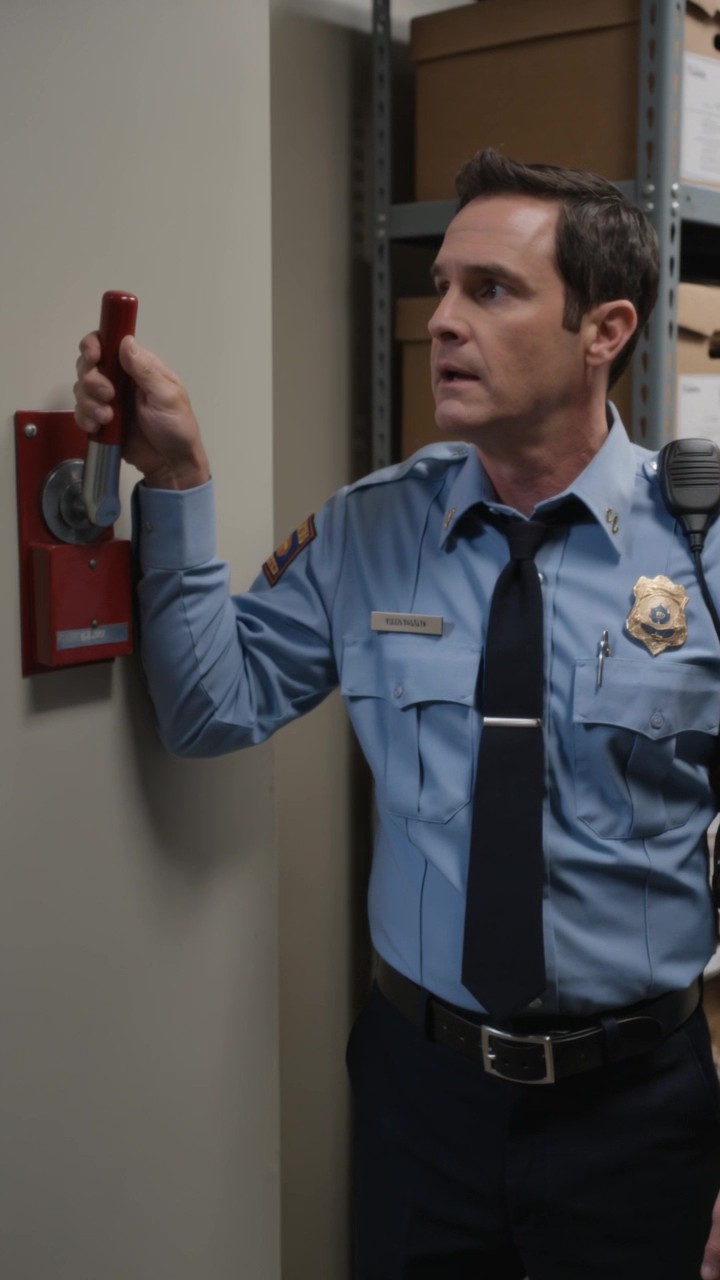
Until then, one red lever controlled a deluge zone covering the archive and adjacent electrical corridor.
During the school visit, an overheated power panel ignited inside the service room.
Automatic sensors detected heat but failed to open the smoke exhaust because the control cable had been damaged during construction.
The workshop’s direct exit filled with smoke.
The children moved toward the archive stairwell.
Then the electrical-room fire door began bending outward.
Ethan had less than a minute.
He could wait for firefighters.
Trust the rated door.
Hope the warped frame held.
Or flood the archive, cool the shared wall, cut power to the lower zone, and create time.
He chose time.
The museum’s internal review began before the floor dried.
Vivian argued Ethan should have waited for command authorization.
Ethan answered:
“The teacher was already moving children toward the stairwell.”
“You did not know the fire would breach.”
“No.”
“You did not know the water would stop it.”
“No.”
“Then you destroyed the collection based on uncertainty.”
Ethan looked at the photographs laid across drying tables.
“I acted because the uncertainty included children breathing smoke.”
That was the moral center.
Not certainty.
Priority under incomplete information.
Fire investigators concluded the deluge probably prevented the electrical fire from spreading into the stairwell wall before crews arrived.
Probably.
Not definitely.
The fire door may have held several more minutes.
The smoke exhaust might have been restored remotely.
Another route might have been opened from outside.
All of those alternatives required time Ethan did not believe he had.
The review found his decision reasonable under emergency conditions.
It did not prove it was the only possible choice.
That ambiguity stayed with everyone.
Especially Margaret.
Her brother Thomas wrote twelve letters from overseas.
Their mother donated them after his death so students could read ordinary details of service life instead of only battlefield summaries.
Ten letters dissolved almost completely.
Two survived with blurred ink.
Margaret sat beside the conservation tables and watched specialists separate paper fibers with brushes.
Ethan approached once.
She did not look at him.
“I know why you pulled it.”
He stopped.
“That does not mean I want to hear you explain it.”
He left.
The museum estimated that forty percent of the paper collection suffered major damage.
Digital copies existed for some items.
Not all.
Scans preserved words and images.
They did not preserve pencil pressure, folded corners, fingerprints, or the backs of photographs nobody had thought important enough to digitize.
The town reacted in two predictable ways.
One group called Ethan a hero and told everyone grieving the archive to remember that children mattered more.
Another group called him reckless and argued the museum should never have hired a security guard with power over preservation systems.
Both responses flattened the event.
The first erased loss.
The second erased urgency.
The children’s parents organized a conservation fund.
Margaret initially refused their money.
“My brother’s letters are not a bill your children owe.”
A parent named Rachel Cole answered:
“No. But the public benefited from the choice. The public should help carry the cost.”
That changed the frame.
The fund did not compensate emotional value.
Nothing could.
It paid for freeze-drying, paper conservation, digital recovery, and oral-history interviews with families whose original materials were lost.
The museum also confronted its own decisions.
Management had delayed the suppression upgrade.
Construction work continued near the smoke-exhaust cable without a full system retest.
School groups were allowed in the basement while one exit route was partially obstructed.
Ethan had made the final painful choice.
Institutional delays created the conditions that made it necessary.
Vivian remained director but lost control of facilities safety after the board found she had minimized repeated requests to close the basement during construction.
She publicly apologized.
Ethan was placed on administrative leave during the review, then reinstated as emergency-safety coordinator.
He accepted only after requesting that a professional conservator hold equal authority in future incidents.
“Someone should always be in the room to say what the water will cost,” he said.
That was not hesitation.
It was better decision-making before emergencies.
New systems followed.
The archive received inert-gas suppression.
School workshops moved above ground.
Construction shutdowns required live safety testing before public reopening.
Emergency plans identified both life-safety priorities and cultural materials that could be moved quickly without delaying evacuation.
The museum created duplicate storage for the most fragile records.
Margaret participated in that planning.
She and Ethan did not become close.
They worked together because disagreement did not make either person unnecessary.
Months after the fire, conservators recovered a fragment from one of Thomas’s letters.
Only six words remained readable:
Tell Margaret I saved the blue ribbon.
Nobody knew what ribbon he meant.
Margaret laughed when she saw it.
Then cried.
She placed the fragment in a new exhibit about the fire.
Beside it sat one child’s paper model from the basement workshop, stained by the same water.
The display title read:
WHAT WE SAVED. WHAT WE LOST. WHO DECIDED IN THE MINUTE BETWEEN.
Ethan objected to placing his photograph there.
The museum used no hero portrait.
Instead, visitors heard several voices.
The teacher describing the smoke.
A child remembering the cold water under her shoes.
A conservator describing dissolved ink.
Margaret describing the letters.
Ethan describing the red lever.
He said:
“I would pull it again.”
Then paused.
“I wish the museum had never made that the only action left.”
Margaret heard the recording before the exhibit opened.
She did not forgive the loss.
She did stop treating Ethan as the person who wanted it.
On the anniversary, she handed him a small blue ribbon found in her mother’s sewing box.
“Maybe this is what Thomas meant.”
Ethan did not take it.
“That belongs with you.”
Margaret nodded.
“Yes.”
She tied it around the handle of the replacement suppression cabinet.
Not as approval.
As memory attached to power.
Before anyone pulled an emergency lever again, they would see the ribbon and understand:
Saving lives comes first.
But the person who acts must never pretend the sacrifice belongs to nobody.




Leave a Reply