
The conductor lowered his baton.
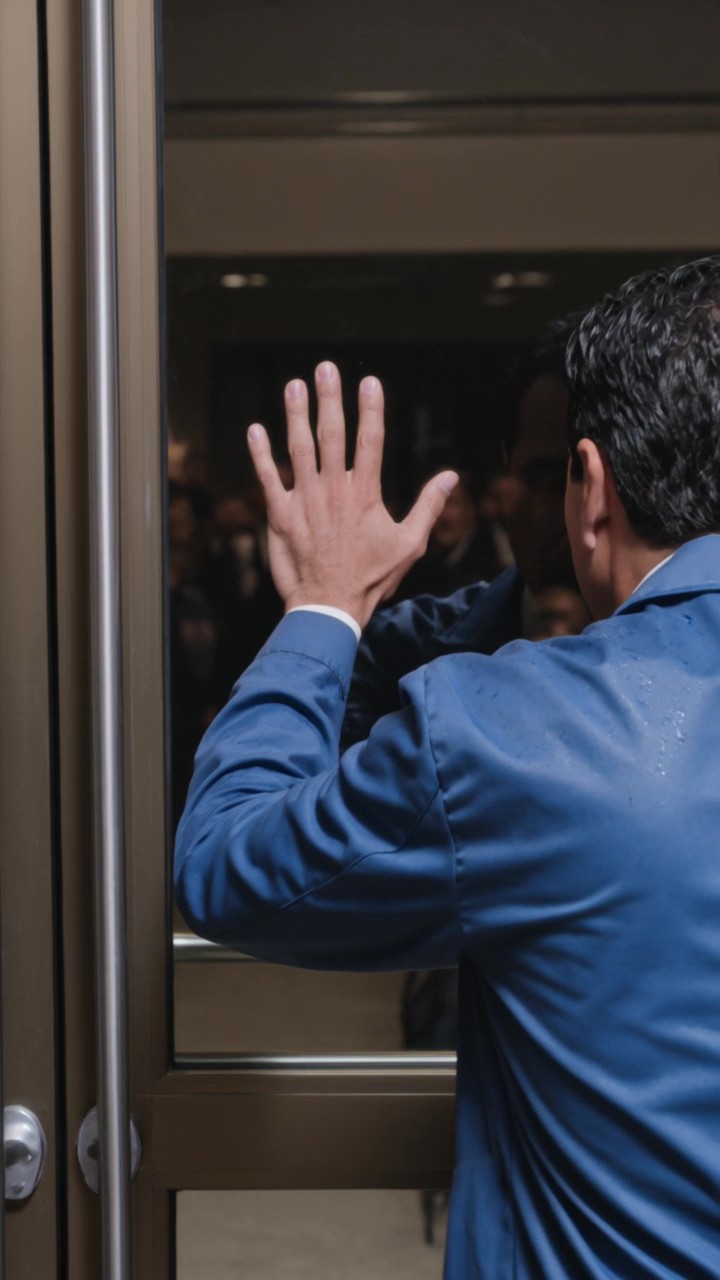
Westbridge Academy’s concert hall became silent enough to hear Miguel’s wet work boots shift behind the glass.
Leah remained at the timpani with both mallets lowered.
She did not begin the solo.
She did not allow the adults around her to turn her father’s exclusion into a private problem that could be solved after the recording.
The audience had to wait.
Vivian Hart approached the stage and signed awkwardly:
We will bring him in after the piece.
Leah shook her head.
Then she tapped the floor twice.
Tap.
Tap.
The rhythm was simple.
Several teachers knew it.
The school’s promotional film had used a version of it beneath footage of Leah practicing. The narration called it “the academy’s innovative tactile cue system.”
Nobody mentioned Miguel.
Leah pointed toward the red board in Vivian’s hands.
Then she signed:
BEFORE THIS SCHOOL HAD A PLATFORM, HE BUILT MINE.
A sign-language interpreter near the first row spoke the words aloud.
The room changed.
Security unlocked the doors.
Miguel entered carrying nothing.
Vivian still held the board.
Guests looked at his damp uniform.
Some recognized him from hotel delivery entrances.
Others had assumed the parent of Westbridge’s celebrated percussion scholar would look different.
Miguel walked to the front but did not step onto the stage.
“This is your concert,” he signed to Leah.
She answered:
IT WAS OUR RHYTHM FIRST.
The interpreter’s voice broke slightly.
Miguel had not planned to become part of Leah’s public story.
When she lost most of her hearing after an illness at age five, specialists explained technical options, therapy schedules, and school accommodations.
Miguel listened.
Then he noticed Leah pressed both palms against the washing machine whenever music played in the apartment upstairs.
She could feel what she could not hear.
Miguel worked nights delivering laundry for hotels. One truck was retired after its cargo floor cracked. He asked the mechanic for a square section of the plywood.
At home, he sanded it.
Painted it red because Leah could see the color from across a room.
Attached rubber feet to transfer vibration without sliding.
Then he tapped.
Slowly at first.
Two taps.
Pause.
Two taps.
Leah answered with her heel.
That became their first rhythm lesson.
Miguel was not a trained music teacher.
He learned enough counting to practice with her.
Watched free percussion videos with captions.
Marked beat patterns on cardboard.
Drove her to community rehearsals after overnight shifts.
When Westbridge Academy offered Leah a scholarship, the school gave her professional equipment and expert instruction.
Miguel was grateful.
But as Leah’s story became useful for fundraising, his role became less visually convenient.
The academy preferred language about institutional opportunity.
Donor-supported innovation.
Transformative access.
A father in a wet delivery uniform carrying a homemade board complicated the polished version.
Vivian had not formally banned him because he was poor.
She had created rules that produced the same result.
Formal entrance times.
Strict gala clothing expectations.
No homemade equipment near sponsor displays.
A guest list that repeatedly identified donor families before scholarship families.
Every rule sounded neutral alone.
Together, they kept certain people near service doors.
The headmaster came to the stage.
He asked Leah whether she wanted to continue.
She nodded, but pointed at the red board.
Vivian hesitated.
The professional platform had already been positioned beneath the timpani.
The board looked small beside it.
Scratched.
Paint chipped along one edge.
One rubber foot replaced with folded tape.
Leah wanted both.
The stage crew placed the red board on top of the professional platform.
Not because it improved the equipment.
Because it told the truth about what came first.
Miguel sat in the front row in his damp uniform.
Leah raised her mallets.
Before the orchestra began, she tapped the red board twice with her heel.
Miguel tapped two fingers against his knee.
She played.
The solo was not flawless.
One cue arrived late.
A cymbal entrance landed slightly behind the conductor.
Leah adjusted.
Finished strong.
The audience stood.
Miguel remained seated until Leah bowed toward him first.
After the concert, Vivian apologized.
Miguel listened.
Then he asked:
“Would the door have opened if Leah had not stopped the orchestra?”
Vivian did not answer.
That was more honest than saying yes.
The academy reviewed the event.
It found no written policy requiring formalwear for parents, yet staff had repeatedly redirected workers in uniforms to service entrances.
Homemade accessibility tools were being rejected for appearance without consultation with students.
Scholarship families often received schedules later than donors.
Westbridge changed the system.
Every student controlled their family guest list directly.
Work uniforms were explicitly accepted at all school events.
Accessibility equipment could not be removed without the student’s consent and a safety reason.
Fundraising materials had to allow students to name the people who supported them before enrollment.
Leah’s promotional film was revised.
The new version did not turn Miguel into a heroic poor father.
It showed the red board.
His hands tapping.
Leah’s feet answering.
The narration said:
Access did not begin when the institution noticed her. It began when someone at home paid attention.
Miguel continued delivering hotel laundry.
The academy offered him a facilities job after the story spread.
He declined.
“I already have work.”
He did agree to help the engineering club design low-cost vibration boards for public-school music rooms.
Students improved his original model.
Better materials.
Adjustable feet.
Portable sensors.
Miguel insisted every board remain red.
Leah asked why.
“So nobody pretends the first one was invisible.”
At graduation, the academy planned to display the original board behind glass.
Leah refused.
She wanted younger students to stand on it.
A tool that had helped someone find rhythm should not become too precious to use.
Years later, the paint wore thinner.
More rubber feet were replaced.
Two taps remained clear.
Whenever a nervous student stepped onto the board before a performance, Leah taught the signal:
Tap.
Tap.
I am here.
It had never meant perfection.
It meant someone was waiting on the other side of the glass.



Leave a Reply