
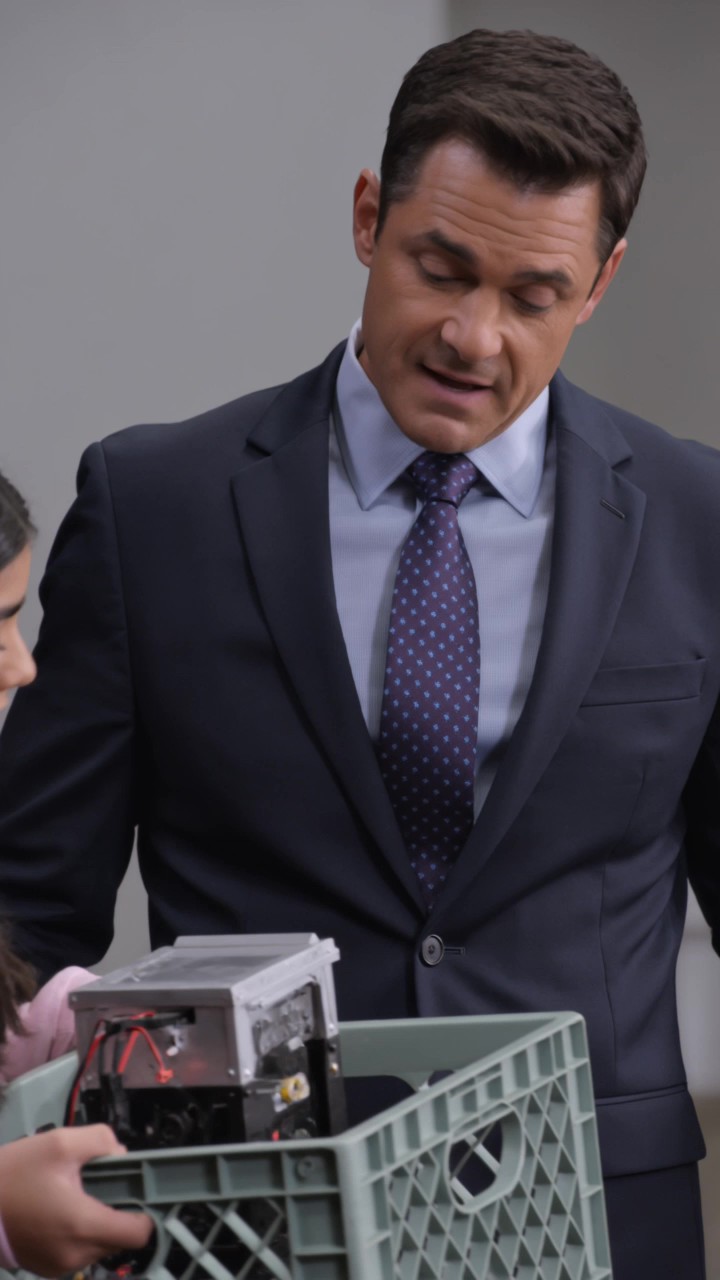
Maya Ortiz set the scrap rover on the competition floor.
The wired controller fit into both hands.
No touchscreen.
No animated dashboard.
Two switches.
One joystick.
A small mechanical lever her father had made from a broken bicycle brake.
The judges watched.
So did every student who had laughed when the robot arrived in a grocery crate.
Maya drove it beneath the lowered gate.
The rover scraped once against the floor.
Its left wheel wobbled.
Then the red chain transferred power to the lifting arm.
The arm caught the manual-release handle and pulled.
The gate rose.
The medicine box became accessible.
Maya guided the rover through the model rubble, lifted the box, and returned to the start line.
No Wi-Fi.
No cloud software.
No sponsor engineer speaking into a headset.
The machine completed the task in two minutes and twelve seconds.
It was not the fastest planned run.
It was the only completed run after the network failed.
Preston Hale approached the judges.
“The student’s entry was removed for presentation and construction concerns.”
Maya looked at him.
“You said it embarrassed the program.”
The microphone above the stage was still live.
The whole hall heard.
Preston’s face tightened.
“I said the exposed components did not meet the professional image expected at a donor event.”
The scholarship chair, Dr. Leah Brooks, turned toward Maya.
“Why is the machine wired?”
Maya answered:
“Because emergency equipment should not depend on a network that may fail during the emergency.”
That sentence revealed the design principle everyone had mistaken for poverty.
Maya’s family lived in the basement apartment of an older building.
Two years earlier, floodwater entered the storage corridor.
The building’s powered garage door failed.
A tenant using a wheelchair could not reach the manual release because boxes blocked the narrow side path.
Maya’s father and two neighbors lifted the door by hand.
Nobody was hurt.
Afterward, Maya began designing a low rover that could travel beneath barriers and pull releases, carry medicine, or drag a light emergency line.
She did not have access to a school lab at first.
The robotics room closed before her mother’s cleaning shift ended.
Maya collected discarded components from approved e-waste bins.
Her father taught her chains, bearings, and torque at the kitchen table.
The red chain link came from the repair stand he sold after his hand injury.
He gave it to Maya and said:
“Fancy systems still move because one small link agrees to carry force.”
Maya used a wheelchair battery because it was stable, rechargeable, and available from a mobility-repair shop.
She used a wired controller because a damaged building might have no network.
She left components visible because she needed to repair them quickly with ordinary tools.
Every rough-looking choice had a reason.
The competition handbook required electrical insulation, guarded moving parts, and emergency shutoff.
Maya’s rover met those rules.
It did not meet Preston’s expectations of what a scholarship finalist should look like.
That difference mattered.
Preston represented the corporate sponsor providing advanced robotics software.
The showcase rewarded elegant integration with the sponsor’s cloud platform.
No written rule required it.
Students simply learned that using the platform pleased judges.
Maya could not afford the compatible control module.
Her exclusion was framed as aesthetics.
In practice, it punished a design that did not advertise the donor’s product.
Dr. Brooks asked the technical inspectors to recheck the rover publicly.
They tested the battery housing.
Wiring.
Motor guards.
Emergency stop.
Everything passed.
Maya was allowed to complete the official course after the gate reset.
The Wi-Fi returned before her run.
She chose not to use it.
The rover navigated the rubble again.
It touched one marked wall, adding a penalty.
A polished team completed the course faster and with no contact.
Maya did not win first place overall.
That made the result more credible.
She won the resilience-design award and a full technical-school scholarship created by the independent engineering panel.
The polished team deserved its performance award.
Maya deserved recognition for solving a different problem:
What still works after the ideal conditions disappear?
The controversy did not end onstage.
Video of Preston calling the robot an embarrassment spread through the school.
Some viewers turned Maya into a symbol of poor students defeating rich students.
She disliked that version.
Several other finalists came from working families.
Their machines represented months of serious work.
The issue was not that polished technology was false.
The issue was that rough technology had been judged before being understood.
Maya invited the finalists to examine the rover.
One student helped her replace the wobbling wheel.
Another showed her a low-cost radio system that could provide wireless control without cloud dependence.
Maya added it later but kept the wired backup.
The best outcome was not scrap defeating sophistication.
It was both designs becoming stronger after sharing what they knew.
The school opened the robotics lab during evening custodial shifts so students with jobs or transportation limits could use it.
Competition rules separated safety from appearance.
Judges had to document technical reasons before removing an entry.
Sponsor products could not be treated as unwritten requirements.
And every emergency-design challenge included a network-offline test.
Preston was removed from student judging for one year and required to disclose sponsor conflicts.
He remained in the program’s industry board.
Some parents believed he should be dismissed completely.
Maya did not ask for that.
She asked him one question during the review:
“If the Wi-Fi had not failed, would you ever have looked inside my machine?”
He answered honestly.
“Probably not.”
That became the most important admission.
The scholarship changed Maya’s future.
It did not remove money problems.
She still worked weekends.
Her father still needed surgery.
Her mother still cleaned classrooms after students left.
The family used the scholarship savings to repair their car and pay medical bills.
At technical school, Maya discovered how much she did not know.
Programming theory.
Materials science.
Circuit protection.
She failed her first advanced-calculus test.
The scrap robot did not make her magically better than everyone.
It proved she belonged in the room where she could keep learning.
She rebuilt the rover three times.
The grocery crate remained its carrying case.
Not because she could not afford something better later.
Because the crate reminded her what presentation had almost cost.
The red chain link stayed beside the motor.
At graduation, Maya demonstrated a new emergency rover for municipal buildings.
It used sensors, radio control, and autonomous mapping.
Under the main panel was a physical wired port.
A judge asked whether that was outdated.
Maya smiled.
“Only until everything modern stops.”
Then she connected the old controller.
The rover moved.






Leave a Reply