
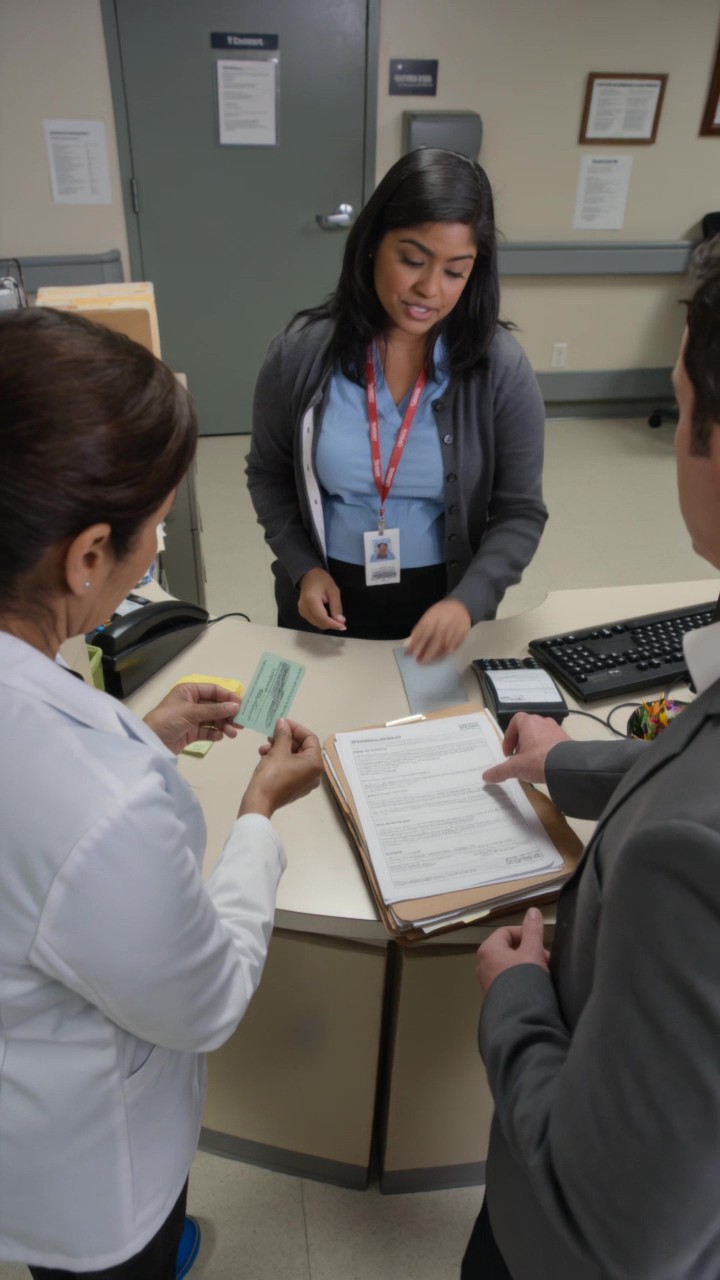
Rosa Alvarez did not remember Daniel Ortiz at first.
That hurt him more than he expected.
For twenty years, he had kept the memory of the cafeteria window bright and specific: the smell of tomato soup, the metal tray, the green lunch card, and the woman who stamped PAID before his family’s paperwork caught up.
For Rosa, he was one child among thousands.
That did not make the act smaller.
It made it more honest.
Rosa worked at Westbridge Elementary for twenty-two years. She served breakfast, lunch, and after-school snacks. She learned which children ate slowly because they disliked peas and which children ate slowly because they were trying to make the meal last. She knew that school food rules mattered. Inventory, federal meal programs, eligibility forms, and audit trails existed for reasons. A cafeteria worker could not simply hand out unlimited food and call it kindness.
But there were gaps.
When Daniel arrived in third grade, his family had just moved from Honduras. His father worked day labor. His mother cleaned offices at night. The free-lunch application had been submitted, but the approval had not arrived.
Daniel came through the line with his tray and no money.
The cashier told him to step aside.
Rosa saw his ears turn red.
She took the green temporary card from his hand, stamped it PAID, and wrote a note to the office:
Eligibility pending. Serve full meal. Follow up.
She did that for eleven days.
She did not announce it.
She did not ask him to be grateful.
She did not pay from her own pocket every day like a movie scene. She used the district’s pending-eligibility procedure, pushed the office twice, and personally covered two breakfasts when the temporary code failed. She made sure the child ate while adults completed forms.
Daniel never forgot.
He later became a hospital financial counselor because he understood what happens when families qualify for help but cannot navigate the doorway to receive it.
Rosa’s own doorway failed after knee surgery.
She had spent years standing on cafeteria floors. Her right knee deteriorated badly. The district insurance covered part of the surgery, but deductibles, out-of-network anesthesia charges, and rehab-related billing created confusion. Rosa should have been screened for hospital charity care because her income fell within the eligible range after medical leave reduced her wages.
The hospital mailed forms to Apartment 3B.
Rosa lived in Apartment 8B.
The error came from an old registration scan where the handwritten 8 looked like a 3. Three notices returned as undeliverable. The system recorded them but did not trigger a phone call because the account was marked “paper notice completed.” After ninety days, the account moved toward collections.
Rosa did not know until a debt letter arrived at her correct address through the outside agency.
She came to the billing desk with pay stubs, district employment proof, rehab records, and the green lunch card because the school secretary had joked that Rosa saved every scrap from cafeteria days.
The green card was not legally necessary.
It became morally impossible to ignore.
Celeste, the billing clerk, was under pressure. The hospital had recently tightened financial-assistance review after duplicate applications and incomplete forms slowed processing. She saw late paperwork and assumed delay meant neglect. Her sentence—“Charity care is not for people who ignore mail”—was not policy. It was judgment disguised as efficiency.
Daniel intervened after recognizing the stamp.
He did not approve the charity care on emotion. He reopened the account for procedural error, pulled the returned-mail scans, verified Rosa’s address history, and requested a deadline reset because the patient had not received proper notice.
The review found Rosa qualified for partial charity care and a reduced payment plan for the remaining balance. The hospital also corrected the anesthesia billing issue and removed the account from collections.
Rosa still owed money.
Not $38,640.
The final responsibility became $1,180, payable over two years with no interest.
That was not a fairy-tale cancellation.
It was the amount she would have faced if the hospital had processed her correctly from the beginning.
Celeste received discipline for tearing patient-provided documents and making a demeaning statement. She was not fired immediately. The hospital required retraining on financial-assistance communication, document preservation, returned-mail escalation, and bias toward paper-based patients. A later audit determined whether her pattern extended beyond Rosa’s case.
Rosa asked Daniel not to make her story a hospital advertisement.
“I did not feed you so you could grow up and put me on a poster,” she said.
Daniel laughed, then apologized because she was serious.
The hospital changed policy without using her face. Returned charity-care mail now required staff to check phone numbers, emergency contacts, clinic addresses, and recent insurance forms before collections transfer. Patients could submit late applications if the hospital failed to deliver notice. Front-desk staff were forbidden to destroy or discard any patient document, even if it seemed irrelevant.
Daniel kept the torn photocopy of the green card in a training folder after Rosa gave permission.
The original stayed with her.
Months later, Daniel visited Westbridge Elementary during lunch. Rosa had returned to work part time after recovery. He stood at the end of the line in his gray suit.
Rosa smiled.
“You want soup?”
“I came to say thank you properly.”
“You already fixed the bill.”
“No,” he said. “I processed the bill correctly. That is my job.”
She looked at him then, really looked, and saw the boy in the man’s face.
“Tomato soup,” she said.
Daniel’s eyes filled.
“You remember?”
“I remember a lot of hungry children,” Rosa said. “And I remember the ones who tried not to look hungry.”
She stamped a visitor meal ticket and handed it to him.
The stamp was not the same old PAID stamp. That one had been retired years earlier.
But the sound against the paper was close enough.
A small help had returned after twenty years.
Not as a debt.
As a person who had learned where to look when another system tried to let paperwork become punishment.







Leave a Reply